SWALE TALES – KENT’S SECRET TREASURE

What I appreciate about the 79km coastline that forms the Swale Estuary is that it doesn’t try and be something it’s not.

Know it? Love it? Visit it?

Whether you do or don’t, it doesn’t really give a shit. It just carries on doing its own thing regardless of who acknowledges it, and we could all be a bit more like that. If it were a person, I’d probably want to be pals.

A body of water which at first glance may seem unremarkable, the Swale Estuary is actually a gem that dazzles brightly… but only if you choose to open the trinket.

On most days it might look a bit bleak. A bit ‘meh‘. Nearby factories in a Sittingbourne suburb I share a name with pump clouds of chemicals into the skies (great). An energy-from-waste site provides aromatic wafts that don’t exactly enamour the nostrils. There’s hardly ever anybody else about, and numerous grey pylons stand proudly, piercing the clouds above.

If the music of Boards of Canada was to be represented as an image, it would probably look something like the Swale Estuary, and if you’re not sure what that means, Spotify-up the track ‘Roygbiv‘ and close your eyes. Then you’ll see it, even if you’ve never been.

The reality is though, that it’s in this very same bleakness that the real beauty lies.

Because without the interference of excessive, modern recreational facilities that come with being a hotspot, and the swathes of seasoned tourists that appear along the rest of the coast, you’re left with something that feels very real, very natural, and very secret.

Much of the grassy pathways that line the waterways are overgrown shin-scratchers. Field mice frolic about beneath your feet requiring a careful step. Cows and sheep are the main form of living being you’ll encounter as you walk, and they’ll stare at you with disdain for encroaching on their space as you pass.

Oystercatchers, identifiable from their long, slender orange beaks – like baby carrots – wade along the water’s edge dipping their bright veggie batons into the sludgey brown liquid, searching for cockles. Rare butterflies and moths flutter around you as the light bounces off the verges in the dusk.

It’s of no real surprise, that this is classed by the authorities as a site of Special Scientific Interest.

And historic interest too.

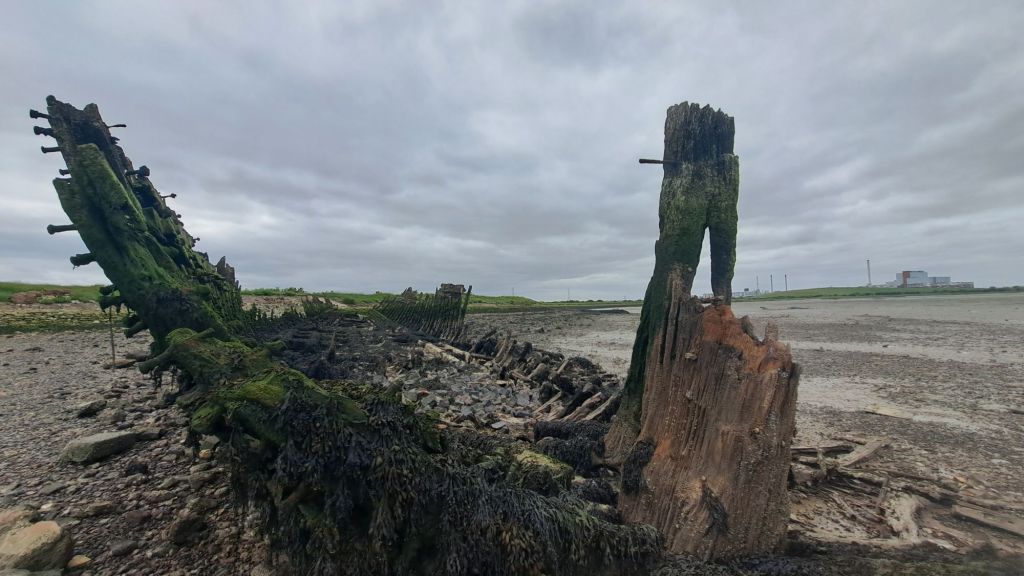
Barnacle-encrusted shipwrecks shaped like fish skeletons sit silently at low tide, rotting away into the mud after decades of abandonment. Once upon a time, these boats might have been taking people to and from the Isle of Sheppey, or up towards the Thames gateway, which sits only a few miles further north. In 2026, they mainly serve as opportunities to take atmospheric photos. No filter needed.
As somebody who lives in Swale and loves walking, you’d think from my enthusiasm that I might be strolling around this often forgotten beauty all the time, but I’m not. It usually takes a suggestion from my friend S, who crosses the water every day to get to work and can incidentally tell me a whole host of facts about it that I would have never otherwise known:

“Just off the coast at Queenborough is ‘Deadman’s Island’. It’s where they used to leave behind all the men and boys who died aboard the prison ships which moored around here in the 1800s. Many of their remains re-surfaced on the island a few years back. It’s strictly a no-go zone, but people still try and get photos.”

“Back in the day there used to be a prominence of brick production sites along here due to all the clay and chalk, and easy access to London by boat. A lot of the city’s landmarks were built with those bricks.

And many others.

And each time I learn something new about the place or see a pair of butterfly wings in patterns I’ve never seen before, I remind myself why I need to get back and explore more of it. I’ve spent many hours exploring it over the years, yet barely scratched the surface, and that’s both worrying and exciting in equal measure, given it’s right on my doorstep.

And when Lonely Planet and all the other established travel guides out there get their acts together and proclaim that the Isle of Sheppey and Sittingbourne are right up there with the likes of Machu Picchu and the Taj Mahal as places you must see before you die, there’s a danger that this place may start losing its magic. Once the secret’s out there, crowds will start drawing in, the snazzy cafes and sports clubs will start popping up, and the wildlife will retreat back into the undergrowth.

But that’s hopefully not for a while yet. Even Faversham hasn’t made the list.

Yet.

See it whilst you can, anyway.

If one thing is certain, you’ll have a Swale of a time.

WALKING THE ELHAM VALLEY WAY

When a friend recently asked me if I fancied doing ‘a really long walk’, it didn’t take much convincing. Not only do I really like walks, but I particularly love ‘really long’ walks – the sort that make your legs feel totally jellified by the end – and at 35km, the Elham Valley Way walk is exactly that. We would walk and walk and walk, from Canterbury – with its impressive Cathedral backdrop – to Hythe, before celebrating with a mini pork pie and tin of beer by the sea. Perfect.

Our route followed the trail of what had once been the Elham Valley Railway, a commuter line which had ran between Canterbury and Folkestone from the late 1800’s until the 1940’s. The line is known by most for the role it played during the second world war, when it temporarily stopped its passenger services to assist with national defence. Three guns were mounted at various locations along the old track, the largest of which (known as the ‘Boche Buster’) was capable of firing shells a distance of up to 20km and could – and did – cause damage to many nearby homes when set off.

I’m no railway buff by any means. I leave that sort of thing to my Dad, who relishes in it. Yet, something about the Elham Valley Railway – or rather – the remnants of it, has always intrigued me. Not far from where my parents live in south Canterbury, down a litter-strewn alleyway that otherwise seems to lead into a rural nothingness, can be found a glorious old honey-toned Victorian railway bridge at the bottom of a steep verge. This was one of the first bridges that trains would pass through having departed from the city centre, and the fact it’s still pretty much intact today – albeit clad in litter, graffiti and discarded Vapes – feels incredibly romantic to me. Absorbing historic architecture – viewing the same bricks as those who came before us – is probably the nearest we will ever get to travelling back in time, and so it’s important that we preserve what we can of it.

My friend shares similar sentiments. She likes to imagine that when walking along a former railway line, personal artefacts may emerge from the earthy banks: an engagement ring, hastily tossed out the carriage window following a fractious conversation between lovers; a pair of binoculars dropped by an excited youth leaning out the window to take a closer look at the rolling hills of Kent; an old shoe – because they somehow manage to get anywhere – or any other signs of an Elham Valley Railway passenger.

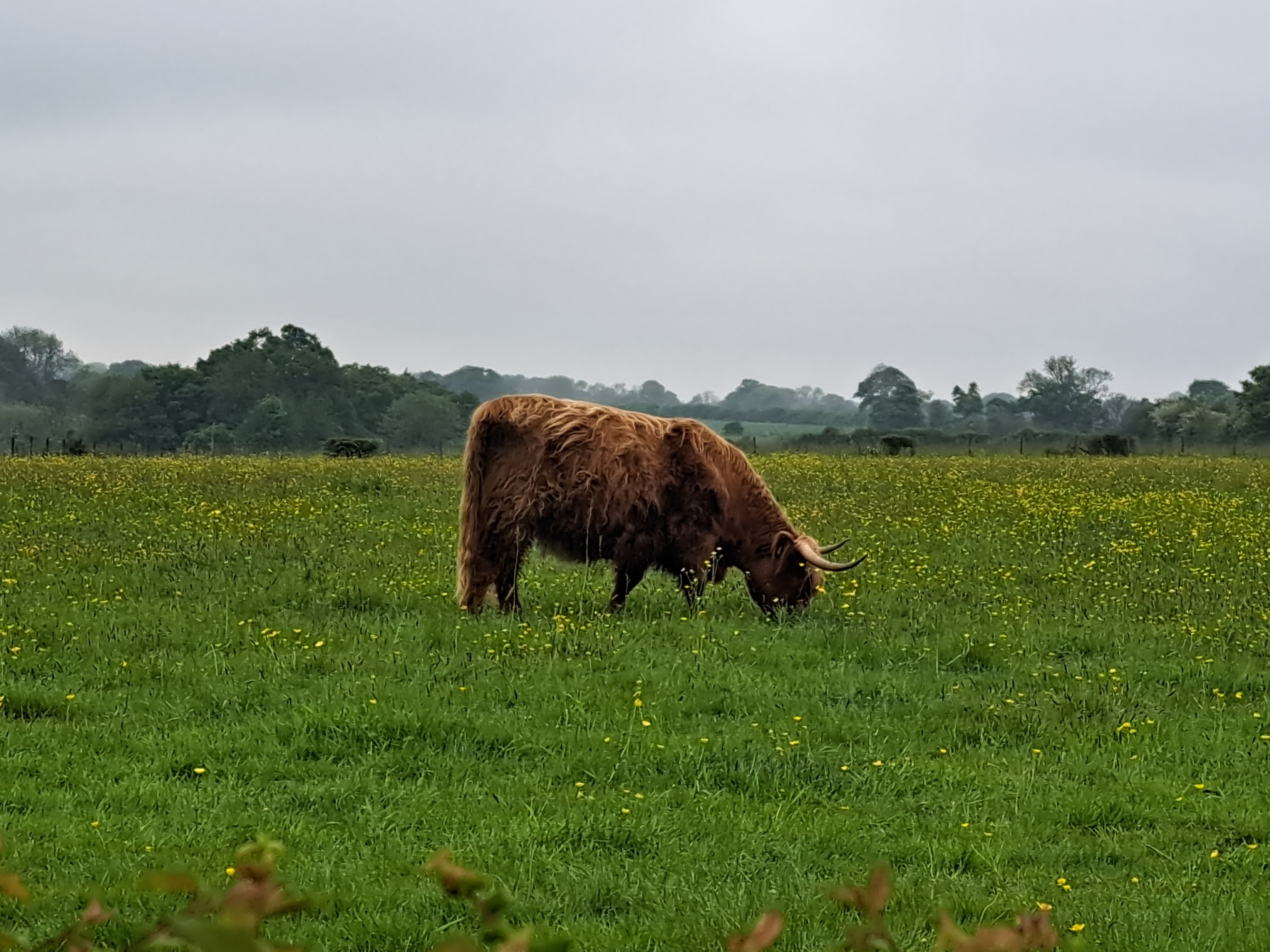
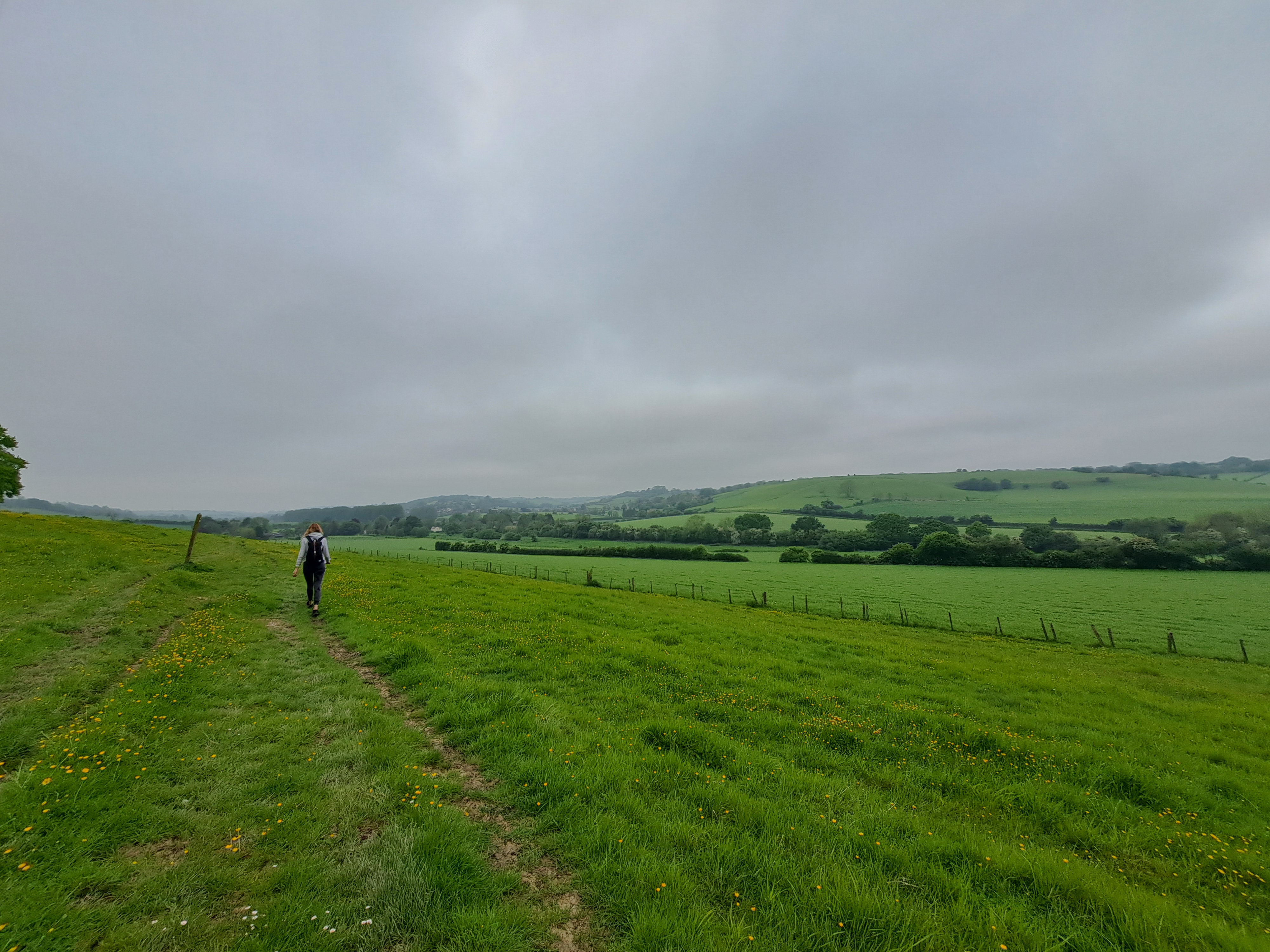
In reality we found no such things during our eight hour trek, but that in itself felt remarkable. Today, there is stillness in coordinates that were once the site of so much movement; peace in a place once associated with war. The Elham Valley Way is one of the most beautiful walks in Kent and a virtually bottomless trove of delights, boasting panoramic views, ancient woodlands, butterflies, cowslips and bluebells, among many other goodies! We ate our packed lunches rested upon a fallen tree surrounded by sheep and spring lambs, most of whom surveyed us carefully as we entered the field, before turning away nonchalantly. A few moments beforehand we had also come across some highland cows on a hillside, their horns silhouetted against the grey skies as they grazed on grasses several hundred miles away from their home. Neither of us had expected to see that.


In the villages that punctuated the journey we passed numerous cottages that gave us house-envy, a former home of Audrey Hepburn in Elham, an ancient well in Lyminge, and a friendly old man in Newington who approached us with an offer of help and a smile after observing us looking a bit lost. The railway museum in Peene had just closed up for the day when we passed but given the lack of engagement rings, binoculars and shoes en route, thank goodness it’s even there at all, to help keep the history of the former railway alive.

Our experiences on the outskirts of Hythe included being out-stared by a group of stern-looking cows the other side of a fence we were looking to cross, and wandering through a misty golf course, fearful of being concussed by a mis-shot. That wouldn’t have been a great ending after the best part of 35km, but fortunately was not to be the case. As we finally heard the lapping of waves and smelt the sea air we knew we had accomplished our mission for the day to reach the coastline, and both the pork pie and the beer lived firmly up to expectation.

Not only had this been a lovely and long walk, but it had surpassed all expectations in terms of what we would encounter along the way. In an age where digital technology attempts to simulate on screens as much of the world around it as it can, walks like this serve as a timely reminder of why it will never be able to fully do so. All the YouTube, Streetviews and online guides in the world cannot replicate reality, no matter how much you zoom in, nor can they tell you everything about a place. There will always be room for wonder and surprise.

There is always so much more beyond the map, just itching to be found.

Song of the Day: Kettel – Duck

Kettel is an artist from the Netherlands who specialises in playful and melodic electronica. Perfect for accompanying Summertime exercise!