In a couple of weeks’ time, I’m going to be saying goodbye to the car I’ve been driving around in for almost eight years and saying hello to a new one. And though – on the surface of it – this is just a case of trading in one costly clump of metal, rubber and plastic for another, I think it’s going to feel a bit sad pulling up the handbrake for the final time and stepping away.
ThecarthatIalwaysintendedtonamebutneverdid and I have had a lot of adventures together over the years. It’s enabled me to get to many destinations for many different purposes, from rubbish dumps to mountain ranges, and all the places in between. It’s been privy to the worst of my language and the worst of my singing (which is also my only singing). It’s put up with my varied taste in music without casting judgement, and has never really let me down.
In recent weeks I’ve been driving a little more than usual (apologies, environment, I promise it’s just temporary) to enable some final adventures with TCTIAITNBND, and some of my favourite times to do this have been at night, when the roads are emptier. There’s something quite stimulating about it, and when you get a good long stretch of motorway it can almost feel quite meditative. No choice but to focus on the road ahead and nothing else. No phones. No emails. No aimless scrolling. Just the warming glows of blurring lights and the names of nearby destinations passing by, with the occasional illuminated views of people eating burgers in service stations overhead. You think about each of their stories – where are they heading to, and why? – and wonder what the wildest reasons are.
You are locked in the present in ways which can be hard to achieve during other activities, practicing mindfulness without even realising. It’s not always about breathing or colouring.
And when the tunes are blaring there’s the temptation to skip the junction that will take you home and just carry on driving, no particular destination in mind, and just seeing what happens. And you won’t, because you need to get back and fuel costs are still ridiculous, but you promise yourself you’ll definitely do it someday.
If I could go back in time and tell myself that there’d come a day when one of my favourite ways to spend a Saturday morning is in Wetherspoons, there’d be two kinds of response, dependent on how far back we’d gone:
18-23 year old me:“Ahh wicked, pitcher of Blue Lagoon and some Apple Sourz to welcome the weekend innit!”
23- sometime in the mid-30’s year old me:“Well, that’s just depressing. What a waste of a Saturday.”
I’d assume I had turned into one of those people I pass spilling out of the local establishments having a pint at 9.30am and regretting my life choices. Yes, that would feel depressing if it were so. That’s still not a point I’d ever like to reach.
But that’s not the reality.
I very rarely drink alcohol in Wetherspoons, but I’m here a lot. Usually with a £1.56 refillable coffee and a notebook, and on the really special occasions if I want to treat myself: a bowl of nachos, made to a recipe that hasn’t changed in at least 20 years.
A thoughtful gift from a friend
To me, Wetherspoons is about so much more than the historic connotations with cheap drinks and sticky tables. It’s a cornerstone of the community, a national institution, a place where people from all walks of life can feel that a decent meal out is a bit more within reach than a lot of other places.
Wetherspoons is a place for everyone… except the more snooty among society perhaps. And who wants to be around people like that anyway?
It’s a place that leaves you to it. A place that doesn’t pressure you to leave as soon as you’ve finished your drink so that a new customer can occupy your seat. A place where even the backs of toilet doors will encourage you to stay for as long as you like – undisturbed – if it helps you to feel safe. And often, when I look around, I sense that a lot of the clientele come here for that quality. Like the octogenarian – we’ll just refer to him as ‘G’ – who frequents my local branch for lunch every couple of days and explains how for him, it’s a place where he can come and feel in good company compared to the loneliness he feels at home.
“It helps me feel connected here” G once shared with me, “I love to see familiar faces… there are so many people my age who come here and have so many great stories to tell about their lives. You’d never know just from looking at them just how many remarkable things they’ve done. I’ve found out all about them just by chatting here.”
G tells me his own life stories as we sit and chat. We’ve spoken a few times because our favourite tables are next to each other (by the windows, to enable the act of people watching outside). Although 80% of the dialogue is from G’s side of the script, I find him a joy to listen to, and he always thanks me for the chat as he leaves, even though I’m not really sure I’ve said that much.
A recent study found that around 30% of UK residents experience regular feelings of loneliness. Whilst Wetherspoons may not be the solution for all, it’s important to acknowledge this value when critiquing the place. As somebody who lives alone in a quiet estate and predominantly works from home, I find that an evening coffee trip (decaf by that time) to ‘Spoons is an important injection of life, people and reality after a virtual day, and can understand why many feel similar.
The chain has a lot of critics, for various reasons. One of the more common concerns is that through its cheaper prices, it takes valuable custom away from the traditional, independent British pub. This is a particularly valid concern at a time when the hospitality industry is under enormous pressure – not least from recent rises in alcohol duty – and many of our beloved ‘locals’ are pulling their final pints left, right and centre.
However, what many often forget is that the two places are very different. The top two selling drinks at Wetherspoons aren’t even alcoholic. They’re Pepsi Max and coffee/tea. More to the point, it’s entirely possible to both support your local pub with your custom, and appreciate your local Wetherspoons. I’d usually pick my cosy local if it was something alcoholic I was after or if I was meeting a friend, but I’m not sure my local would necessarily appreciate a whole table being taken up for a couple of hours by someone who’s just after a coffee, and that’s fair enough. You can make the most of both, it doesn’t have to be a case of either or.
The food is another characteristic that often attracts criticism, whether it’s the fact that the chip count can vary (as attested by the 250k strong membership of a particular Facebook group where members share / compare / condemn counts) or that it all tastes like it’s been “made in a microwave.”
Well, so what? I mean really, so what! Quite frankly, if it’s produced in a hygienic environment, is hot, tasty and edible, then I couldn’t care less if it was prepared by a teenager monitoring a microwave or Nigella Lawson poring over her aga oven. At least you always know, no matter what branch you’re in, what you’re going to get. Wetherspoons is a complete opposite of Forrest Gump’s infamous box of chocolates, (unless you’re focusing on the chip count). There may be better quality meals available elsewhere, but the reality is that they’re a lot more expensive, and most people can’t afford this as regularly. Sometimes you just want to have a break from cooking without breaking the bank. Sometimes you just want cheap stodge.
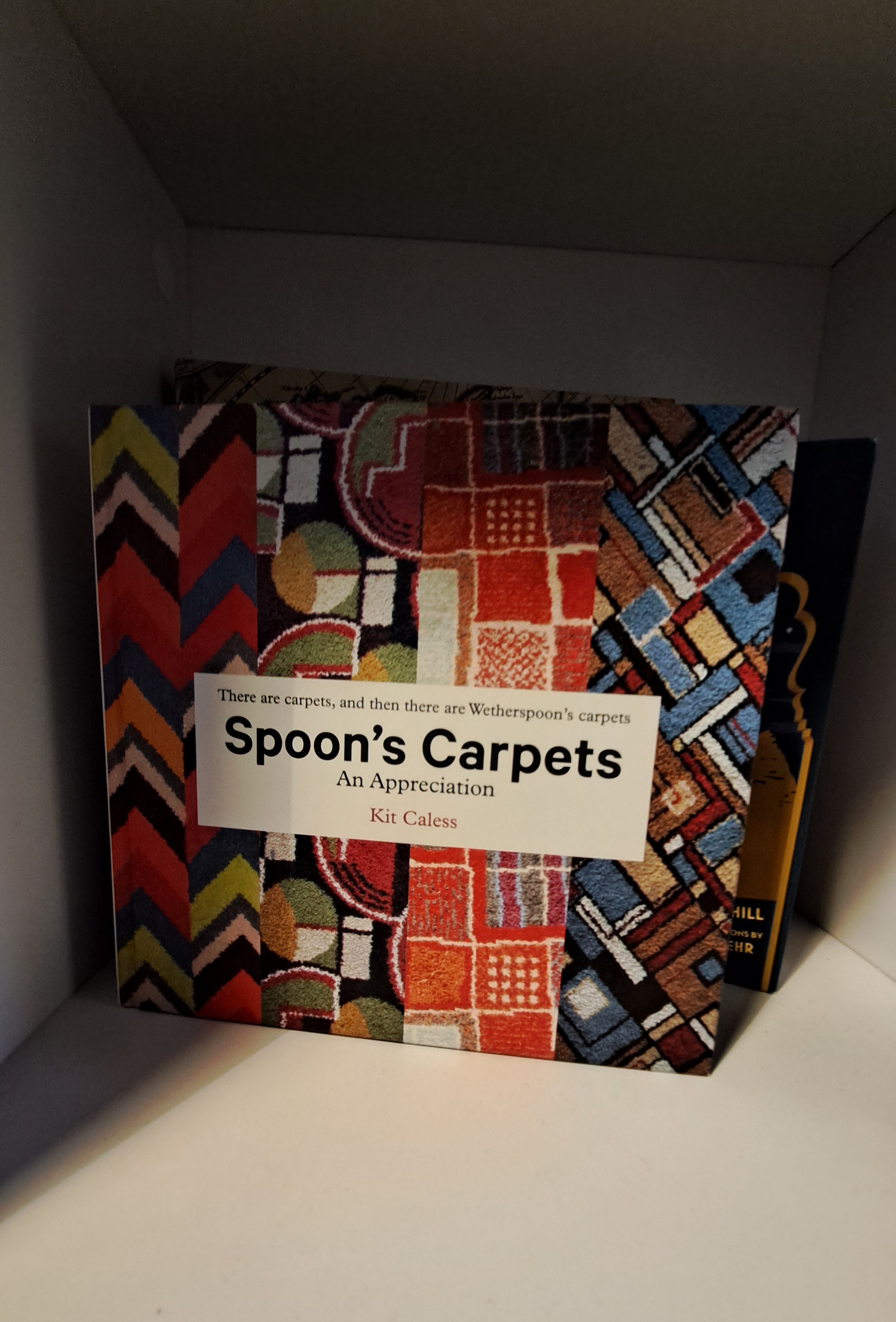
And where do we start with the iconic buildings themselves, and their carpets? It’s a little known – but absolutely incredible no less – fact that each of the 850 Wetherspoons establishments in the UK has its own unique carpet, designed around something to do with local culture, history or heritage. Take a look the next time you go into your local ‘Spoons. I am in awe of the likes of Kit Caless, who visited hundreds, set up a website and even released a book to document them. A book I proudly own and which has taught me a lot about notable figures and history from other areas:
The book really exists, and it’s amazing
As for the buildings, you’ll often find that those now hosting the chain once served a purpose as something entirely different, and the history is usually palpable upon entry. One of my favourite Wetherspoons buildings is ThePalladium in Llandudno, Wales, not least because it means I must be near Snowdonia, but just because of the general feel of the building. Before it became what it is today, it was a 1920s theatre, and as you gaze at the various boxes and balconies around you, you can almost hear the echoes of decades of historic performance. You order your scampi, chips and mushy peas thinking about how the people a few decades in front of you in the queue were ordering their ‘ices’ at the interval, and not only does it feel exciting, but it also feels like a sentimental connection to the local past.
The Opera House in Tunbridge Wells has a similar history, and the reverberations of a former art deco cinema are felt immediately as you enter The Peter Cushing in Whitstable (a branch which recently won platinum prize in the UK’s Loo of the Year awards, in what I’m certain was a ‘sparkling’ ceremony). I’m not entirely sure what my local branch, The Leading Light in Faversham, used to be, but I believe it was a carpet store, which is a little less exciting than those above perhaps, but also quite fitting when you consider the pursuits and passions of Kit Caless and Co.
Should this have piqued your interest in your own local branches, then it’s worth checking out the Wetherspoons website, which contains a lot of contextual information about each branch, including explanations for the name.
Additionally, it’s a firm belief of mine that there’s a Wetherspoons for every occasion, but to take inspiration from the menu and add some variety to this post I’ll represent this as an amateur poem as opposed to a paragraph – a small plate compared to a main – if you will:
Turning 18 with a pitcher of Purple Rain. A bowl of nachos before catching the train. A pre-holiday pint before boarding the plane. A cheap breakfast whilst taking shelter from the rain. Buying a cup of coffee, and filling it again and again…
There’s just one more characteristic about Wetherspoons I wish to praise, out of a raft of many more which I could possibly feature, and for this I’ll tell a true story:
It’s February 2020. Storm Ciara has swept up the UK and caused carnage everywhere, not least cancelling all the trains to London from Lancaster, where a friend and I have been visiting our former University haunts. We’re cold and miserable about it and have had to book an extra night’s accommodation and buy emergency underwear in Primark, as well as inform our respective works that we won’t be able to come in on Monday. Once we have accepted this fate we head to The Sir Richard Owen, which just so happens to be next to our hotel. In the spirit of student memories we order a Smirnoff Ice each and my friend tells me about a trend whereby people post their Wetherspoons table numbers on Twitter and people order food for them via the app. I struggle to believe this is true, and so she offers to try it.
Within minutes of her posting on Twitter, a side of baked beans arrives unaccompanied by anything else, sent by a mystery donor. We laugh. A lot. And then try and work out the best way to distribute them. British tapas.
It’s utterly bizarre, utterly hilarious and also utterly Wetherspoons. Which is a way in which I’d also describe the pandemonium of Summer 2024 when a bird flew into the Faversham branch and mesmerised an audience of a couple of hundred customers, who all got on board with the rescue attempt of encouraging it to fly safely back out, which it eventually did.
And really, there’s so much more I could possibly say, but I’m making myself hungry, so instead I’ll shawarmachickenwrap up this post to include a soft drink. £5.70 each. Ordered via the app.
The clocks went back an hour last night and the consequent earlier onset of daily darkness will be the main topic of conversation between British people for the entirety of this week. It always has been, and always will be.
It’s been less than twenty four hours and we’re already feeling it. LED strip lights rising from the ground and suddenly appearing everywhere we turn. A black velvet curtain drawing the days to an early close. Menacing orange and black paraphernalia everywhere, and the inexplicable smells on the streets of metal and smoke.
For me, this time of year often makes me think back to my time as a student at Lancaster University in north west England. I’d heard the expression, ‘It’s grim up North’ numerous times prior to making the move and was determined to see for myself if this were true or not. It definitely wasn’t. Yet whenever I think about the place, it’s usually in the context of a Winter evening, much like this one.
It’s November 2005 and I’m sat on the top floor of a double decker Stagecoach bus that smells of Wrigley’s Orbit, wee, and diesel oil. The wheels on the bus are going round and round, and the lights on the bus are making my hungover head pound and pound as they illuminate the harsh orange zig-zag seat patterns. A Sainsburys bag, fill to the brim with representatives of the Basics range (soups, garlic breads and pastas aimed to last the week), is hooked on to my wrist threatening to cut off circulation to my hand as I cling on to both the bag and the seat for dear life.
Inertia flings me towards accidentally nutting the bell each time the bus brakes. I find comfort in seeing the neon red letters that spell out BARGAIN BOOZE, because it means we’re finally at the bottom of the hill from hell in the Bowerham part of town, and the ride home should become more smooth from here. I may even be able to safely place my shopping bag on the floor before it rips from the weight of all the soup cans and sends them rolling down the aisle like the barrels hurled by Donkey Kong in the retro arcade game (yes, that did actually happen once).
I finally reach campus and step off the bus to walk to my halls of residence, but first I have to have a fag, after all that hard work clinging on to heavy shopping bags and trying to keep upright. As I puff away my student loan (the current me still hasn’t forgiven the younger one for this) I look up at half a dozen kitchen windows and see several episodes of a student drama tv series all screening at once. A couple of lads in striped polo shirts with emo hairstyles are chucking the entire contents of their food cupboards into what appears to be some sort of stir fry. The girls upstairs are dancing around in brightly coloured rara skirts and drinking out of fluorescent beakers. One of them is swapping the CD around in the stereo that sits on the windowsill. There’s another kitchen where the window is covered in a collection of handmade paper snowflakes that gets bigger with each passing day, and a couple of others where the lights are out. All the occupants are either out on the town ploughing through vodka Redbulls, or in their rooms graffiti’ing the reincarnations of forests with neon Stabilo highlighter pens.
I head up the internal stairwell towards my flat, being careful not to step in the congealed puddle of Dolmio sauce that’s been there all week following a drunken dare gone wrong. The unmistakable scents of the tomatoey residue and washing powder fill the air. As I push through the heavy fireproof doors to my flat I’m overwhelmed by even more senses. The smell of Heinz spaghetti and garlic bread being cooked away in the kitchen. The audience of Deal or No Deal gasping as the infamous 1p box is exposed on a flatmate’s tv. Another flatmate on the phone to her mum, assuring her that she’s eating well. The wisps of somebody else’s cigarette floating out from underneath their bedroom door. Somebody listening to Binary Love by The Rakes. The smell of burning garlic bread.
Shit. The smell of burning garlic bread.
The shriek of the fire alarm which ensues. The cackle of students, most of whom are half cut, trying to evacuate the building as the porters arrive to shout instruction in loud, northern tones. We shiver in the cold air of a northern Winter, watching each others’ exhales under the streetlights, whilst waiting for various risk assessments to be complete. Eventually, we’re able to file back in.
“So, what shall we have for dinner?” “Garlic bread?” “Fook off!”
**********
‘The Proust Effect’ is the name of the phenomenon whereby certain senses can evoke sudden nostalgia. The novelist Marcel Proust coined the expression after feeling transported to his childhood following consumption of a particular tea-soaked cake in his later years. It’s a legitimate effect backed by science – all to do with how we process memories – and something I find particularly staggering is how it can appear out of nowhere, all encompassing. Stepping back to a former life. Have you experienced The Proust Effect recently?
This post is dedicated to R.G. 19 years after our shopping rolled out all over the bus as we returned to campus. How we laughed that day x
It’s not that I suddenly shot up in bed one night with a burning urge to visit Podgorica. In fact, prior to this year, I’d never even heard of it, and probably would have assumed it was some kind of jolly eastern European wafer snack as opposed to the Montenegrin capital.
Our chance encounter occurred because I’d booked onto a group trip to explore the Durmitor National Park to the north of the country, and was advised that I should fly into Podgorica airport to join the starting point. Not knowing much about Montenegro at all, I thought it’d make sense to spend a couple of days in the capital before beginning the trip. The first impressions were good, as I booked a lovely looking hotel in the heart of the city for a mere £38 a night. With the accommodation arranged, I started to do a bit more research.
To say the results yielded from internet searches were disparaging about the place would be a complete understatement. Apparently, I’d just booked a couple of nights in ‘Europe’s most boring destination’, a ‘not particularly interesting’ place to visit, and – better yet – ‘Podgorica is a hole!’. Well. Happy holidays to me! But none of these articles succeeded in convincing me to change my itinerary. Opinions are just opinions, I wanted to see it for myself.
The plane descended from above red-roofed houses that looked like Monopoly hotels scattered over a green mattress and touched down into the airport on one hot Monday in July. The first thing that struck me upon landing was the smell of cigarettes. With the terminal building seeming to be only the size of a saucer, I wondered if I’d landed in an ashtray as opposed to an airport. After the shortest passport control line ever, I stepped outside into stifling heat – a welcome break from the exceptionally wet British Summer – and spotted a guy who looked like a Montenegrin version of Harold Bishop from Neighbours holding my name on a piece of paper. The hotel had arranged a taxi for me, and here was my driver. He walked me over to the taxi and offered me a cigarette on the way, to which I shook my head. At least, I think that’s what he was doing. If he was checking that I was okay with the smoke in the car, he certainly wasn’t paying any attention to my headshake, but – terrible though smoking is – there was something somewhat endearing about the casual nature of it all. I held my breath and gazed out the window at signs adorned in unfamiliar Cyrillic script, and thought to myself, “I have officially arrived in a place some consider to be the most boring in Europe. Hello, Podgorica!” It will take me a few days to learn that the correct pronounciation rhymes with ‘pizza’.
As we reach the city centre, I begin to hear a growing chorus of car horns, and Harold does not hold back either. Beep beep beeeeeeep. We stop in a random street, where another vehicle is blocking the layby Harold wants to pull into, and I realise we have arrived at my hotel. Harold presses his horn firmly, but the driver in the vehicle ahead is playing on a tablet, and has no intention to move. This goes on for a while until Harold is within a fingernail of the rear bumper, which is the same point I notice large dents in virtually all the vehicles around us, including one with its entire front grille peeled off. It doesn’t take long to identify that this is not a city in which I would wish to drive.
Parking melee eventually overcome, Harold kindly carries my suitcase to the hotel reception where I am surprised to see a doppelganger of somebody I work with at the front desk. “Oh, hi! Sorry I haven’t replied to your e-mail yet” I start to say. Well – not really – but it wouldn’t have felt too amiss if I had. Nonetheless, there’s something comforting about this small fraction of familiarity. Entering a new country for the first time can sometimes feel incredibly strange at first, and this was no different, but it would very soon fade.
The receptionist’s name is Teodora, and she is very helpful. Treating her a bit like a genie arising from a magic lamp, I am keen to restrict my number of questions / wishes to three. Not being able to speak a word of Montenegrin, I am reliant upon her years of studying English for our communication to be a success, and don’t want to take advantage of that. I die a little inside every time I see a British person abroad start reeling off demands with no attempt to check that the recipient understands English, and I don’t want to be ‘that person’. I select my questions carefully. Teodora says that yes, I can leave my luggage at the front desk whilst I go and explore, as it’s too early to check into my room, and yes there’s WiFi, but no, they don’t have any print-out maps. I have many more questions, like where’s the best place for a wander, but feel I’ve put Teodora through enough, and head out to work the rest of it out for myself.
I step outside and having no map – either physical or on my phone – make a mental note of whereabouts I am: downtown Podgorica, right opposite Independence Square. I head down a busy road which from memory of Google Maps would take me towards the old town, something I’ve read up on as a place to see. After some welcome moments under the shade of trees in Kings Park – built to commemorate the coronation of Nicholas I in Montenegro – I follow a stony staircase down towards the Moraca River and cross a bridge from which I see bathers dipping into the water. I make a mental note to return here after my trip to the old town, which is now only a few hundred metres away, up another stony staircase.
The old town really is an old town, but not quite the sequence of cobbled squares and Lipton parasols in which I’d been expecting to enjoy some sort of luminous, carbonated citrus beverage. Instead, it’s a scattered arrangement of small houses – some of which are completely dilapidated – and a couple of mosques. I later find out that this is an Ottoman-era neighbourhood which served as the hub of the city between the 15th and 19th centuries before being heavily bombed during World War II. I am struck by the amount of Argentinian-themed murals on display, including a homage to Diego Maradona captioned, ‘Adios El Pibe De Oro’. It transpires that the two countries have long-standing good relations, and that the South American country has the largest communities of Montenegrins outside of Europe. This isn’t something I’d ever have imagined to be the case, but feel so grateful to learn.
The heat is immense and I can start to feel sweat beads roll like rivers down my back, so take temporary solace in a nearby supermarket to stand near a fridge. I use this as an opportunity to officially the declare the start of ‘Crisps Around the World’, which is basically a fancy name I give to the act of ogling savoury snacks in foreign supermarkets and trying to select the most bizarre and unusual to try. Within a few moments of reviewing the offerings I feel I’d have more choice if I were playing a tobacco-themed version of the game… and there are plenty of crisps on display, just none that seem particularly novel. I wander out of the supermarket and begin to worry that I may have lost my bearings, until I see The Hilton hotel up ahead, which I recall passing on my way here. ‘Good old Paris and family‘, I think to myself in a moment of relief. I’m reassured by the fact that if I were to get completely lost and need to ask someone for directions, there’s at least one building here that I know how to pronounce.
I stop in the city centre for a tasty lunch of beef cream soup, bread and Montenegrin Niksicko beer that come served with a bonus waft of Lovcen cigarettes from the people next to me. Again, though part of me thinks it disgusting, another welcomes the sensory reminder of a bygone era, when all holidays smelt like sunshine, chips, and tobacco. I look back over Independence Square and wonder what the name means. Montenegro is a tiny country which could fit into the UK 18 times. Its population is only a little bit over that of Leeds, at 617 thousand. Surely a country of this size has a history small enough to quickly digest? Well – yes and no – but in its briefest form, it was part of the Kingdom of Yugoslavia for most of the 20th century. When the Socialist Federal Republic of Yugoslavia was dissolved in 1992, Montenegro joined hands with Serbia to become the Federal Republic of Yugoslavia, later known cunningly as ‘Serbia and Montenegro’ from 2003. In 2006, a referendum of Montenegrin independence took place with the results in favour of the country breaking off from Serbia, and in the Summer of that year it joined the UN as its 192nd member state.
After going back to my hotel to officially check-in and change attire, I head for another walk around the city. Njegoseva Street is where it all appears to be happening, and I stop off to refresh and do some journaling in a random bar with a waitress who looks less than thrilled to see me but is polite enough. I find myself thinking back to the spot by the Moraca River where people had set up a makeshift beach and feel it’s time to go back and check it out properly. I’m so glad that I do. By the time I return, the numbers have grown, the music is in full flow, and a bar framed in fairy lights has started selling drinks and t-shirts. A number of people – including some German tourists – swim in the river towards the Blazo Jovanovic bridge whilst their friends sit on the shingle smoking cigarettes, sunbathing, and enjoying loud conversations. A guy with dark, deep set eyes – like that of an albatross – serves me a Niksicko before returning to the riverbank to fish for trout – a favourite on Montenegrin dinner tables – and I sit on a stone wall, taking it all in. It’s strange to think I was waking up in an airport near Horley this morning. Right now, I couldn’t feel further away. The soft air, the excitable tingle from strange surroundings, the setting sun shimmering on the water – this is peace.
I think about what those Google searches said about Podgorica, and already I’m coming to the conclusion that they were a load of rubbish. I fully admit that what I’m experiencing is no Paris, no London, no New York, but there is still something quite sublime here – a city making the best of itself, in an understated yet enjoyable way. I walk back to my hotel via the 17th century clock tower that was framed as one of the key sights to see in Podgorica, a symbol of historic Turkish rule. As with many famous landmarks, it’s somewhat underwhelming, looking exactly the same in real life as it does on Google. You’ll visit Podgorica for reasons beyond this, I swear.
It’s the end of day 1 in Podgorica. Am I bored? No. Do I think it’s “a hole”? Absolutely not.
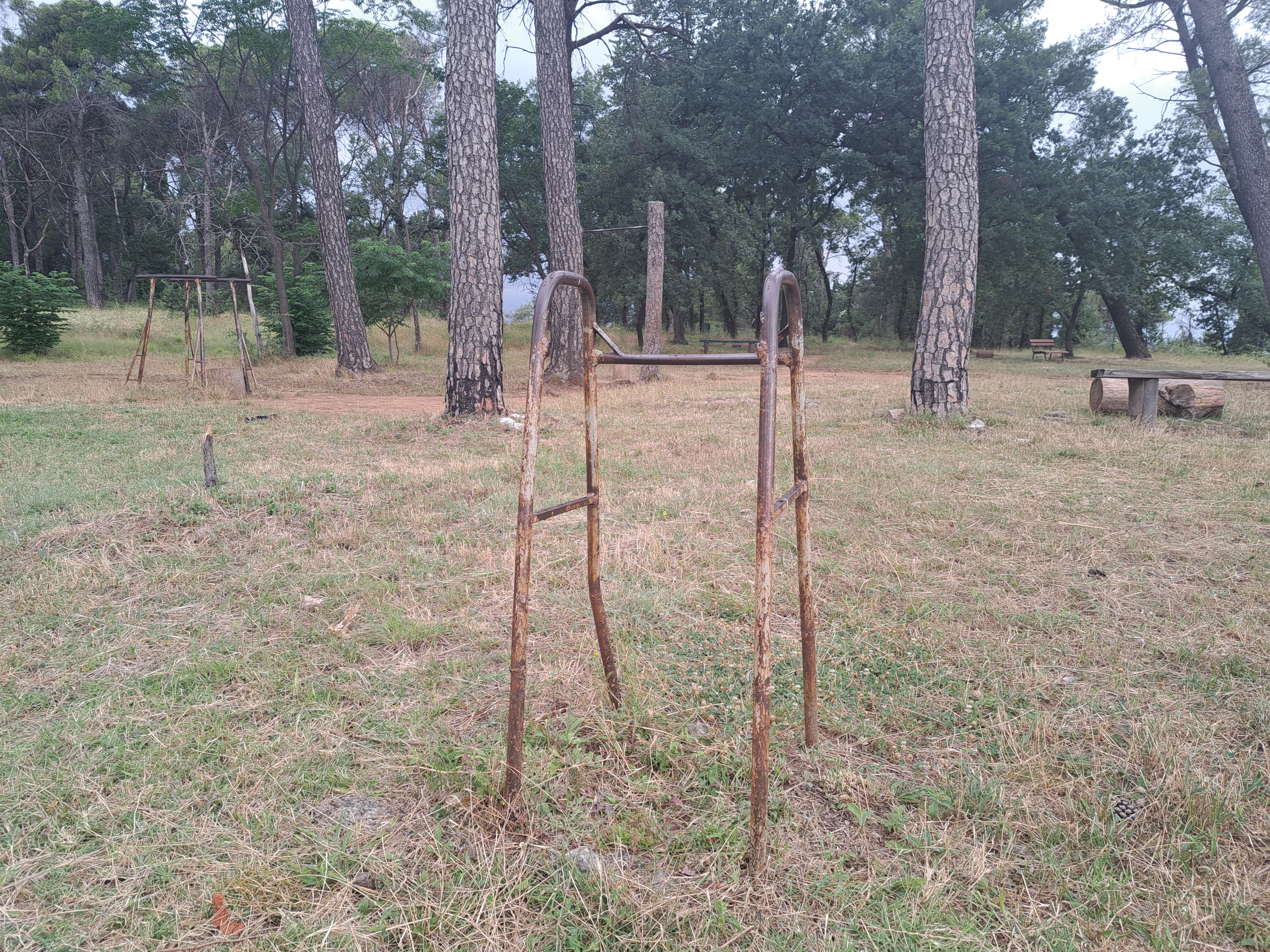
Day 2 starts with a hotel breakfast of random cold meats, cheeses, olives and pickles. The weather is slightly cooler than yesterday, and I choose to head to Gorica Park, a massive forested hill in the north of the city from which Podgorica gets its name (‘under the hill’). I am quite taken by Gorica Park. There is something quite alluring about its range of green shades and panoramic views of the city, reached by its seemingly endless trail paths. A wire-fenced, brutalist looking football pitch sits at the brow of the hill and opposite is an outdoor gym formed from corroded iron bars affixed to trees, looking a little like something straight out of Pripyat. I give a couple of the pieces of equipment a go before concluding that I should desist; I’ve a physically demanding week ahead, and shouldn’t go breaking my ankles on the second day.
Before long, there are flashes of lightning, and heavy rain sets in. Becoming a bit scared, I retrace my footsteps for about thirty minutes, back to the log-cabin style cafe in the centre of the park where I can take shelter with an apple and peach juice recommended by the English-speaking waiter. Heavy flumes of rain cascade from the awning and a ferocious wind blows menus across the outdoor seating area. It’s quite a contrast to yesterday’s heat, and an ever so slightly welcome one. Likewise, when the heat returns, it will be welcome back, and maybe there’s room in life for both. I sit tending my juice for an hour or so, literally waiting for a storm to pass, and think about how a swooshy font somewhere on Instagram is telling me I should be dancing in the rain. Although that’s a lovely sentiment, in these conditions it’s a pretty dangerous one. It later transpires that two men – one a Turkish construction worker in Canj, and another a Montenegrin enjoying a game of golf on the coastal Lustica bay – are killed by the lightning I watch from the safety of the cafe.
In the afternoon, once the rain has subsided and sunshine returned, I head back to the ‘beach’ at the Moraca River. My new happy place. I sit in a small cove, welcoming its shade, and write whilst looking out over the water. I am very tempted to swim, but on this occasion the voice of caution within prevails. The water moves rapidly, and though it looks nice and clean, I don’t know enough about what’s in it or how fast the current moves. Instead, I watch as a small turtle crawls over the pebbles, basking in the heat. A lady in floral dress then passes by, looking very wistful.
“She’s having a nice moment”, I think to myself, before seeing her partner following a few metres behind her, recording her with his phone.
Instagram influencer.
As for me, I’m just a novice writer whose most regular reader is my mum. I can’t influence you in the same way these perfectly curated Instagrammers can, but hey, at least I can give you a .JPG of Podgorica’s most famous attraction that you can print and pin on your fridge if you feel so particularly inclined.
At this reflective moment, a massive filling dislodges and I have to take a temporary return to reality in order to arrange a dentist’s appointment for soon after I return home. It wouldn’t be a holiday of mine without a dental-related drama! I purchase Panadol and mouthwash and hope for the best for now.
That evening, I head for a dinner of chicken in hazelnut sauce in Njegoseva Street before returning to Gorica Park. It’s still light and the settings are ripe for a beautiful sunset walk, especially with the storm having finished. I am surprised to see another turtle, a Hermann’s tortoise, crossing a path near to the ironwork gym I’d sampled earlier. Gorica Park is full of surprises, and I find myself liking the place more and more. It’s mysterious, it’s understated, and it’s beautiful. As I later make my way out of the park, I notice a small cafe bar – Klub Bocara – decked out in fairy lights and showing the Netherlands vs Romania game, and identify it as a perfect pit-stop. I sit on a table next to two girls who are smoking and playing a game of poker dice, and sip on another fresh, cold Niksicko lager. This place has a real vibe, one that just clicks. The evening warmth, the international football, the multiple languages being spoken, the fairy lights, the swing jazz on the radio, and A CAT! I stay there for a lot longer than planned just taking it all in and absorbing the moment (and taking every opportunity I can to stroke the cat). There’s tonnes I need to do to prepare for the next few days, but it can all wait.
Prior to moving on in the morning I reflect upon the last two days in Podgorica, and think back to those Google reviews. Is Podgorica the most vibrant, exciting place in the world? No. It’s not even the most vibrant and exciting place in Montenegro, as later trips to Durmitor and Budva alone would attest. But, does that mean it’s boring? Certainly not. And it’s certainly no ‘hole’. I’d go as far to wager that if you think that strongly about a place, it’s probably not the place that’s boring, but you. A lot of tourists need to understand that places don’t necessarily have to peacock to please those that visit. If they did, they’d all start looking the same, losing their unique identities to whatever algorithms constitute ‘amazing cities‘. Instead, it’s far better to take the time to really explore somewhere, and see and appreciate it for what it really is. What I particularly liked about Podgorica was that it didn’t pretend to be something it wasn’t. If it did, it probably would have felt like a lot of other places in the world.
Instead, it felt like Podgorica, Montenegro. And I absolutely loved it for that.
There is a particularly famous Chinese proverb which we are probably all familiar with:
“A journey of a thousand miles begins with a single step.”
We can probably all see it right now, written in a swooshy font, pasted over a picture of a mountain range or the sole of a battered old hiking boot stepping off into a sunset, and posted somewhere within our social media newsfeeds. It’s arguably so over saturated a quote, that the impact has probably been diluted over the years. Yet, as I stood at the foot of Moel Siabod – the tenth highest mountain in Snowdonia – looking up in slight dismay at the height of the summit I was aiming for, that very same proverb was one of the first things to spring to mind, and it set me on my way. Albeit quite gingerly at first.
I was walking the mountain alone, a context which I knew wasn’t ideal but which was also a driver behind the determination to do it. I had been debating with myself for a while and the internal dialogue had gone something like this:
“Could I do it?” “…Maybe it’s safer not to. Go for a coffee and do some writing, instead!” “Okay then, I’ll do the mountain.”
(Writing and coffee almost always win, usually)
I wasn’t completely naive to the challenge and risk of doing a mountain hike alone, and carried out a fair amount of research beforehand, equipping myself with all the right safety gear for if I were to get stuck: first aid kit, plenty of extra food, an emergency whistle, bright attire to be visible to rescue services, a power pack to charge my phone, and a headtorch for if I were to get stranded into nightfall. All the gear, and definitely some idea, although it’s also fair to admit that despite this I’d still underestimated quite how challenging the walk would be. Having done Snowdon several times I thought I’d have no trouble with a smaller mountain, and that was rookie mistake number one. The height is one thing, the accessibility is something completely different. In selecting to ascend Moel Siabod via the eastern Daear Du ridge I’d chosen a route which would involve a lot more physical challenge than I was expecting. This walk required hands as well as feet, but I wouldn’t realise that until way too late. Nor did I realise that I would be the only person climbing this particular mountain that morning. The security of there being other people around had been something I’d naively banked upon, but it was an off-season weekday and I may as well have had the whole thing to myself.
I left my car in Pont Cyfyng and crossed the river, past Rhos Farm, to begin my ascent to a peak I’d been told gave way to some of the finest views of Snowdonia. I’d naturally gravitated towards choosing Moel Siabod for my solo hike. It was close to where I’d been staying in Betws-y-Coed and the route back afterwards would take me past Ty Hyll – the famous ‘Ugly House’ – which a friend had told me was great for cake. Not only that, but it was also close to Dyffryn Farm, the subject of ‘I Bought a Mountain’ and home of the incredibly inspiring Esme Kirby who I had been writing about only a couple of months earlier. Moel Siabod. Alone. It just had to be.
The first couple of hours went by without too much drama, following a steep, boggy and almost waterfall-like in parts path that ran along the left hand side of the mountain. It was strenuous at times and incredibly wet, but I could see where I needed to go at least and that was half the battle won. I kept thinking about the peanut butter and marmite bagel I had in my bag and how despite my lingering hunger I’d save it for the summit, when it would taste even better than it would on terra firma. Food – fuel in more ways than one – the prospect of it keeping me going.
I reached the Daear Du ridge in tired but high spirits. Between lashings of heavy rain and snow there had been gorgeous outbreaks of sunshine that had illuminated the landscape and were able to transform the neighbouring Llyn y Foel lake from a pit of ominous bubbling treacle to a shimmering cobalt masterpiece. Now that I was at the ridge the summit was surely within sight, and that bagel would shortly be out of its foil and exposing itself to the elements… and my mouth.
Except it wasn’t that straightforward, as I had absolutely no idea how to progress along the ridge. A clear pathway was no longer visible; replaced instead with a bunch of rocks and boulders of numerous different shapes of sizes that made it harder to see the way beyond. All I could do to navigate my way was to try and move myself ever-further in the direction of the summit, and hopefully that would work. I pulled myself up the first boulder and just knew it was going to be a long couple of hours to the summit. I knew I was in roughly the right place, but had no idea if the particular boulders I chose to climb were right. It’s fair to say I went down a few proverbial rabbit holes: routes that turned out not to be routes, dead ends, insurmountable rocks, and numerous U-turns. And these seemed to go on for ages. In blizzards of snow which only obscured my vision and froze my fingers further. I was getting tired, frustrated and hungrier.
There were several points at which I sat down and sighed, and deliberated eating my bagel early. It was during these moments that I started to think that maybe I had made a massive mistake in trying to do this alone. At times I felt completely stuck and was convinced that this wasn’t going to end well; either a sheepish (no pun intended) call to Mountain Rescue or worse, my carrion-pecked corpse being discovered weeks or months later, a half eaten bagel disintegrated into the dirt beside me. I considered recording a note on my phone for my family, to explain what had happened and how I was sorry for being so stupid to have come on this walk alone. It sounds far-fetched now; yet at the time it felt so very real. My story had a (spoiler alert) happy ending but a lot of others don’t, and for all the wonders of climbing mountains, it’s important to consider at all times just how dangerous they can be too. Rescues are carried out across Snowdonia virtually every day, and tragically, not all of them are successful.
I had three options. Either I try and go back on myself and head home, call Mountain Rescue for assistance off the ridge, or I just carry on. I knew what I wanted to do, but had to consider whether it was the safest or most responsible thing. Almost immediately, I judged that it was the best option. To go back on myself would involve a risky and steep descent back to the main path and at least two hours walking back, not to mention a feeling of disappointment and failure. To call Mountain Rescue felt a bit unnecessary just yet, and could divert them from greater emergencies elsewhere. I had to just do this. I just had to do this.
At the same time I heard the voice of society within: “You shouldn’t have done this on your own” it said, “especially not as a woman. What were you thinking?!” It was hard not to see the point of the imaginary voice in my head. What had I been thinking? If I’d had somebody with me, we would have been able to problem-solve together. Maybe they’d have been able to see the path I’d clearly failed to see. Maybe a big, strong man would have been able to plough on ahead to work out the route and come back to give me a lift-up and encouragement when I needed it.
Or maybe those internal voices are just a manifestation of messages that have been pushed upon soloists – especially female ones – by society for decades. And maybe I needed to shove a dummy in its mouth. In my own head, at least.
I promptly sought out the biggest rock around me and dragged myself up onto it. Then the next one. And the next. I was tired, a bit delirious, and still not sure I was going the right way, but knew that to keep on going was my only choice. Bagel or no bagel, I had to keep moving. The summit may have felt like a thousand miles away, but with every single step west, I was getting closer to it. There would – nor could – be any turning back.
Heavy winds and further snow blizzards set in. They weren’t ideal but the feet and hands I’d previously doubted weren’t failing me, mainly thanks to decent boots and gloves. I was finally progressing along the ridge that I’d thought was going to be my nemesis. Step by step. Rock by rock. One step at a time – that’s all it needed to be. In weather I couldn’t control but just needed to endure.
And then there it was. The trig point marking the summit of Moel Siabod. The finest trig point I’ve ever seen, even if I was too frozen to appreciate it fully. I had made it – I think. My head was completely spun and didn’t feel too sure of anything anymore. Until I turned round and saw the most beautiful rainbow above a snow-capped mountain range:
This may sound a self-congratulatory post, it’s not meant to be. Thousands of people climb mountains every day. Instead, it’s about some of the concepts that arose from the trek and how they can apply to many things in life, something a friend recently described beautifully as ‘symmetries of nature’.
A mountain can seem huge and daunting but when broken down into single steps, not so much. Equally, we can’t control the weather; but we can control whether we choose to carry on throughout. A glove here; a waterproof jacket there – there are things we can do to adapt – and the heaviest of rain and greyest of skies will often lead only to the most beautiful rainbows. One of the most aesthetically pleasing presentations of the weather is only able to occur because of another that is so often maligned – how wonderful is that? A tough climb makes for an even sweeter summit.
To descend from the mountain I followed a much simpler path on the western side that led down to the village of Capel Curig, affording wonderful views of Llynau Mymbyr and Dyffryn Farm looking down on it. By this point, the cake was almost in sight, and I was feeling that I had really earned it. I was proud to have reached the summit and arguably even more so for having done it alone. Had it really been unwise to do so? I’m not so sure it was. They say there’s safety in numbers but sometimes I think that’s a bit of an illusion; maybe company would have been a distraction, maybe we’d have been so ensconced in gossip that we misplaced a foot and took a nasty tumble, maybe we would have relied on each other too much and underestimated the scale of the challenge, leaving behind the safety gear. Maybe one of us would have slipped whilst trying to give the other a leg-up. Maybe that’s a lot of maybes.
This month I’ve struggled to unfasten myself from Cheryl Strayed’s gripping memoir, ‘Wild’. It tells the tale of her 1,100 mile hike across America’s Pacific Crest Trail in the 1990’s, as a woman in her late ’20’s.
Cheryl undertook this mammoth feat at a time in her personal life in which she was struggling, having recently lost her mother and divorced from a man she still cared about a huge amount but just couldn’t see a future with. For her, the Trail was an opportunity for self-discovery, and a way to prove to herself that she not only can, but does. I’m only halfway through the book but already understand why it was a #1 Best Seller in the New York Times, and material for a blockbuster movie starring Reese Witherspoon.
It seems quite fitting to be reading this book in the same week as International Women’s Day, a time to revere in all things womanhood, and celebrate those wonderful females both past and present who have ever taken a risk that paved the way for the rest of us to do the same. Women who have ever diverged from the beaten track of societal norms. Women who didn’t – or don’t – allow their gender to determine what they can or can’t do. Strong, loving and caring women who hold their own and have a positive impact on those around them, in whatever way that may be.
I have met many inspiring women over the years, for a multitude of different reasons, and I appreciate their influence every day, but recently – and no doubt inspired by my choice of literature at the moment – I have particularly been thinking about female explorers, a bit like Cheryl Strayed (who I obviously haven’t met, but would love to one day). Women who set out on their own to explore the world around them, even if their bags were painfully heavy (like Cheryl’s), even if their shoes were worn, and even if – by the very nature of being a lone woman in a foreign place – they were at a heightened risk of nasty things happening to them along the way.
There have been a number of inspiring female explorers throughout history. Amelia Earhart or the aptly named Isabella Bird may be among the first that spring to mind, and whilst their influence cannot be downplayed, I often think that among the most inspiring are those who we come across in our day to day. The hidden heroines who come in and out of our lives leaving longer term lessons behind.
I thought back to a trip to Canada I had made in the Summer of 2006, a few months before my 21st birthday. It was my first time traveling without anyone I knew and as such, I had approached it with a bit of trepidation and unease. Overall, I managed fine, but do remember being a little upset one day whilst we were staying in a beautiful riverside hostel at Fort Coulonge – some nonsense to do with a phone and worrying about some administrative issues back home regarding University accommodation for the following term. I remember sitting on the thin, lumpy mattress of a bunk-bed that looked like it could snap should somebody set down their rucksack onto it too swiftly, and crying. An Australian nurse in her late ’30s named Jo – who was on the same trip – saw I was upset, sat down next to me and took my hand whilst listening to me talk through what was – in hindsight – a bit of a non-problem in the grand scheme of things, involving lots of mundane detail. She listened patiently, offering support and assurance throughout, before suddenly adopting a more stern demeanour and heading out the door to join the rest of the group:
“Now, get ya shit together!! You won’t get this moment again.“
And maybe, initially, I was quite taken aback by this sudden change of tone and (also a little embarrassed for having blubbered away at somebody I’d only known for two days). But, within minutes I found myself away from the bunk and plunging into the Ottawa River with my fellow travellers, trying to get back into the moment as we all played a game. I remember feeling rejuvenated by Jo’s laid-back attitude, and perspective on what really mattered and what didn’t. What she had said had worked, and transformed the course of my afternoon, shifting my focus back to where it needed to be. It’s worth noting here that those administrative concerns I’d been so worried about were resolved within a few frantic but otherwise non-descript days of phone-calls when back home a few weeks later, to the point where I can’t even remember what the exact problem was, and certainly don’t hold it to the same historic merit that I do the Canada trip. Yet at the time, it had felt massive. Jo’s perspective had been correct.
On the same trip was Dorothea, a lady from the Black Forest – who was again in her late ’30’s – and would sit on the minibus with her earphones in and just do her own thing, laughing at her own jokes – most of which the rest of us didn’t understand – splitting away from the group during most stops, but engaging with us when it mattered, and fundamentally always smiling and being kind. A really calming presence. Hana was a flame-haired lady in her 60’s – also from Germany – who was on the trip having recently become widowed, and wanting to do something a bit special to try and make the best out of a chapter that could easily have been overwhelmed by grief. She was the oldest person on the trip by at least twenty five years but you wouldn’t have been able to tell from the way in which she joined in with everything, especially the wild water rafting! I remember her welcoming smile and state of chill, and also her maternal instincts, which included paying attention to my nutritional needs:
“EatzummorepotatoZophie!” she had once interrupted a story she was telling to snap at me when she noticed I’d finished my lunch, thrusting a foil container of cheesy diced potatoes into my immediate sphere and simultaneously ensuring I fulfilled my potassium quota for the day. It’s funny how some sentences stay etched in your mind for years to come; that one certainly did in mine. I hear it every time I eat potato, and since it’s now been almost eighteen years, I guess I probably always will.
BusDriverJen, a Canadian native from Ontario, had driven us around for much of the trip as our tour-guide, and she too was an energising character. She was so passionate about her work and for us to feel the same levels of enthusiasm for Canada and for its native music – such as Stompin’ Tom Connors‘ ‘Hockey Song’ – that she did. In reality, the most any of us wanted to do with Stompin’ Tom Connors’ after hearing the song for the ten-thousandth time within a day was to throw the CD right out of the window and firmly into the trunk of any single one of the pines we passed on our route so that it would smash into smithereens. Despite this, the enthusiasm had been infectious and inspiring. The Hockey Song is saved onto one of my Spotify playlists and appears every now and then whilst on shuffle mode. I no longer want to fervently chuck it at a tree, even if such a thing were possible. Instead I think about that trip, the long bus journeys, BusDriverJen warbling out, ‘the good ol’ hockey gaaaaaame’ at the wheel in a valiant effort to encourage the rest of us to join in; some apprehensively attempting, and the likes of Dorothea adjusting their headphones and pretending to be fixated by something out of the window so as to avoid having to do so.
Meeting all of these interesting women within the space of a couple of weeks had been an incredibly powerful and marked experience. The volume of independent, explorative women I met on the trip had outnumbered that of men, and that’s not meant as a slight on males, each of the ones I met on the trip had been lovely too. It’s more an acknowledgement of having come across the unexpected, and taking inspiration from it at an impressionable age. Until that point I had only ever heard or read about solo female travellers – never met one myself – yet here they were, dancing to their own headphones in the minibus, calmly responding to intrusive questions about where their husbands were, and defying well-intended yet slightly patronising suggestions on where they should and shouldn’t be going if traveling alone. I remember considering these women in a similar way that you may consider a particularly inspiring teacher in school, when you quietly hope that you might turn out to be a bit like them by the time you reach their age.
At the end of the trip we all went our separate ways. Social media was still to become a real thing back then so instead we’d all exchanged e-mail addresses and vowed to keep in touch that way. Within a few months the e-mails had tapered off and these people I’d come to know so well within those two weeks had faded back into being strangers again, the same ones who’d first stepped onto the minibus and introduced themselves all those months before. In the years that have passed I can’t claim to have thought about them overly often. Life is ever moving and it’s been a very long time. Yet, almost twenty years later, as I sit and really think about it, I see the impact that meeting them had had on me, a planted seed, how in their own ways they had altered what I had thought womanhood was all about back then, that it wasn’t just about x, y and z but about all the other letters of the alphabet too, including solo explorations in a world that had convinced us that as women, we shouldn’t.
That womanhood could be – and is – about absolutely anything you want it to be.
Happy International Women’s Day (for two days ago) to all the inspiring women out there. Keep doing what you do and being true to what you believe in.
Song of the Day:Chantal Kreviazuk – Before You
This seems a pretty appropriate one for the post. This had been another song on BusDriverJen’s CD of Canadian music, but this tune I didn’t mind hearing umpteen times a day. Beautiful song.
As part of my ongoing love-affair with Snowdonia, I used some of the Christmas break to read a couple of books that were set there. The first was Thomas Firbank’s “I Bought A Mountain”, which is a true story about the author’s experience giving up the corporate world in the 1930’s, moving to North Wales, and turning to a life of farming. Although it sounds idyllic (and actually, not too far removed from some of my own daydreams minus the 1930’s part) the success of the book lies in the rawness of the narrative, an honest account of a complex patchwork including both loss and prosperity, love and tragedy, ignorance and learning and most of all, hard work. As well as all that, there’s a lot of salivating descriptions of gorgeous scenery that effortlessly transports the reader to the subject area.
It was an enjoyable read, but I was much more engaged by the second book, a biography of Esme Kirby, Firbank’s first wife who played a key role in supporting her husband to manage Dyffryn Farm. Among her achievements during this time was setting a new women’s record for conquering the Welsh 3000s, an extremely tough physical challenge which involves reaching all fifteen peaks of over 3000 feet in Wales within 24 hours. Kirby completed it in nine and a half, in 1938, long before the days of protein bars and fancy hiking boots that can assist us with such challenge today.
Incredible as this is, the most inspiring part of her story starts when Firbank sets off to fight in the second world war and decides not to return to Dyffryn, or to Esme, leaving her to choose between a potentially easier, economically stable life away from the likes of sheep shearing and pig selling, or continuing to manage all 3000 acres alone. She chose the latter, and she made it work. To keep financially afloat she rented out the farm and instead lived in a caravan within the grounds. She brushed her teeth and washed her hair in the river, but every now and then would dress herself up for cosy evenings with friends in local hostelries. Her life satisfied her, even if it could be tough to make ends meet.
Kirby was also an ardent conservationist who was extremely passionate about protecting the local landscape from development, and decades of effort in doing so eventually earned her the touching moniker of “Guardian of Snowdonia”. She founded the Snowdonia National Park Society in 1967 after successfully campaigning against the construction of a youth hostel on the Glyder mountains by Dyffryn. The Snowdonia Society, as it is now known, has remained active ever since, and has had a crucial influence on the pleasing visuals we see today, keeping the rivers free of litter and enabling responsible tourism through improved footpath access to mountain ranges, among lots of other things.
Kirby was a very well respected pillar of the local community, but she wasn’t liked by everybody, and some of her decisions were not as popular as others. During her time as Chairperson for the Society she was known to occasionally neglect any notion of consultation when sated by her own staunch beliefs and opinions. She took a hard line against a few development proposals that had the potential to bring greater economic prosperity and job opportunities to the area. In her view, the mountains needed to be left well alone and unspoilt by unnecessary constructions and eyesores.
Kirby passed away in 1999, some fourteen years before the first Zip World attraction opened creating a new use for the Penrhyn slate quarry, and that’s probably for the best. I don’t think she would have liked it very much, despite the eye-watering £121 million it has pumped into the local economy from people gliding along ziplines in boilersuits, bouncing around on underground trampolines, and meandering through the forest on toboggans.
She may not have got everything quite right – because nobody does – and her leadership skills may have sometimes been lacking, but I am full of admiration for her sense of conviction and devotion to protecting the natural magic of the area she so loved. On top of this, she succeeded in a difficult industry dominated by men (even more so back then). There is something quite ironic about the fact I only came to know of her by reading her first husband’s book, despite being aware of the Snowdonia Society from having pored through one of their fabulous bi-annual magazines one morning last August whilst eating the most syruppy (not a bad thing) French Toast in the legendary Cafe Siabod.
The international, best-selling success of “I Moved A Mountain” should not be apportioned wholly to the author Firbank. For me, it’s Esme who’s the real star of this story, and in an era where the term ‘female influencer’ might be more often attributed to the likes of Kim Kardashian or a random on TikTok who regularly explains the best way to apply lipliner, more people need to know about this one.
Song of the Day: JACK – Try to Arrive Alive
Another gem recommended to me by Spotify! I don’t know too much about this artist but the lyrics are incredibly motivating and at a time where there is so much challenge in the world everyone should listen to it. Cool video too.






 sophiekemsley