So with a relatively important piece of work to be getting on with on this pleasantly Spring-like Saturday, I did what most people do when they’ve a billion better things to be doing and logged onto Facebook for a bit of voyeuristic procrastination. Whilst scrolling down the Newsfeed, expecting not to see anything of any real importance, I saw that WWF’S Earth Hour – United Kingdom had posted a link to an intriguing sounding video – a timelapse filmed from the International Space Station as it passed over continents and cities at night.
The concept of space and the Universe has always been one to absolutely stagger me. Despite wanting to, I just can’t understand the science or enormity of it all. There are so many things I’d love to know about the solar system, but each time I try to learn I become lost within an intimidating wave of terminologies, equations and measurements that I simply can’t even begin to process. So, for me, space is just that. A limitless and mysterious yet fascinating mass that has long preexisted mankind and will longer still outlive it.
Thankfully, you don’t need to have an intellectual understanding of space to be able to enjoy this video. In fact, limited knowledge of the subject only serves to make this video all the more fascinating. How strange to see our planet from this angle. How strange to see the Western US coast as just a mere black landmass splattered with lights – no sign at all of its cosmopolitan cities and suburbs which brim with movie stars, mansions, beaches, beauty salons and bubble-tea bars. How strange to see Europe without seeing continental breakfasts, Alpine rivers and roving valleys. How strange to see the Northern Lights flutter above the planet like emerald ribbons in the wind… quite a contrast to the view from ground-level – rooted to a hill North of Reykjavik in freezing evening winds, salopettes flapping against shins, faces gazed up waiting for even the briefest of views of those green flashes… How strange just to see the World without seeing that which constantly beavers away to keep it going, and keep those lights lit – its people…
Imagery like this fascinates me because it reminds me of just how big the world truly is. It’s funny to think of all of the things that were going on below the recording equipment that were just too minute, too obscure, to be picked up: people cooking dinner, catching buses, watching television, brushing teeth, embracing, getting married, giving birth, fighting wars, passing away… all things which are significant to us individually, but appear not to be acknowledged in Space…
No wonder its size is so hard to comprehend…
Song of the Day: Tennis – Deep In The Woods
“The smoke in the night the ash on the light I think that it might be the last thing in sight I know now I am right to let you be consumed by the smoke in the night the ash on the light
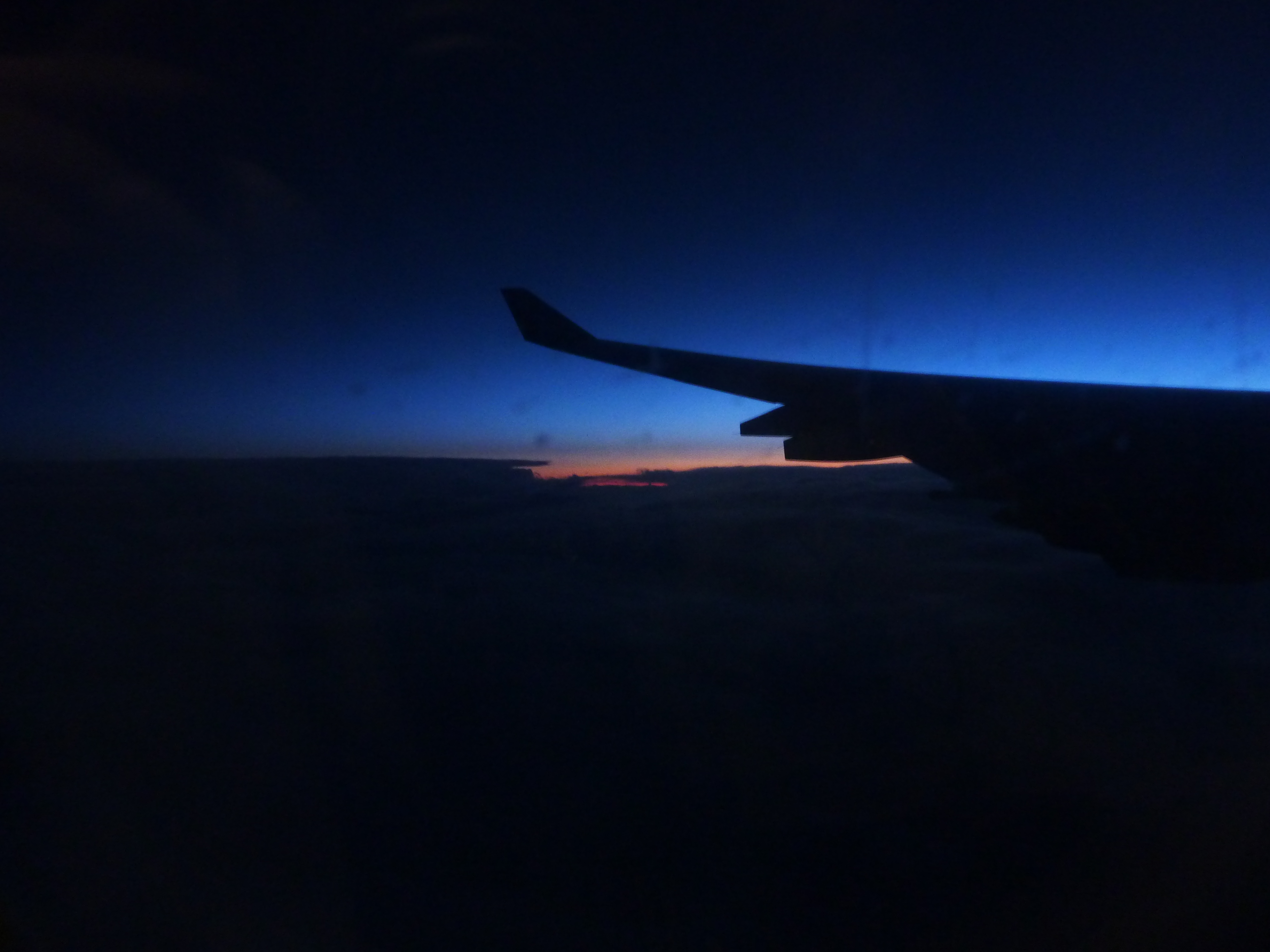
From the window of a passenger jet making it’s way over the Atlantic in 2009
One of my most favourite places to be is up in the air. Thirty-five thousand feet up to be precise.
It’s not so much about the fact that if I’m on an aeroplane, then I must be on holiday – although that too creates the association between flights and fun. Actually, it’s more about the concept of being so high up, and the rare chance to be so much closer to the stars as I glide through the upper-regions of the troposphere with 150 strangers. Flight also provides us with that so mesmerizingly natural view of the planet below us; a view which can evoke memories of pages from all those Physics and Geography textbooks that we used to begrudgingly carry around in school and chuck back into our lockers as soon as class was finished. Aerial views of the jagged coastlines below us – defined at night by lamps which dot their glowing amber hues along the borders to contrast with the black masses of ocean next to them- bring all those world maps we’ve ever looked at to life. We remember that we live not just in houses, towns and countries, but Planet Earth – just one shiny bluey-green marble in an unfathomable, mysterious mass of infinite black space the total contents of which nobody has ever been able to say for certain.
In any given second of commercial flight we are looking down on thousands of civilians, doing thousands of different things, in thousands of different circumstances. They may be living in homes which vary from the glamorous to the squalid, fulfilling acts from the most innocent to the most illicit, or experiencing events from the most joyful to the most tragic. Suddenly, my own circumstances, my successes and failures, highs and lows, seem less significant. With the humblest of meaning, my whole life seems less significant, because I am just one of 7 billion others who share the planet with me. The disappointment served by the frozen, inedible, sour tasting carrots in my in-flight meal turns from one of contempt and concern that I won’t have eaten enough on this long-haul flight, to just another of life’s little inconveniences that we ought just flick away with our forefinger into the depths of time and never dwell on again.
There’s another thing I think about during flight:
“From way up high, I drink a coca-cola and look out of a small sheet of plastic at the Earth below me where it came from, but whilst Earth appears so big, it is not so big that it can survive on it’s own forever. It is not so big, that separate nations can shirk their responsibility for the wellbeing of their neighbours. When stars that are lightyears away can appear as small as specks of dust, but be as bright as the bulbs directly above our heads, we are reminded that we each, as individuals, are merely passengers through time, but that doesn’t mean we don’t have footprints to leave. Each of us has a contribution to make.”
One of the things I value the most about Challenge to Change – the charity I volunteer for which aims to help rural Asian communities adapt to the threats of climate change through sustainable methods, is that – like all international charities – it relies on nations working together to support one another, just like they should do. We also seek to inform people in the UK about the effects their CO2 emissions can have on homes on the other side of the world. Charities such as CtC are here to show that there is no place in society for ignorance towards other parts of the world anymore. Generally, international aid and environmentalist movements are just two of the wonderful ways in which modern day Earth is finally managing to interweave each fragment of it’s landmass, or each patch of it’s tapestry, together in recognition of the fact that all 7 billion of the globe’s inhabitants are united in at least one thing – their position in the Solar System. We are thankfully so far beyond the archaic days before global exploration, when one had no concept of a world beyond their backyard.
Today, we live in an age where, the unfortunate obstacle of money aside, we can be on the other side of the world within the space of a few hours. Time Space Compression was the name that 20th century Geographer David Harvey gave to the idea of the world seeming smaller and smaller in size due to the emergence of innovative technologies like the internet and travel, and there aren’t many clearer demonstrations of this than the ability to send a message to the other side of the world in realtime, or being able to wake up in one continent and fall asleep in another. These are both things which we could not do prior to the 20th century.
On the other hand, the world can still seem significantly larger if you were to compare the standards of living in somewhere like the tiny African nation Burundi with the most expensive, luxurious home in Beverly Hills. We are still years, possibly centuries away from being a planet in which the smallest of African states can boast the same economic status as the likes of the USA and the Middle East. Perhaps there will always be such divide, and perhaps it will always be the one thing that keeps us believing that the Earth is big when new ideas such as the aforementioned time space compression theory will try telling us that it isn’t. To me, the world is both big and small, and it is during flight, looking down on it all, that I realise this the most.
When people proclaim that the Earth is a big place, I think about the internet and mainstream aviation and struggle to wholly concur. When others utter the phrase, “It’s a small world” (usually in reference to the sporadic meet of familiar faces in distant places) I consider the economic differences between East and West and struggle to wholly concur that as well. To try and weld our wonderful planet Earth into any kind of labels seems to take away it’s magic. It is what it is, but it may also be what it isn’t. And I like it that way.
Song of the Day: Miniature Tigers – The Wolf
Fun-loving indie-rock from Brooklyn, New York. Further evidence to support the notion that any band who’s name includes that of an animal, has a keyboardist, and comes from the East Coast of North America, will automatically be pant-wettingly awesome and produce genius lyrics like “I’ve got nothing keeping me here, I’ve wasted all the love that I hold dear. I’ll throw a dart: L.A. The wolf has run away…”
 sophiekemsley