MET WITH CHANGE – AN UNDERGROUND STORY

This month I ticked off an item from my bucket list, by going on a steam train ride with my parents.

It was the second time this year I found myself fawning over old trains…

My dad has always been into them, an interest that never really resonated with me in my younger years. Trips up to the London Underground Met Line Station in Watford – just up the road from our family home between 1989-2011 – to see the special visit of some old steam trains – were experiences I felt I needed to politely endure rather than enjoy, whilst dad took countless photos of what all looked like the same thing.

Really, I just wanted to be at home watching grainy American teen drama series on MTV, or playing Donkey Kong Country on the Super Nintendo with my big sister.

Roll forward about 30 years, to February 2026.

I’ve been staying with an old school friend – E – in Willesden Green following another friend’s 40th. I need to catch the Met Line back into central in order to get back to Kent, and find myself enveloped in nostalgia as we get to the Underground station.

“Look at all this old, original architecture!” I hear myself say as we enter, in a voice I don’t recognise. The dark wooden panelling around the ticket booths. The brickwork and vintage sea green tiles. All the things I wouldn’t have even blinked at as a child who used these trains a lot, suddenly becoming something of fascination and awe.

I bid goodbye to E by the ticket barriers and head down to the platform. The winter morning sunshine poking out from the white skies casts a glow over the leafy suburb that sits on the other side of the fence. I’m reminded of growing up in Watford, that confusing it’s-not-London-but-it-is-London sprawl of a place which is often maligned in jokes. A bit like Slough, maybe only slightly nicer, and with a name that doesn’t sound like a garden pest.

I reminisce seeing the tube trains pull away from Watford Met station out of my childhood bedroom window; close enough to see the passenger-shaped silhouettes through the carriage windows, far away enough to be unable to identify them. Disappointing, when you’re trying to spot your crush on their way home from the Boys’ school next to the station.

The nostalgic thoughts continue all the way to Baker Street, when something even more strange happens.

I’m actually excited to see it. Because nowadays I really appreciate and understand, that it’s the oldest station on an underground network that was the first of its kind anywhere in the world, and that’s something pretty remarkable, to be fair.

When we used to travel into London from Watford in the ’90s / early ’00s, we’d change at Baker Street to catch the Jubilee line to Bond Street, which pretty much meant Oxford Street, which pretty much meant crowds, strangers, and shops. As much as I appreciated the opportunity to go into bigger shops and buy things I couldn’t find at home, I wasn’t otherwise fond of the area, mostly because of those same crowds, and strangers.

And also because there was a wild rumour flying around at the time about somebody buying a Mars’ Topic bar at one of the dusty looking snack shops on the platform, and finding the head of a chocolate-encased rat as they bit into it. Not sure how true that is, and will never really get to find out…

…but it was all enough to taint my view of the Underground somewhat.

Until I became old (40), and suddenly Baker Street station represented a key part of our social history as opposed to nasty vermin surprises…

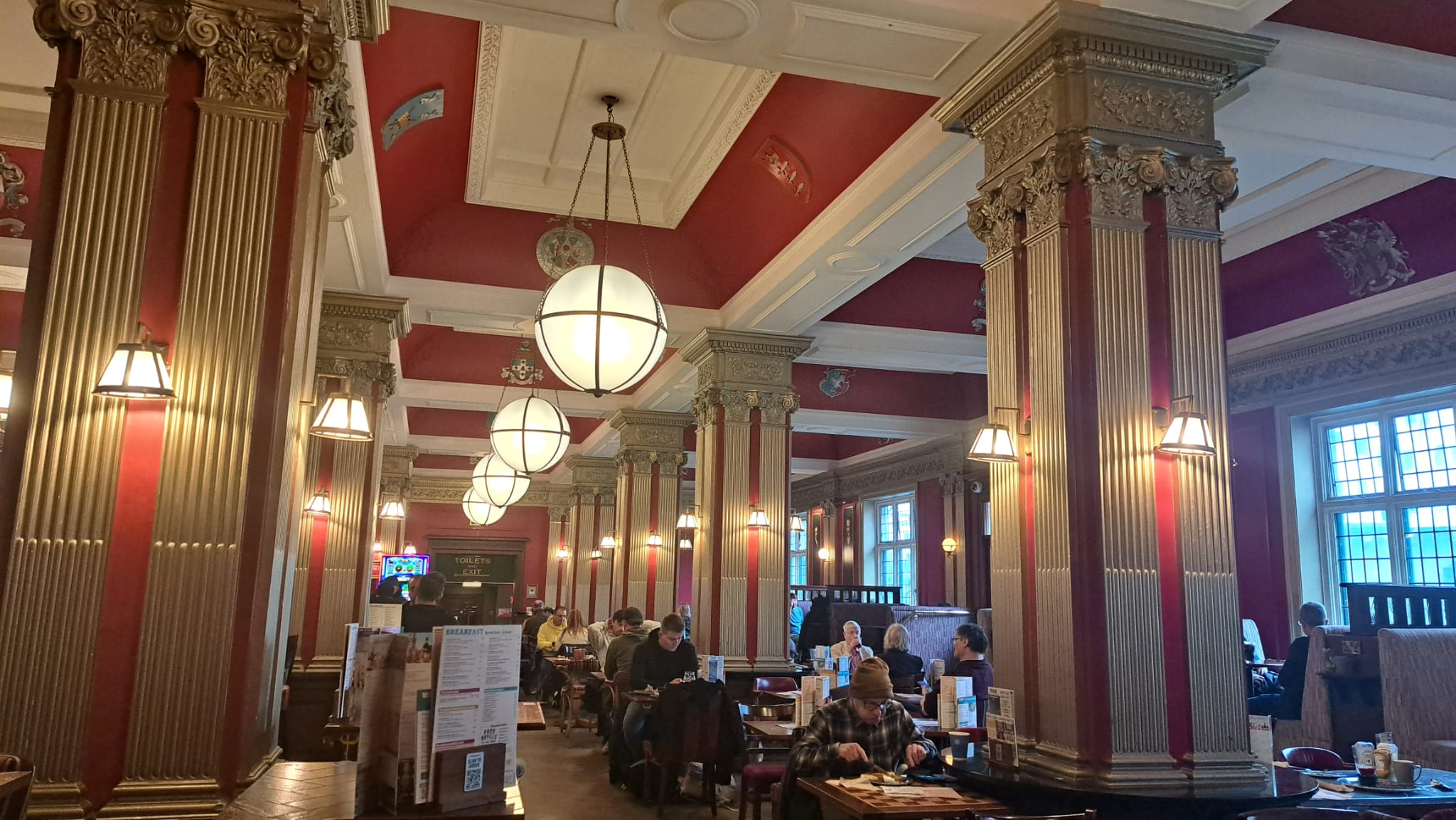
In February 2026, instead of thinking about the accidental digestion of rat heads, I think about how there’s a Wetherspoons next door that was once a high end dining hall affectionately known as ‘The Chiltern Court Restaurant’, a popular pit stop for those about to take a ride on the new subterranean railway in the late 19th / early 20th century.

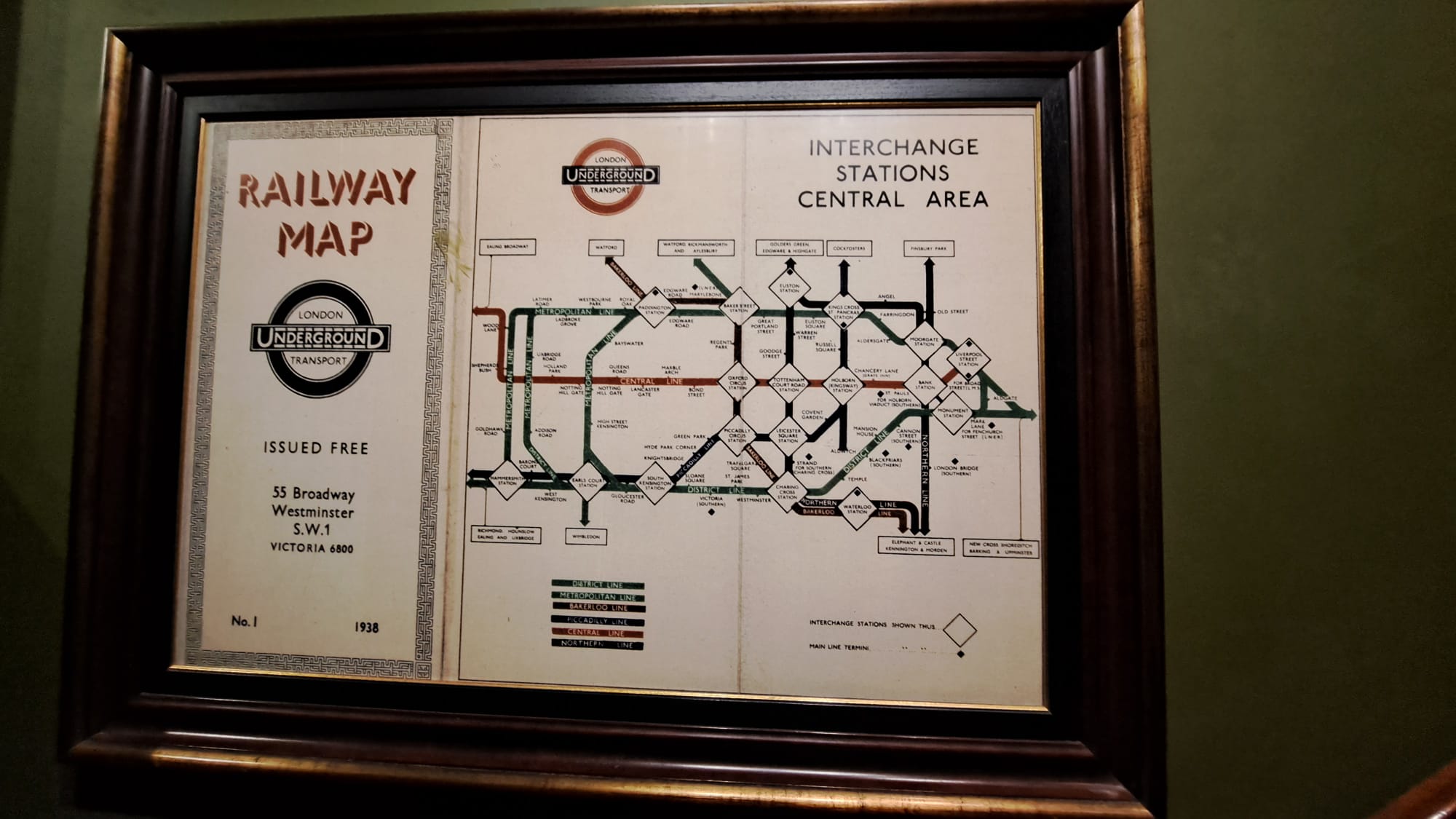
I must visit it, because conveniently I need a coffee or five, and that refill machine is a dream in that situation. Now cleverly known as ‘The Metropolitan Bar’ in homage to the Underground’s first ever line – opened in 1863 – the space is just as familiar as it isn’t. Same old sticky tables and nachos, but surrounded by grand pillars and vintage rail posters that remind you of the role of this same set of coordinates in years gone by, when the world had yet to learn about paninis and pitchers of WooWoo.

Because it was only just about getting used to the ChooChoo.
It’s hard not to notice a beautiful – almost comforting – sense of anemoia creeping in at this point. You think about all the people that ate in this very same room decades before you, where they were going, and why they were going there? To check out potential homes in the new, leafy suburbs of Greater London perhaps, or a trip out to the countryside? How were they feeling? What were they chatting about?

It took my parents 38 years to convince me to watch Sir John Betjeman’s famous 1973 documentary ‘Metro-Land’, about the creation of the Metropolitan Line and – most crucially – the positive socio-economic impact it had. Many of the towns and villages in north-west Greater London would benefit from a quicker access to the city centre granted by the new Underground system, and grew larger and more populous as a result.

Watford was effectively part of that Metro-Land, and we had lived in it, but I never really knew what that meant. I certainly wasn’t bothered about watching a film about the likes of Harrow, Pinner and all those other suburbs we’d pass on the way into central, but as an older person, I found myself glued to the screen admiring it all. It would turn out that E had watched it once too and we had a great chat about it, but I wouldn’t imagine we’d have done so over those gossips on the landline during the evenings of 1999.

And now I find myself looking more intently at everything whenever I take the Underground, particularly on the original lines. The hidden passageways once trodden by thousands of vintage shoes, the remnants of platforms of disused stations (known colloquially as ‘ghost stations’). Echoes of the past reverberating around the very present, dozens of metres below street level.

If there are indeed ghosts on the Underground, what must they think of the passengers of today? Shuffling along at pace. Stressed. Shoving into each other. All staring at small metal oblongs and all lost them within themselves, just trying to get to their destinations as quickly as possible in a world that doesn’t seem to wait anymore.

Not because it actually doesn’t, but because we often forget that it can.

I frequently think that if there was anywhere in the world I could go – if logistics weren’t an issue – it wouldn’t be so much about a place anymore, but a time.

And a train ride would probably feature.

I turn into my parents more and more every day…
MEDITATION, FROM A STATION

There are certain things that feel hard to admit in public, particularly as a 40 year old female. But here we go:

I really don’t like yoga.

And that’s surprising, because as someone who’s always been in touch with my more spiritual side, yoga feels like the sort of thing I should love. And I really, really wanted to. But, after years of attempts that always concluded with me counting down the minutes until the end of the sessions, or having the instructor move my limbs to where they needed to be, I realised that I just… don’t. It’s a no-ga from me. I’ve downward-dogged for the last ever time, no more chances, or time wasted trying to like something that I probably never will.

I get why other people like it, though. I think all of us can benefit from more mindfulness within our daily lives, but what I’ve come to learn is that it doesn’t always have to be about things as disciplined as yoga, or meditating in a quiet room with strangers in a pretzel-shaped pose (and probably paying £15 an hour to do so). Instead, I think mindfulness and meditative activity can be practised anywhere, anytime, it’s just about figuring out what way feels right for you.

The other week I had to catch a train to London. Usually, I’d spend that time in the same way that most others do: doom-scrolling on my phone. Catching up with life admin. Conversing with people via WhatsApp. Watching reels about AI cats eating pastries. Basically, anything that fills up the time and makes the journey go faster… but pretty much always looking at a phone.

On this occasion though, I wanted to do something slightly different. I challenged myself not to look at my phone once throughout the journey, and to look out the window the whole time whilst listening to music (electronica, without any distracting lyrics) instead. To ensure my mind wouldn’t wander beyond what was right in front of me, I decided to jot down in my notebook all the things I saw along the way. Constantly. Pen to never leave the page, to ensure I didn’t drift. And here’s the output of those notes…

Technically speaking the first thing I observe are the golden, flakey remnants of my seat’s previous occupant’s sausage roll. It’s hardly the most inspiring start to my mindfulness challenge, but I did instruct myself to write down everything. And to some people, myself included at times (usually if hungover), a sausage roll pretty much is everything. So yes. This is a perfectly acceptable start, and I manage to swiftly shut down the resurfacing memories of all the best sausage rolls I’ve ever eaten (Wall’s caramelised onion circa 2012) to focus back on the here and now.

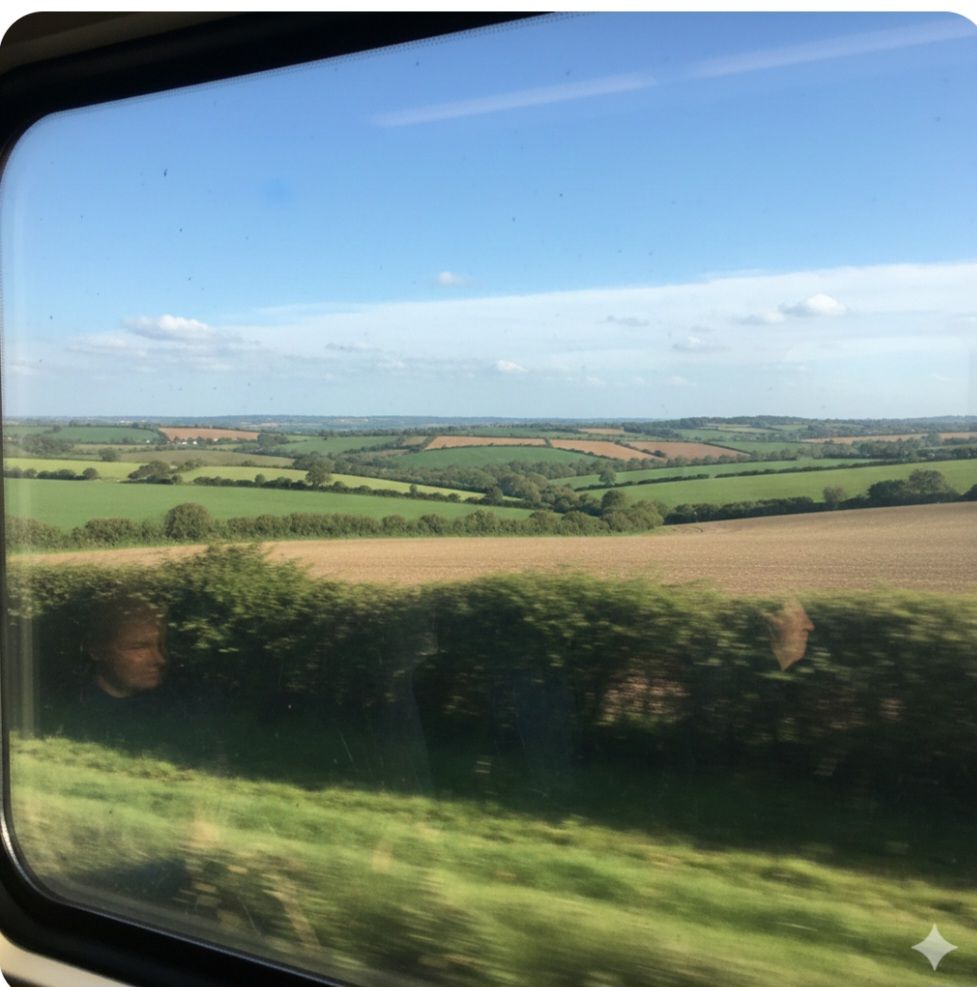
Succumbed to using AI for this image, because my phone ban during the journey also meant taking no photos!

The train rolls out of Faversham and I look out over a bunch of buildings, some of which are the homes of people I know, or knew. The house where my grandad grew up. The churchyard many of my relatives are buried at. My friend Dan’s house. The paddocks which were so lovely to walk around during the otherwise weird, balmy Summer of 2020. The grade II former manor house with the flat I looked around in 2018 which I really wanted but couldn’t afford, and still think about to this day.

The buildings become more and more sparse as we drift towards Teynham. Kentish orchards exposed by the December sunlight, their fruits both a distant memory and a chapter waiting to happen.

New housing developments: we need them, but why do they all have to look the same?

Sittingbourne. I always like to look out the window here, not for the aesthetics – of which there aren’t all that many in fairness – but for the fact my grandmother spent many happy years calling it home. The train runs adjacent to her housing estate and I’m amused by the fact her garage door has still not been painted in over 25 years – pillar box red when I was a little girl, now patchy and pastel. Maybe the white ’80’s Fiat is still behind it, and maybe grandma is still in the house, waiting to dish us up a plate of fishcakes and mushy peas and ask us how our journey was.

“Quite long actually, grandma. 18 years in fact.”

As we get ever closer to the Medway towns, I think about how – despite the downsides, like cost and waiting around on cold platforms with boney seats – train travel allows us to see so much of the area we live in ways that driving doesn’t allow for. This is far more interesting than the M2, and it reminds me of how beautiful and diverse a landscape Kent has.

Some washing hangs from a line in Twydall – a row of vests in blacks, browns and greys – before we pass a large cemetery. The winter sun is beating down over rows upon rows of headstones, shining light and life over those gone but not forgotten.

I can still remember where I was, and exactly what I was doing, when I learnt that the place is not pronounced “Twye-dall” but “Twidd-all”, and it still amuses me as much now as it did then.

“This post is starting to read like a load of old Twydall”, I imagine the reader starting to think at this point… and that would be a fair point to make, but I’ve yet to look at my phone on this train…

I spot the stadium of Gillingham F.C – Kent’s leading football club – but not for long, I predict. Surely Faversham Town F.C will take that crown soon? Champions of Europe, 2035. You heard it here first… there’ll be a procession around the Guildhall and the building which was once ‘Annette’s Baguettes’ and everything.

The train pulsates the veins of Chatham as we travel along the bottom of some steep verges. They are strewn with the gifts from fly-tippers and litterbugs: a jerry can here, a child’s plastic wheelbarrow there, all scattered about like some Generation Game finale, there to observe then try and regale from memory in a list.:

“Wheelbarrow. Cuddly toy. Typewriter. Empty Lucozade bottle!”

It’s always Lucozade bottles, and I’ve no idea why or how, since it’s not even the most popular soft drink. Maybe their slightly awkward, tall shape makes them harder to fit into bins? Or maybe – given the association with exercise – consumers prefer to try drop-kicking or throwing them in but miss, in a sign that they need to train more.

I’m thinking way too much about the aerodynamics of Lucozade bottles at this point, but I still haven’t looked at my phone.

At the next station, we begin to see the growing numbers of people with wheely suitcases. It’s fun to try and guess where they’re going, using the size of their cases to determine whether it’s a short or long break. There is a sense that the hustle and bustle will only increase from this point, as we get closer to the capital. Empty seats will become rarer gems, as more and more people – and sausage rolls – board the train to occupy them. I best move my bag.

Rochester, an historic old town peppered with lots of pretty old buildings and some not so nice new ones. The castle stands proudly at the top of the hill, and there’s even a sign to tell us exactly what we’re looking at!

Oh wait, no, that’s just a sign for the “Castle Hand Car Wash” that sits some streets beneath it. Not quite as postcard perfect as it could be.

“England’s largest second-hand bookshop” Baggins Book Bazaar – is still there and visible from the train, but it no longer seems to have its claim to fame painted on the back of the building. Does that mean that there’s now a larger second-hand bookshop somewhere in the country? If so, what a gutting thing to have to do in having to paint over all that. I have only visited that bookshop once, which incidentally is the same amount of times I’ve visited Rochester, but it was quite an experience, – almost needed a map to navigate my way around – and am still very surprised that I was ever able to get out.

Many people get on board at Strood, which feels surprising since this is one of the smaller of the Medway towns. There isn’t a whole lot to see here, just Peking Express, which doesn’t appear to look overly inviting but nonetheless probably serves some tasty satay skewers. My belly rumbles.

We enter the first of the many long Victorian railway tunnels which will punctuate the rest of this trainline as we get into London. We are well and truly feeling the creeping clutch of the capital’s gnarly fingers at this point, the land around us turning from vibrant green into a more dismal grey. The buildings become taller, the sky starts to feel heavier, and everything is feeling a little bit busier. The back gardens are looking more and more unkempt, and I know less about this part this part of Kent, but have heard – multiple times – that it has lots of beauty to offer. I can believe that, as I scope the rolling golden hills in the background.

When the train arrives at London Bridge, I finally check my phone. All I’ve missed is a message confirming the meeting place, and an e-mail about my most recent utility bill.

But I haven’t missed much else. In two senses.

By the way, Lucozade bottle. Just because it’s been a few paragraphs, and they’re usually scattered about everywhere.