WHY I’D RATHER BE IN WETHERSPOONS

If I could go back in time and tell myself that there’d come a day when one of my favourite ways to spend a Saturday morning is in Wetherspoons, there’d be two kinds of response, dependent on how far back we’d gone:

18-23 year old me: “Ahh wicked, pitcher of Blue Lagoon and some Apple Sourz to welcome the weekend innit!”

23- sometime in the mid-30’s year old me: “Well, that’s just depressing. What a waste of a Saturday.”

I’d assume I had turned into one of those people I pass spilling out of the local establishments having a pint at 9.30am and regretting my life choices. Yes, that would feel depressing if it were so. That’s still not a point I’d ever like to reach.

But that’s not the reality.

I very rarely drink alcohol in Wetherspoons, but I’m here a lot. Usually with a £1.56 refillable coffee and a notebook, and on the really special occasions if I want to treat myself: a bowl of nachos, made to a recipe that hasn’t changed in at least 20 years.

A thoughtful gift from a friend

To me, Wetherspoons is about so much more than the historic connotations with cheap drinks and sticky tables. It’s a cornerstone of the community, a national institution, a place where people from all walks of life can feel that a decent meal out is a bit more within reach than a lot of other places.

Wetherspoons is a place for everyone… except the more snooty among society perhaps. And who wants to be around people like that anyway?

It’s a place that leaves you to it. A place that doesn’t pressure you to leave as soon as you’ve finished your drink so that a new customer can occupy your seat. A place where even the backs of toilet doors will encourage you to stay for as long as you like – undisturbed – if it helps you to feel safe. And often, when I look around, I sense that a lot of the clientele come here for that quality. Like the octogenarian – we’ll just refer to him as ‘G’ – who frequents my local branch for lunch every couple of days and explains how for him, it’s a place where he can come and feel in good company compared to the loneliness he feels at home.

“It helps me feel connected here” G once shared with me, “I love to see familiar faces… there are so many people my age who come here and have so many great stories to tell about their lives. You’d never know just from looking at them just how many remarkable things they’ve done. I’ve found out all about them just by chatting here.”

G tells me his own life stories as we sit and chat. We’ve spoken a few times because our favourite tables are next to each other (by the windows, to enable the act of people watching outside). Although 80% of the dialogue is from G’s side of the script, I find him a joy to listen to, and he always thanks me for the chat as he leaves, even though I’m not really sure I’ve said that much.

A recent study found that around 30% of UK residents experience regular feelings of loneliness. Whilst Wetherspoons may not be the solution for all, it’s important to acknowledge this value when critiquing the place. As somebody who lives alone in a quiet estate and predominantly works from home, I find that an evening coffee trip (decaf by that time) to ‘Spoons is an important injection of life, people and reality after a virtual day, and can understand why many feel similar.

The chain has a lot of critics, for various reasons. One of the more common concerns is that through its cheaper prices, it takes valuable custom away from the traditional, independent British pub. This is a particularly valid concern at a time when the hospitality industry is under enormous pressure – not least from recent rises in alcohol duty – and many of our beloved ‘locals’ are pulling their final pints left, right and centre. 

However, what many often forget is that the two places are very different. The top two selling drinks at Wetherspoons aren’t even alcoholic. They’re Pepsi Max and coffee/tea. More to the point, it’s entirely possible to both support your local pub with your custom, and appreciate your local Wetherspoons. I’d usually pick my cosy local if it was something alcoholic I was after or if I was meeting a friend, but I’m not sure my local would necessarily appreciate a whole table being taken up for a couple of hours by someone who’s just after a coffee, and that’s fair enough. You can make the most of both, it doesn’t have to be a case of either or.

The food is another characteristic that often attracts criticism, whether it’s the fact that the chip count can vary (as attested by the 250k strong membership of a particular Facebook group where members share / compare / condemn counts) or that it all tastes like it’s been “made in a microwave.”

Well, so what? I mean really, so what! Quite frankly, if it’s produced in a hygienic environment, is hot, tasty and edible, then I couldn’t care less if it was prepared by a teenager monitoring a microwave or Nigella Lawson poring over her aga oven. At least you always know, no matter what branch you’re in, what you’re going to get. Wetherspoons is a complete opposite of Forrest Gump’s infamous box of chocolates, (unless you’re focusing on the chip count). There may be better quality meals available elsewhere, but the reality is that they’re a lot more expensive, and most people can’t afford this as regularly. Sometimes you just want to have a break from cooking without breaking the bank. Sometimes you just want cheap stodge.

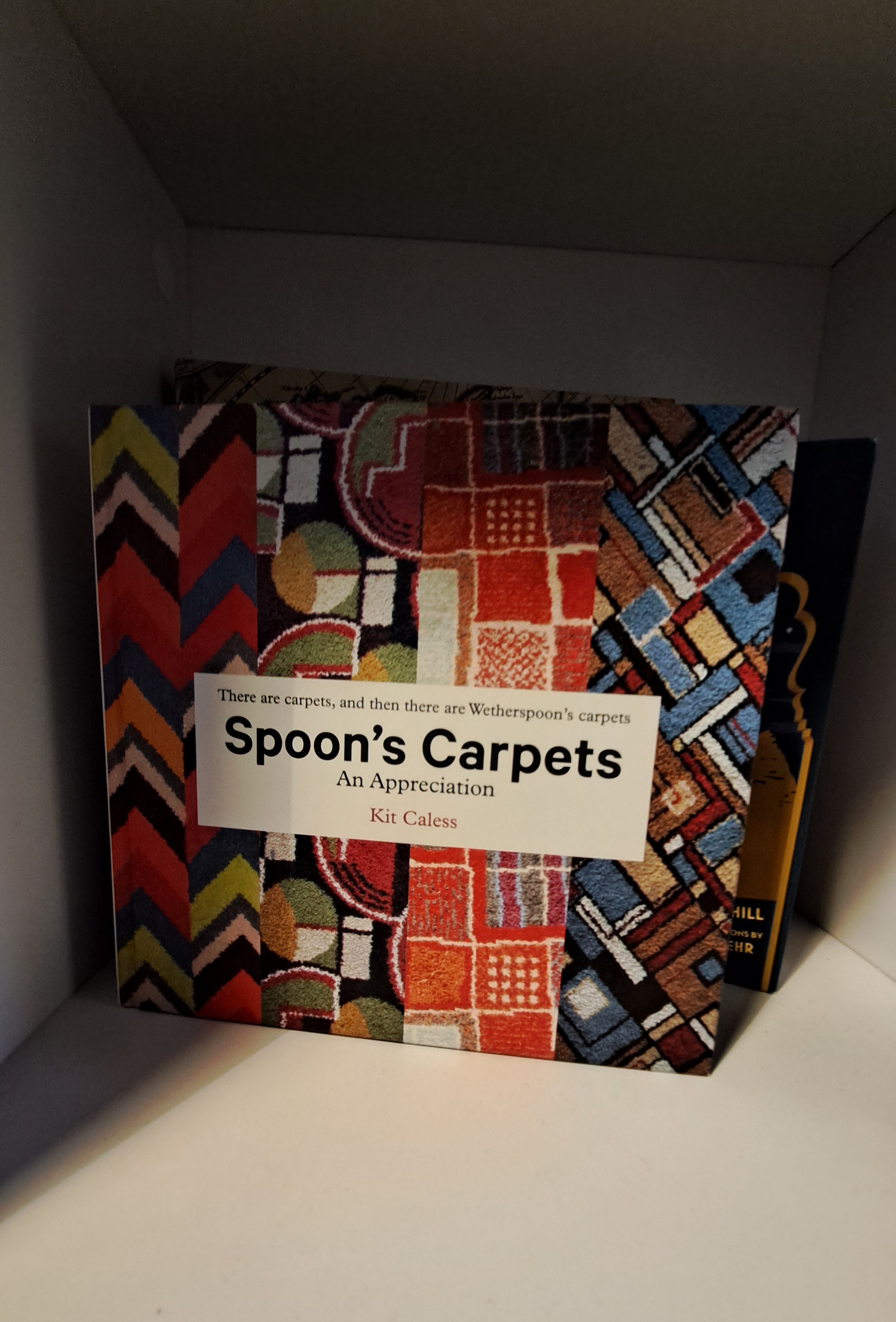
And where do we start with the iconic buildings themselves, and their carpets? It’s a little known – but absolutely incredible no less – fact that each of the 850 Wetherspoons establishments in the UK has its own unique carpet, designed around something to do with local culture, history or heritage. Take a look the next time you go into your local ‘Spoons. I am in awe of the likes of Kit Caless, who visited hundreds, set up a website and even released a book to document them. A book I proudly own and which has taught me a lot about notable figures and history from other areas:

The book really exists, and it’s amazing

As for the buildings, you’ll often find that those now hosting the chain once served a purpose as something entirely different, and the history is usually palpable upon entry. One of my favourite Wetherspoons buildings is The Palladium in Llandudno, Wales, not least because it means I must be near Snowdonia, but just because of the general feel of the building. Before it became what it is today, it was a 1920s theatre, and as you gaze at the various boxes and balconies around you, you can almost hear the echoes of decades of historic performance. You order your scampi, chips and mushy peas thinking about how the people a few decades in front of you in the queue were ordering their ‘ices’ at the interval, and not only does it feel exciting, but it also feels like a sentimental connection to the local past.

The Opera House in Tunbridge Wells has a similar history, and the reverberations of a former art deco cinema are felt immediately as you enter The Peter Cushing in Whitstable (a branch which recently won platinum prize in the UK’s Loo of the Year awards, in what I’m certain was a ‘sparkling’ ceremony). I’m not entirely sure what my local branch, The Leading Light in Faversham, used to be, but I believe it was a carpet store, which is a little less exciting than those above perhaps, but also quite fitting when you consider the pursuits and passions of Kit Caless and Co.

Should this have piqued your interest in your own local branches, then it’s worth checking out the Wetherspoons website, which contains a lot of contextual information about each branch, including explanations for the name.

Additionally, it’s a firm belief of mine that there’s a Wetherspoons for every occasion, but to take inspiration from the menu and add some variety to this post I’ll represent this as an amateur poem as opposed to a paragraph – a small plate compared to a main – if you will:

Turning 18 with a pitcher of Purple Rain.
A bowl of nachos before catching the train.
A pre-holiday pint before boarding the plane.
A cheap breakfast whilst taking shelter from the rain.
Buying a cup of coffee, and filling it again and again…

There’s just one more characteristic about Wetherspoons I wish to praise, out of a raft of many more which I could possibly feature, and for this I’ll tell a true story:

It’s February 2020. Storm Ciara has swept up the UK and caused carnage everywhere, not least cancelling all the trains to London from Lancaster, where a friend and I have been visiting our former University haunts. We’re cold and miserable about it and have had to book an extra night’s accommodation and buy emergency underwear in Primark, as well as inform our respective works that we won’t be able to come in on Monday. Once we have accepted this fate we head to The Sir Richard Owen, which just so happens to be next to our hotel. In the spirit of student memories we order a Smirnoff Ice each and my friend tells me about a trend whereby people post their Wetherspoons table numbers on Twitter and people order food for them via the app. I struggle to believe this is true, and so she offers to try it.

Within minutes of her posting on Twitter, a side of baked beans arrives unaccompanied by anything else, sent by a mystery donor. We laugh. A lot. And then try and work out the best way to distribute them. British tapas.

It’s utterly bizarre, utterly hilarious and also utterly Wetherspoons. Which is a way in which I’d also describe the pandemonium of Summer 2024 when a bird flew into the Faversham branch and mesmerised an audience of a couple of hundred customers, who all got on board with the rescue attempt of encouraging it to fly safely back out, which it eventually did.

And really, there’s so much more I could possibly say, but I’m making myself hungry, so instead I’ll shawarmachickenwrap up this post to include a soft drink. £5.70 each. Ordered via the app.

Never, ever change, ‘Spoons.

TEA (OR IS IT DINNER?) WITH MARCEL IN NORTH WEST ENGLAND

The clocks went back an hour last night and the consequent earlier onset of daily darkness will be the main topic of conversation between British people for the entirety of this week. It always has been, and always will be.

It’s been less than twenty four hours and we’re already feeling it. LED strip lights rising from the ground and suddenly appearing everywhere we turn. A black velvet curtain drawing the days to an early close. Menacing orange and black paraphernalia everywhere, and the inexplicable smells on the streets of metal and smoke.

For me, this time of year often makes me think back to my time as a student at Lancaster University in north west England. I’d heard the expression, ‘It’s grim up North’ numerous times prior to making the move and was determined to see for myself if this were true or not. It definitely wasn’t. Yet whenever I think about the place, it’s usually in the context of a Winter evening, much like this one.

It’s November 2005 and I’m sat on the top floor of a double decker Stagecoach bus that smells of Wrigley’s Orbit, wee, and diesel oil. The wheels on the bus are going round and round, and the lights on the bus are making my hungover head pound and pound as they illuminate the harsh orange zig-zag seat patterns. A Sainsburys bag, fill to the brim with representatives of the Basics range (soups, garlic breads and pastas aimed to last the week), is hooked on to my wrist threatening to cut off circulation to my hand as I cling on to both the bag and the seat for dear life.

Inertia flings me towards accidentally nutting the bell each time the bus brakes. I find comfort in seeing the neon red letters that spell out BARGAIN BOOZE, because it means we’re finally at the bottom of the hill from hell in the Bowerham part of town, and the ride home should become more smooth from here. I may even be able to safely place my shopping bag on the floor before it rips from the weight of all the soup cans and sends them rolling down the aisle like the barrels hurled by Donkey Kong in the retro arcade game (yes, that did actually happen once).

I finally reach campus and step off the bus to walk to my halls of residence, but first I have to have a fag, after all that hard work clinging on to heavy shopping bags and trying to keep upright. As I puff away my student loan (the current me still hasn’t forgiven the younger one for this) I look up at half a dozen kitchen windows and see several episodes of a student drama tv series all screening at once. A couple of lads in striped polo shirts with emo hairstyles are chucking the entire contents of their food cupboards into what appears to be some sort of stir fry. The girls upstairs are dancing around in brightly coloured rara skirts and drinking out of fluorescent beakers. One of them is swapping the CD around in the stereo that sits on the windowsill. There’s another kitchen where the window is covered in a collection of handmade paper snowflakes that gets bigger with each passing day, and a couple of others where the lights are out. All the occupants are either out on the town ploughing through vodka Redbulls, or in their rooms graffiti’ing the reincarnations of forests with neon Stabilo highlighter pens.

I head up the internal stairwell towards my flat, being careful not to step in the congealed puddle of Dolmio sauce that’s been there all week following a drunken dare gone wrong. The unmistakable scents of the tomatoey residue and washing powder fill the air. As I push through the heavy fireproof doors to my flat I’m overwhelmed by even more senses. The smell of Heinz spaghetti and garlic bread being cooked away in the kitchen. The audience of Deal or No Deal gasping as the infamous 1p box is exposed on a flatmate’s tv. Another flatmate on the phone to her mum, assuring her that she’s eating well. The wisps of somebody else’s cigarette floating out from underneath their bedroom door. Somebody listening to Binary Love by The Rakes. The smell of burning garlic bread.

Shit. The smell of burning garlic bread.

The shriek of the fire alarm which ensues. The cackle of students, most of whom are half cut, trying to evacuate the building as the porters arrive to shout instruction in loud, northern tones. We shiver in the cold air of a northern Winter, watching each others’ exhales under the streetlights, whilst waiting for various risk assessments to be complete. Eventually, we’re able to file back in.

“So, what shall we have for dinner?”
“Garlic bread?”
“Fook off!”

**********

‘The Proust Effect’ is the name of the phenomenon whereby certain senses can evoke sudden nostalgia. The novelist Marcel Proust coined the expression after feeling transported to his childhood following consumption of a particular tea-soaked cake in his later years. It’s a legitimate effect backed by science – all to do with how we process memories – and something I find particularly staggering is how it can appear out of nowhere, all encompassing. Stepping back to a former life. Have you experienced The Proust Effect recently?

This post is dedicated to R.G. 19 years after our shopping rolled out all over the bus as we returned to campus. How we laughed that day x

Song of the Day: The Rakes – Binary Love