A BOWL OF IRISH CHARMS IN KILLARNEY, CO. KERRY

Before visiting for the first time,  the image in my head of Ireland was always a fusion of greens and greys, Celtic symbols, and a language containing an abundance of b‘s, h‘s, and n‘s strung together in sequences that I have no clue how to pronounce. Shbhnnhsh. All set against some backing music provided by Enya.

Did my trip to Killarney, County Kerry, change any of that? No, but it certainly added a number of new features to that internal vision, and I fell in love with it instantly.

Even as soon as I alighted the plane I sensed something sweet about the place. Literally. The concourse of Cork airport smelled not of aviation fuel but sugar, and I couldn’t work out why. After spending the following days witnessing more rainbows than I’ve ever seen in such quick succession, I deduced that the air was full of Skittles, which we must have been tasting (or smelling), as per the tagline. I’d later find out the real reason and I’ll tell you that later, but in coming to Ireland, I had seemingly dived head first into a sugary bowl of Lucky Charms, and there were lots of those charms to find.

Sally being one. She was the 12 year old piebald horse that clip-clopped our traditional jaunting car through the crispy orange leaves of Killarney National Park under the instruction of her owner, Mikey, who was the third generation of guides in his family.
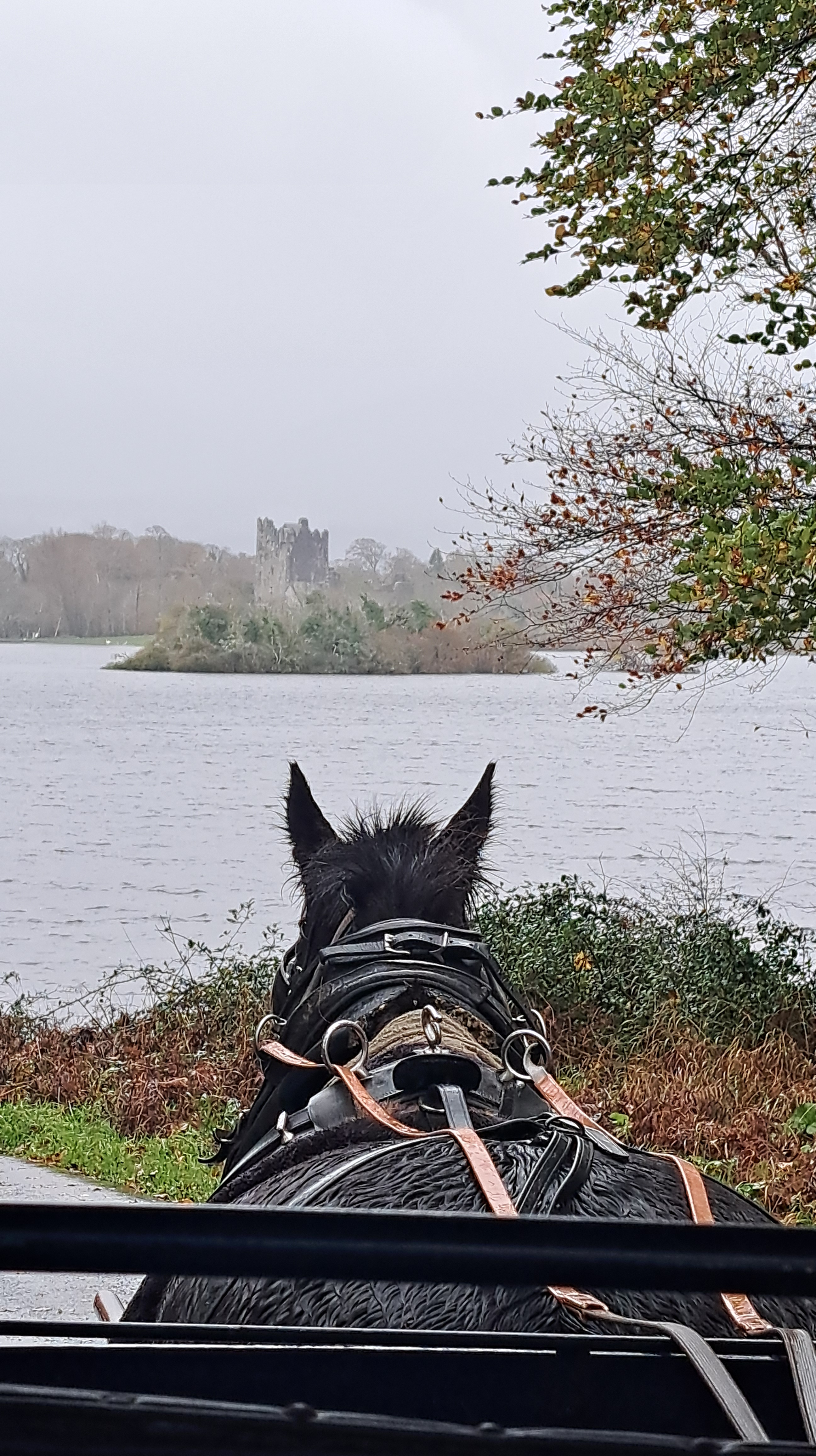
“She works two days then has a day off”, explained Mikey. I quite liked the sound of Sally’s working pattern, and briefly thought about becoming a horse, before being distracted by the sight of Ross Castle in the distance. There must be people who exist with the name Ross Castle. I expect it drives them around the bend – or moat – when people come to visit, particularly if they start asking about entrance fees.

I doubt that there’s anybody out there called MacGillyCuddy Reeks, though (and if there are I feel more sorry for them than I do Ross Castle). These unusual words form the name of the local mountain range which is home to the highest peak in Ireland, Carrauntoohil. My original plan had been to spend a day scaling Carrauntoohil, but on this occasion I gave in to sense, on account of not being sure if there’d be enough hours of daylight in mid-November to complete it. Instead I settled for Torc Mountain, the just as impressive 329th highest, and home to a waterfall that is one of the many must-see points along the Ring of Kerry, for which Killarney is the perfect place to base oneself for a few days.

The geography informed our choice to come here out of everywhere else in Ireland. People speak of ‘moving mountains’, but it’s always the mountains that move me. They make me weak at the knees, in both senses. On mountains, time disappears. Things disappear. The entirety of the wider world disappears, along with all its ugly parts. It’s just you and the product of a tectonic plate collision that’s been there for a billion years before you, and will be there for billions of years after. The mountains have seen everything there is to see as they look down on us (probably in more ways than one), yet they do not ever judge. Which is very kind of them.

I’m about three quarters of the way up the ‘prolonged climb’ of the Red Trail and starting to wonder if I should have just stayed in the town and drank Murphy’s in one of the warm taverns before I notice some pink writing painted on to one of the large stones that make up the ‘staircase’.
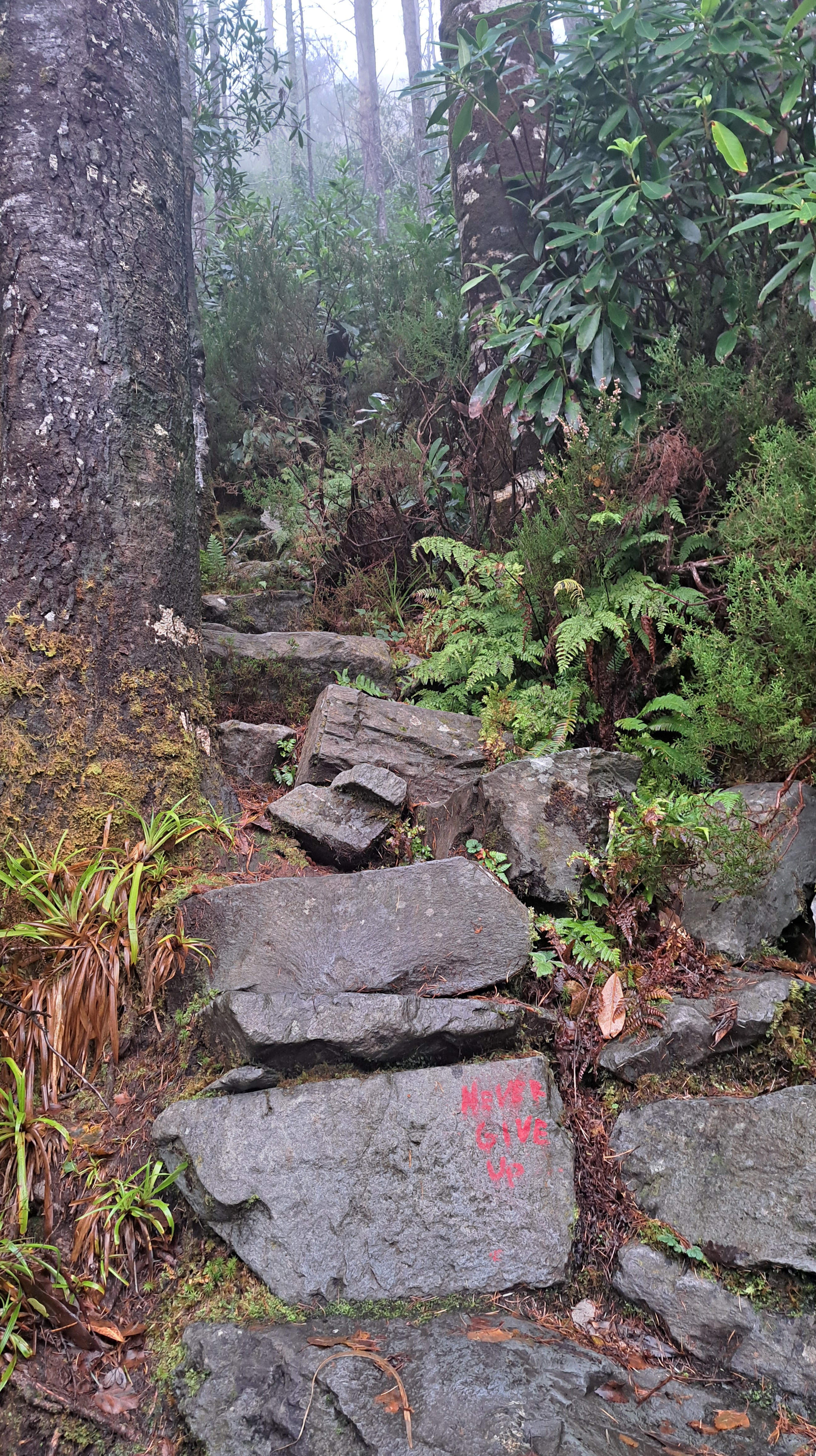
“Never give up”.

Clearly many before me have experienced similar feelings to those I’m feeling now: tempted to retreat back down, get back in the car and go back to bed. There’s comfort in knowing this.

I thank the anonymous scribe and obey the pink scrawl and I’m so glad that I do so, because I’m soon at the top and able to enjoy the plateaued ridge that runs along the top of the mountain affording misty yet magical views of Muckross Lake below. It’s at this point that a particularly heavy rain-shower occurs, and my thoughts immediately turn to the food in my non-waterproof bag, which wouldn’t taste nice wet. Somehow, just somehow, to my right is a stone shelter complete with a bench inside, the only one of its kind that I’ll see along this entire route. Is this what they mean when they talk about Irish Luck? Either way, I’ll take it, and enjoy the shelter for as long as is needed whilst the clouds get the rain out of their system.

The rain would feature a lot during our time in Ireland, as you would expect from an island in the Atlantic, yet Irish people don’t tend to bother with brollies, a stoicism underpinned by the strong winds that render them impractical. The equivalent of trying to heat a house with a single tealight. I overhear a rain-related joke that evening in the pub:

“Who ordered the rain?”
“I don’t know, but send it back”

The women laugh over their Dingle gins, a homegrown product from a peninsular just a bit further north here in County Kerry. Lady 2 is clearly very pleased with her quick-witted reply to her friend, but I get the feeling she’s maybe used it a few times before. There’s regular opportunity to do so in Ireland, afterall.

For every rain shower here on the Emerald Isle though, there seems to be a golden sunshine that enjoys dancing off the orange autumn leaves. That’s how those many rainbows come into being, a fact that always makes me smile as a metaphor for life’s varied paint palette itself. We see another beautiful one as we begin our tour of the Ring of Kerry. At the end of this particular ‘bow sits Kerry Bog Village, a museum in Glenbeigh consisting of a preserved 19th century village where real people lived and worked.

The minibus stops and allows us some time to explore Kerry Bog, and if it weren’t for the host of smartphones being waved about taking photos, we could have quite easily felt that we had stepped back 150 years or so. We venture into each of the buildings, all former homes of workers, and breathe in the surprisingly calming scent of burning peat whilst contemplating what it must have been like to share a kitchen with farm animals and climb up a long ladder to get to bed.

Nearby, an American tourist – one of over a million who visit here each year to connect with their ancestors – is excitedly rolling around on the floor with one of the Irish Wolfhounds. Despite their status as one of the largest and most intimidating of all breeds of dog, this one is looking quite embarrassed by the encounter.

“She said next time she gets a dawwwg, that’s the one she’s gonna get,” I overhear her companion sigh a little while later, as the one-way carry-on carries on in the background with no signs of abating.

These tourists are part of a different group, so I never get to know if they make it back to their bus without a new four-legged addition. Or if they even make it at all. Ireland’s charm is infectious and I wouldn’t hesitate to place a bet on everyone on these buses remembering this day for the rest of their lives. Even the lady behind me, who spends quite some time explaining to her partner – in one of the longest, most mundane conversations ever overheard – that looking at her phone whilst the bus is in motion makes her feel “seasick”.

Well, I guess we are traversing the Wild Atlantic Way…

When we eventually arrive back in the UK, the post holiday blues swallow me up in the way they usually do and I find myself doing the same old things I always do when I feel this way. Searching for documentaries on YouTube about the places recently explored so that I can see even more of them. Listening to Enya and pretending I’m back looking out over the patchwork of greens and golds that make up the beautiful Irish landscape. Carrying out important research on Google…

“Why does Cork airport smell of sweets?”

Well, it turns out that just over the road, as we alighted the plane, 35% of the world’s Tic Tacs were being produced at the Ferrero factory. My theory about Skittles wasn’t far wrong. But I think I prefer my own version of the truth…

Ireland, you were worth the wait, and I’ll be back to collect even more charms someday.

WHY I’D RATHER BE IN WETHERSPOONS

If I could go back in time and tell myself that there’d come a day when one of my favourite ways to spend a Saturday morning is in Wetherspoons, there’d be two kinds of response, dependent on how far back we’d gone:

18-23 year old me: “Ahh wicked, pitcher of Blue Lagoon and some Apple Sourz to welcome the weekend innit!”

23- sometime in the mid-30’s year old me: “Well, that’s just depressing. What a waste of a Saturday.”

I’d assume I had turned into one of those people I pass spilling out of the local establishments having a pint at 9.30am and regretting my life choices. Yes, that would feel depressing if it were so. That’s still not a point I’d ever like to reach.

But that’s not the reality.

I very rarely drink alcohol in Wetherspoons, but I’m here a lot. Usually with a £1.56 refillable coffee and a notebook, and on the really special occasions if I want to treat myself: a bowl of nachos, made to a recipe that hasn’t changed in at least 20 years.

A thoughtful gift from a friend

To me, Wetherspoons is about so much more than the historic connotations with cheap drinks and sticky tables. It’s a cornerstone of the community, a national institution, a place where people from all walks of life can feel that a decent meal out is a bit more within reach than a lot of other places.

Wetherspoons is a place for everyone… except the more snooty among society perhaps. And who wants to be around people like that anyway?

It’s a place that leaves you to it. A place that doesn’t pressure you to leave as soon as you’ve finished your drink so that a new customer can occupy your seat. A place where even the backs of toilet doors will encourage you to stay for as long as you like – undisturbed – if it helps you to feel safe. And often, when I look around, I sense that a lot of the clientele come here for that quality. Like the octogenarian – we’ll just refer to him as ‘G’ – who frequents my local branch for lunch every couple of days and explains how for him, it’s a place where he can come and feel in good company compared to the loneliness he feels at home.

“It helps me feel connected here” G once shared with me, “I love to see familiar faces… there are so many people my age who come here and have so many great stories to tell about their lives. You’d never know just from looking at them just how many remarkable things they’ve done. I’ve found out all about them just by chatting here.”

G tells me his own life stories as we sit and chat. We’ve spoken a few times because our favourite tables are next to each other (by the windows, to enable the act of people watching outside). Although 80% of the dialogue is from G’s side of the script, I find him a joy to listen to, and he always thanks me for the chat as he leaves, even though I’m not really sure I’ve said that much.

A recent study found that around 30% of UK residents experience regular feelings of loneliness. Whilst Wetherspoons may not be the solution for all, it’s important to acknowledge this value when critiquing the place. As somebody who lives alone in a quiet estate and predominantly works from home, I find that an evening coffee trip (decaf by that time) to ‘Spoons is an important injection of life, people and reality after a virtual day, and can understand why many feel similar.

The chain has a lot of critics, for various reasons. One of the more common concerns is that through its cheaper prices, it takes valuable custom away from the traditional, independent British pub. This is a particularly valid concern at a time when the hospitality industry is under enormous pressure – not least from recent rises in alcohol duty – and many of our beloved ‘locals’ are pulling their final pints left, right and centre. 

However, what many often forget is that the two places are very different. The top two selling drinks at Wetherspoons aren’t even alcoholic. They’re Pepsi Max and coffee/tea. More to the point, it’s entirely possible to both support your local pub with your custom, and appreciate your local Wetherspoons. I’d usually pick my cosy local if it was something alcoholic I was after or if I was meeting a friend, but I’m not sure my local would necessarily appreciate a whole table being taken up for a couple of hours by someone who’s just after a coffee, and that’s fair enough. You can make the most of both, it doesn’t have to be a case of either or.

The food is another characteristic that often attracts criticism, whether it’s the fact that the chip count can vary (as attested by the 250k strong membership of a particular Facebook group where members share / compare / condemn counts) or that it all tastes like it’s been “made in a microwave.”

Well, so what? I mean really, so what! Quite frankly, if it’s produced in a hygienic environment, is hot, tasty and edible, then I couldn’t care less if it was prepared by a teenager monitoring a microwave or Nigella Lawson poring over her aga oven. At least you always know, no matter what branch you’re in, what you’re going to get. Wetherspoons is a complete opposite of Forrest Gump’s infamous box of chocolates, (unless you’re focusing on the chip count). There may be better quality meals available elsewhere, but the reality is that they’re a lot more expensive, and most people can’t afford this as regularly. Sometimes you just want to have a break from cooking without breaking the bank. Sometimes you just want cheap stodge.

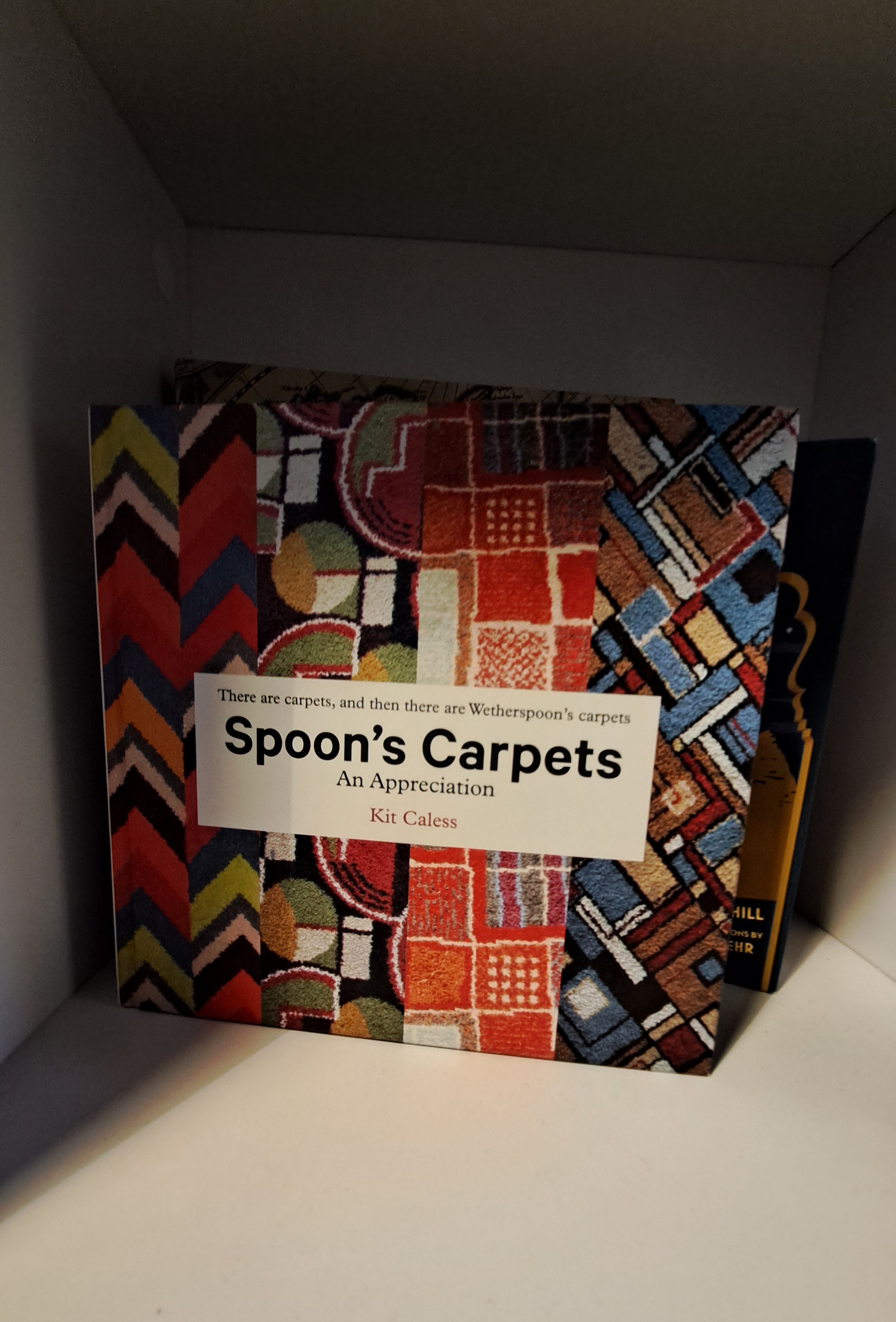
And where do we start with the iconic buildings themselves, and their carpets? It’s a little known – but absolutely incredible no less – fact that each of the 850 Wetherspoons establishments in the UK has its own unique carpet, designed around something to do with local culture, history or heritage. Take a look the next time you go into your local ‘Spoons. I am in awe of the likes of Kit Caless, who visited hundreds, set up a website and even released a book to document them. A book I proudly own and which has taught me a lot about notable figures and history from other areas:

The book really exists, and it’s amazing

As for the buildings, you’ll often find that those now hosting the chain once served a purpose as something entirely different, and the history is usually palpable upon entry. One of my favourite Wetherspoons buildings is The Palladium in Llandudno, Wales, not least because it means I must be near Snowdonia, but just because of the general feel of the building. Before it became what it is today, it was a 1920s theatre, and as you gaze at the various boxes and balconies around you, you can almost hear the echoes of decades of historic performance. You order your scampi, chips and mushy peas thinking about how the people a few decades in front of you in the queue were ordering their ‘ices’ at the interval, and not only does it feel exciting, but it also feels like a sentimental connection to the local past.

The Opera House in Tunbridge Wells has a similar history, and the reverberations of a former art deco cinema are felt immediately as you enter The Peter Cushing in Whitstable (a branch which recently won platinum prize in the UK’s Loo of the Year awards, in what I’m certain was a ‘sparkling’ ceremony). I’m not entirely sure what my local branch, The Leading Light in Faversham, used to be, but I believe it was a carpet store, which is a little less exciting than those above perhaps, but also quite fitting when you consider the pursuits and passions of Kit Caless and Co.

Should this have piqued your interest in your own local branches, then it’s worth checking out the Wetherspoons website, which contains a lot of contextual information about each branch, including explanations for the name.

Additionally, it’s a firm belief of mine that there’s a Wetherspoons for every occasion, but to take inspiration from the menu and add some variety to this post I’ll represent this as an amateur poem as opposed to a paragraph – a small plate compared to a main – if you will:

Turning 18 with a pitcher of Purple Rain.
A bowl of nachos before catching the train.
A pre-holiday pint before boarding the plane.
A cheap breakfast whilst taking shelter from the rain.
Buying a cup of coffee, and filling it again and again…

There’s just one more characteristic about Wetherspoons I wish to praise, out of a raft of many more which I could possibly feature, and for this I’ll tell a true story:

It’s February 2020. Storm Ciara has swept up the UK and caused carnage everywhere, not least cancelling all the trains to London from Lancaster, where a friend and I have been visiting our former University haunts. We’re cold and miserable about it and have had to book an extra night’s accommodation and buy emergency underwear in Primark, as well as inform our respective works that we won’t be able to come in on Monday. Once we have accepted this fate we head to The Sir Richard Owen, which just so happens to be next to our hotel. In the spirit of student memories we order a Smirnoff Ice each and my friend tells me about a trend whereby people post their Wetherspoons table numbers on Twitter and people order food for them via the app. I struggle to believe this is true, and so she offers to try it.

Within minutes of her posting on Twitter, a side of baked beans arrives unaccompanied by anything else, sent by a mystery donor. We laugh. A lot. And then try and work out the best way to distribute them. British tapas.

It’s utterly bizarre, utterly hilarious and also utterly Wetherspoons. Which is a way in which I’d also describe the pandemonium of Summer 2024 when a bird flew into the Faversham branch and mesmerised an audience of a couple of hundred customers, who all got on board with the rescue attempt of encouraging it to fly safely back out, which it eventually did.

And really, there’s so much more I could possibly say, but I’m making myself hungry, so instead I’ll shawarmachickenwrap up this post to include a soft drink. £5.70 each. Ordered via the app.

Never, ever change, ‘Spoons.

“EUROPE’S MOST BORING DESTINATION”? THE SURPRISE OF PODGORICA

It’s not that I suddenly shot up in bed one night with a burning urge to visit Podgorica. In fact, prior to this year, I’d never even heard of it, and probably would have assumed it was some kind of jolly eastern European wafer snack as opposed to the Montenegrin capital.

Our chance encounter occurred because I’d booked onto a group trip to explore the Durmitor National Park to the north of the country, and was advised that I should fly into Podgorica airport to join the starting point. Not knowing much about Montenegro at all, I thought it’d make sense to spend a couple of days in the capital before beginning the trip. The first impressions were good, as I booked a lovely looking hotel in the heart of the city for a mere £38 a night. With the accommodation arranged, I started to do a bit more research.

To say the results yielded from internet searches were disparaging about the place would be a complete understatement. Apparently, I’d just booked a couple of nights in ‘Europe’s most boring destination’, a ‘not particularly interesting’ place to visit, and – better yet – ‘Podgorica is a hole!’.
Well. Happy holidays to me! But none of these articles succeeded in convincing me to change my itinerary. Opinions are just opinions, I wanted to see it for myself.

The plane descended from above red-roofed houses that looked like Monopoly hotels scattered over a green mattress and touched down into the airport on one hot Monday in July. The first thing that struck me upon landing was the smell of cigarettes. With the terminal building seeming to be only the size of a saucer, I wondered if I’d landed in an ashtray as opposed to an airport. After the shortest passport control line ever, I stepped outside into stifling heat – a welcome break from the exceptionally wet British Summer – and spotted a guy who looked like a Montenegrin version of Harold Bishop from Neighbours holding my name on a piece of paper. The hotel had arranged a taxi for me, and here was my driver. He walked me over to the taxi and offered me a cigarette on the way, to which I shook my head. At least, I think that’s what he was doing. If he was checking that I was okay with the smoke in the car, he certainly wasn’t paying any attention to my headshake, but – terrible though smoking is – there was something somewhat endearing about the casual nature of it all. I held my breath and gazed out the window at signs adorned in unfamiliar Cyrillic script, and thought to myself, “I have officially arrived in a place some consider to be the most boring in Europe. Hello, Podgorica!” It will take me a few days to learn that the correct pronounciation rhymes with ‘pizza’.

As we reach the city centre, I begin to hear a growing chorus of car horns, and Harold does not hold back either. Beep beep beeeeeeep. We stop in a random street, where another vehicle is blocking the layby Harold wants to pull into, and I realise we have arrived at my hotel. Harold presses his horn firmly, but the driver in the vehicle ahead is playing on a tablet, and has no intention to move. This goes on for a while until Harold is within a fingernail of the rear bumper, which is the same point I notice large dents in virtually all the vehicles around us, including one with its entire front grille peeled off. It doesn’t take long to identify that this is not a city in which I would wish to drive.

Parking melee eventually overcome, Harold kindly carries my suitcase to the hotel reception where I am surprised to see a doppelganger of somebody I work with at the front desk.
“Oh, hi! Sorry I haven’t replied to your e-mail yet” I start to say. Well – not really – but it wouldn’t have felt too amiss if I had. Nonetheless, there’s something comforting about this small fraction of familiarity. Entering a new country for the first time can sometimes feel incredibly strange at first, and this was no different, but it would very soon fade.

The receptionist’s name is Teodora, and she is very helpful. Treating her a bit like a genie arising from a magic lamp, I am keen to restrict my number of questions / wishes to three. Not being able to speak a word of Montenegrin, I am reliant upon her years of studying English for our communication to be a success, and don’t want to take advantage of that. I die a little inside every time I see a British person abroad start reeling off demands with no attempt to check that the recipient understands English, and I don’t want to be ‘that person’. I select my questions carefully. Teodora says that yes, I can leave my luggage at the front desk whilst I go and explore, as it’s too early to check into my room, and yes there’s WiFi, but no, they don’t have any print-out maps. I have many more questions, like where’s the best place for a wander, but feel I’ve put Teodora through enough, and head out to work the rest of it out for myself.

I step outside and having no map – either physical or on my phone – make a mental note of whereabouts I am: downtown Podgorica, right opposite Independence Square. I head down a busy road which from memory of Google Maps would take me towards the old town, something I’ve read up on as a place to see. After some welcome moments under the shade of trees in Kings Park – built to commemorate the coronation of Nicholas I in Montenegro – I follow a stony staircase down towards the Moraca River and cross a bridge from which I see bathers dipping into the water. I make a mental note to return here after my trip to the old town, which is now only a few hundred metres away, up another stony staircase.

The old town really is an old town, but not quite the sequence of cobbled squares and Lipton parasols in which I’d been expecting to enjoy some sort of luminous, carbonated citrus beverage. Instead, it’s a scattered arrangement of small houses – some of which are completely dilapidated – and a couple of mosques. I later find out that this is an Ottoman-era neighbourhood which served as the hub of the city between the 15th and 19th centuries before being heavily bombed during World War II. I am struck by the amount of Argentinian-themed murals on display, including a homage to Diego Maradona captioned, ‘Adios El Pibe De Oro’. It transpires that the two countries have long-standing good relations, and that the South American country has the largest communities of Montenegrins outside of Europe. This isn’t something I’d ever have imagined to be the case, but feel so grateful to learn.


The heat is immense and I can start to feel sweat beads roll like rivers down my back, so take temporary solace in a nearby supermarket to stand near a fridge. I use this as an opportunity to officially the declare the start of ‘Crisps Around the World’, which is basically a fancy name I give to the act of ogling savoury snacks in foreign supermarkets and trying to select the most bizarre and unusual to try. Within a few moments of reviewing the offerings I feel I’d have more choice if I were playing a tobacco-themed version of the game… and there are plenty of crisps on display, just none that seem particularly novel. I wander out of the supermarket and begin to worry that I may have lost my bearings, until I see The Hilton hotel up ahead, which I recall passing on my way here. ‘Good old Paris and family‘, I think to myself in a moment of relief. I’m reassured by the fact that if I were to get completely lost and need to ask someone for directions, there’s at least one building here that I know how to pronounce.

I stop in the city centre for a tasty lunch of beef cream soup, bread and Montenegrin Niksicko beer that come served with a bonus waft of Lovcen cigarettes from the people next to me. Again, though part of me thinks it disgusting, another welcomes the sensory reminder of a bygone era, when all holidays smelt like sunshine, chips, and tobacco. I look back over Independence Square and wonder what the name means. Montenegro is a tiny country which could fit into the UK 18 times. Its population is only a little bit over that of Leeds, at 617 thousand. Surely a country of this size has a history small enough to quickly digest? Well – yes and no – but in its briefest form, it was part of the Kingdom of Yugoslavia for most of the 20th century. When the Socialist Federal Republic of Yugoslavia was dissolved in 1992, Montenegro joined hands with Serbia to become the Federal Republic of Yugoslavia, later known cunningly as ‘Serbia and Montenegro’ from 2003. In 2006, a referendum of Montenegrin independence took place with the results in favour of the country breaking off from Serbia, and in the Summer of that year it joined the UN as its 192nd member state.

After going back to my hotel to officially check-in and change attire, I head for another walk around the city. Njegoseva Street is where it all appears to be happening, and I stop off to refresh and do some journaling in a random bar with a waitress who looks less than thrilled to see me but is polite enough. I find myself thinking back to the spot by the Moraca River where people had set up a makeshift beach and feel it’s time to go back and check it out properly. I’m so glad that I do. By the time I return, the numbers have grown, the music is in full flow, and a bar framed in fairy lights has started selling drinks and t-shirts. A number of people – including some German tourists – swim in the river towards the Blazo Jovanovic bridge whilst their friends sit on the shingle smoking cigarettes, sunbathing, and enjoying loud conversations. A guy with dark, deep set eyes – like that of an albatross – serves me a Niksicko before returning to the riverbank to fish for trout – a favourite on Montenegrin dinner tables – and I sit on a stone wall, taking it all in. It’s strange to think I was waking up in an airport near Horley this morning. Right now, I couldn’t feel further away. The soft air, the excitable tingle from strange surroundings, the setting sun shimmering on the water – this is peace.

I think about what those Google searches said about Podgorica, and already I’m coming to the conclusion that they were a load of rubbish. I fully admit that what I’m experiencing is no Paris, no London, no New York, but there is still something quite sublime here – a city making the best of itself, in an understated yet enjoyable way. I walk back to my hotel via the 17th century clock tower that was framed as one of the key sights to see in Podgorica, a symbol of historic Turkish rule. As with many famous landmarks, it’s somewhat underwhelming, looking exactly the same in real life as it does on Google. You’ll visit Podgorica for reasons beyond this, I swear.

It’s the end of day 1 in Podgorica. Am I bored? No. Do I think it’s “a hole”? Absolutely not.

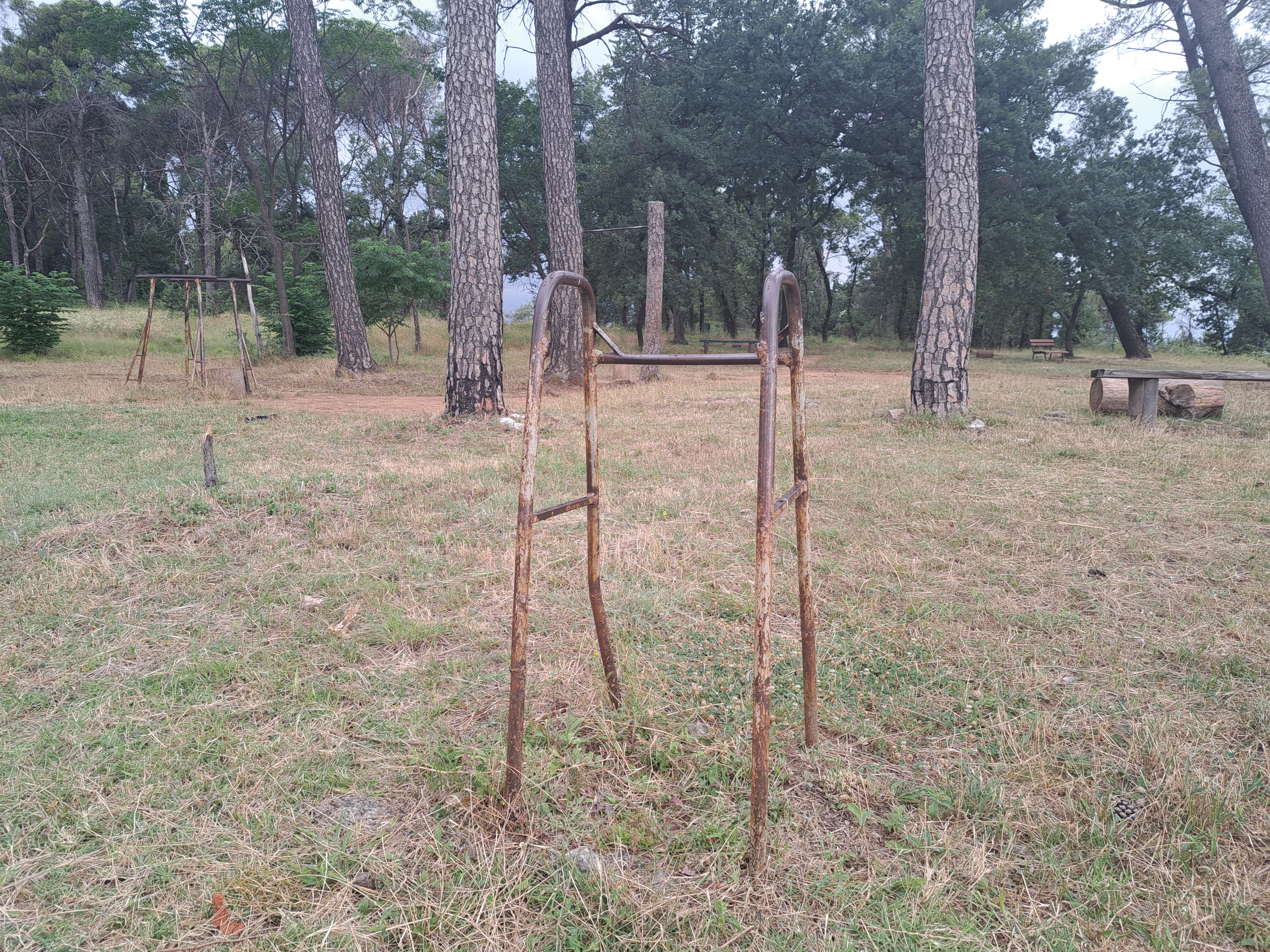
Day 2 starts with a hotel breakfast of random cold meats, cheeses, olives and pickles. The weather is slightly cooler than yesterday, and I choose to head to Gorica Park, a massive forested hill in the north of the city from which Podgorica gets its name (‘under the hill’). I am quite taken by Gorica Park. There is something quite alluring about its range of green shades and panoramic views of the city, reached by its seemingly endless trail paths. A wire-fenced, brutalist looking football pitch sits at the brow of the hill and opposite is an outdoor gym formed from corroded iron bars affixed to trees, looking a little like something straight out of Pripyat. I give a couple of the pieces of equipment a go before concluding that I should desist; I’ve a physically demanding week ahead, and shouldn’t go breaking my ankles on the second day.

Before long, there are flashes of lightning, and heavy rain sets in. Becoming a bit scared, I retrace my footsteps for about thirty minutes, back to the log-cabin style cafe in the centre of the park where I can take shelter with an apple and peach juice recommended by the English-speaking waiter. Heavy flumes of rain cascade from the awning and a ferocious wind blows menus across the outdoor seating area. It’s quite a contrast to yesterday’s heat, and an ever so slightly welcome one. Likewise, when the heat returns, it will be welcome back, and maybe there’s room in life for both. I sit tending my juice for an hour or so, literally waiting for a storm to pass, and think about how a swooshy font somewhere on Instagram is telling me I should be dancing in the rain. Although that’s a lovely sentiment, in these conditions it’s a pretty dangerous one. It later transpires that two men – one a Turkish construction worker in Canj, and another a Montenegrin enjoying a game of golf on the coastal Lustica bay – are killed by the lightning I watch from the safety of the cafe.

In the afternoon, once the rain has subsided and sunshine returned, I head back to the ‘beach’ at the Moraca River. My new happy place. I sit in a small cove, welcoming its shade, and write whilst looking out over the water. I am very tempted to swim, but on this occasion the voice of caution within prevails. The water moves rapidly, and though it looks nice and clean, I don’t know enough about what’s in it or how fast the current moves. Instead, I watch as a small turtle crawls over the pebbles, basking in the heat. A lady in floral dress then passes by, looking very wistful.

“She’s having a nice moment”, I think to myself, before seeing her partner following a few metres behind her, recording her with his phone.

Instagram influencer.

As for me, I’m just a novice writer whose most regular reader is my mum. I can’t influence you in the same way these perfectly curated Instagrammers can, but hey, at least I can give you a .JPG of Podgorica’s most famous attraction that you can print and pin on your fridge if you feel so particularly inclined.

At this reflective moment, a massive filling dislodges and I have to take a temporary return to reality in order to arrange a dentist’s appointment for soon after I return home. It wouldn’t be a holiday of mine without a dental-related drama! I purchase Panadol and mouthwash and hope for the best for now.

That evening, I head for a dinner of chicken in hazelnut sauce in Njegoseva Street before returning to Gorica Park. It’s still light and the settings are ripe for a beautiful sunset walk, especially with the storm having finished. I am surprised to see another turtle, a Hermann’s tortoise, crossing a path near to the ironwork gym I’d sampled earlier. Gorica Park is full of surprises, and I find myself liking the place more and more. It’s mysterious, it’s understated, and it’s beautiful. As I later make my way out of the park, I notice a small cafe bar – Klub Bocara – decked out in fairy lights and showing the Netherlands vs Romania game, and identify it as a perfect pit-stop. I sit on a table next to two girls who are smoking and playing a game of poker dice, and sip on another fresh, cold Niksicko lager. This place has a real vibe, one that just clicks. The evening warmth, the international football, the multiple languages being spoken, the fairy lights, the swing jazz on the radio, and A CAT! I stay there for a lot longer than planned just taking it all in and absorbing the moment (and taking every opportunity I can to stroke the cat). There’s tonnes I need to do to prepare for the next few days, but it can all wait.

Prior to moving on in the morning I reflect upon the last two days in Podgorica, and think back to those Google reviews. Is Podgorica the most vibrant, exciting place in the world? No. It’s not even the most vibrant and exciting place in Montenegro, as later trips to Durmitor and Budva alone would attest. But, does that mean it’s boring? Certainly not. And it’s certainly no ‘hole’. I’d go as far to wager that if you think that strongly about a place, it’s probably not the place that’s boring, but you. A lot of tourists need to understand that places don’t necessarily have to peacock to please those that visit. If they did, they’d all start looking the same, losing their unique identities to whatever algorithms constitute ‘amazing cities‘. Instead, it’s far better to take the time to really explore somewhere, and see and appreciate it for what it really is. What I particularly liked about Podgorica was that it didn’t pretend to be something it wasn’t. If it did, it probably would have felt like a lot of other places in the world.

Instead, it felt like Podgorica, Montenegro. And I absolutely loved it for that.