MAD ABOUT HIDDEN MADRID

What’s nice about visiting a foreign city for a second time, is that you really see it then.

The ‘must do’s” have already been done, the main sights have already been seen, and your itinerary feels a little bit more free because of it.

You’ve seen the ‘best’, now you can unlock the rest.

It didn’t take long for Madrid to feel familiar, as my taxi wove around the city towards the La Latina district where my best friend now lives for a lot of the year. I recognised the impressive gates of Retiro Park opposite the big arch of Puerta del Alcalá where I’d had the custom tourist photo taken back in 2022. You know the one, that stilted pose where you clasp your hands in front of you and smile awkwardly at the stranger taking the photo, before having to be polite and pretend that what they took was great even though they basically decapitated you in the picture, and subtly ask somebody else so you can repeat this whole sorry process again and again.

“I wouldn’t mind repeating a trip to Retiro, actually”, I thought to myself, comforted by the fact I knew I didn’t need to. As it happened I had no choice, the park was closed throughout my stay due to bad weather and the risk of falling trees, a precaution in place following a tragic fatality involving a child in 2018.

The weather had been much kinder in March 2022. I had been able to spend the week in a pair of hot-pants and flip flops and even develop a tan back then. I was quite poorly at the time and the vitamin D had been the perfect medicine. This time round, despite only being a few calendar weeks earlier in the year, I’d spend the duration looking like a giant sausage roll about to hit the slopes.

Turns out the rain in Spain doesn’t just stay mainly in the plain. Liars.

In a perverse way though, the poor weather actually added to the experience, as did spending it with a ‘local’. They both made for a very different kind of adventure than the one usually dictated by guidebooks or the perfected sunny curations on social media.
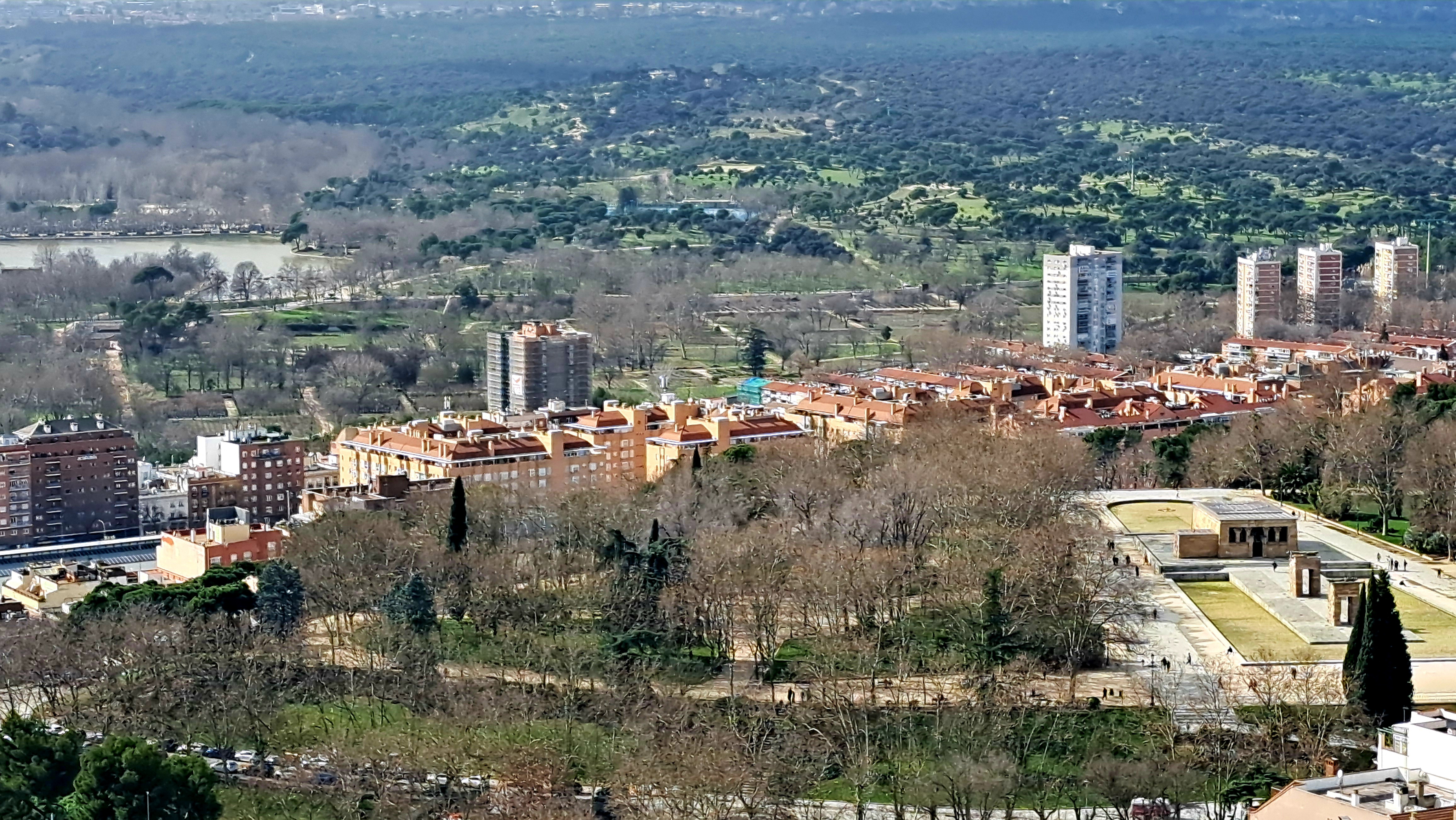
View of Casa de Campo from a central rooftop bar.

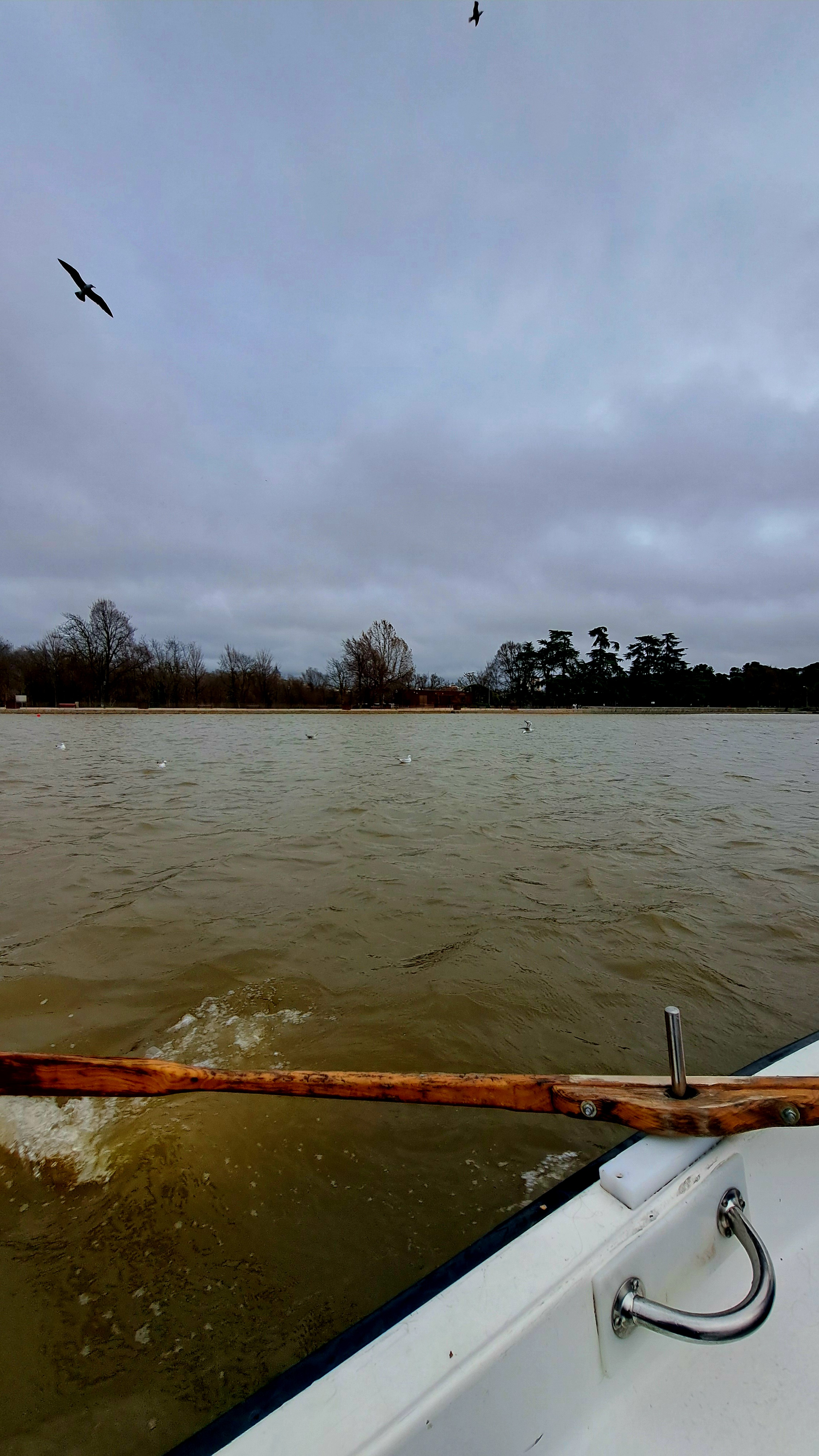
I was smitten with Casa de Campo, once a 16th century royal hunting estate and – for the past hundred years – a public park outside the city centre which is about 5 times the size of New York’s Central Park. A large man-made lake forms one of the focal points, surrounded by numerous eateries. H and I chose one and spent a nice couple of hours sat on a table by the window that the slightly abrupt waitress had seemed reluctant to let us have, and after warming ourselves up on coffees decided to see if we could hire out one of the rowing boats we saw parked up on the water. The advantage of it being wet and windy meant that there was nobody else using them. This not only meant that we had the entire lake to ourselves, giving us the freedom to roam wherever we wanted, but more importantly, it limited the opportunities for us to crash.

The cold, choppy waters and my inability to operate a boat took me back to my sailing days at Seasalter. Eventually, H hinted at her frustration with my rowing skills by stating that it “might be nice to see a different part of the lake”. I’m not sure what her problem was. We’d only been spinning around by the boundary buoys for about 15 minutes, but if we were to have any chance of returning the boat within the allotted time then we would need to rely on what H could remember from her rowing classes. In the end we were about 20 minutes late returning the boat, but nobody cared. Do the same thing in Hyde Park and you’ll probably be charged for an additional session or sent an intimidating letter in the post, complete with grainy time-stamped CCTV image of you haplessly buggering about with an oar.
“They don’t really care about time here”, H advised me, and she was right. My watch was a bit redundant for those few days in Madrid, and that felt nice.

The “mercados” – indoor markets – were another highlight. H‘s local in La Latina was Mercado de la Cebada. I had browsed some of the more touristy ones in the city centre during my last visit, but ones like this felt that little bit more real. There was – of course – the encapsulating smell of fish upon entry, but it was overcome by the sense of sight: the rainbow of fruit and vegetables on display, including the biggest tomatoes I’ve ever seen. Can’t get those at Tesco in Faversham.

A man whose stall consisted of piles of chocolate-coated nuts and dried fruits called us over and offered us some free samples. He spoke a bit of English, and seemed to be proud (as he should be) of being able to name the items he was selling:

“This one chocolate covered sunflower seed. This one: coconut. This one: strawberry. And here: papaya”

Papaya.

He’d said it.

For some reason, I only mentally tap in to my fondness of papaya when I’m in Spain. I hadn’t really thought about papaya for four years, when the same excitement – again in a Madrid mercado – had prompted me to pay way over the odds for a giant papaya that I didn’t even manage to eat most of (sore topic. I’ll leave it there). But here I was again, the terrific tropical goodness being flaunted in front of me. I immediately advised the seller that I would like to purchase a selection of his goods. At 12 Euros a bag, I felt the price pretty steep for some fruit and nuts but – papaya.

“I’ll take a bit of everything, but I especially like papaya please.”

He speedily bagged up a range of items and priced it all up. It was a little over the set weight, but never mind, because papaya.

Except he hadn’t included any.

“What about the papaya?”, I asked sadly after looking in the bag, like a scene from a modern-day Oliver Twist.

“No papaya. You want papaya? I charge more.”

Sometimes you just have to accept defeat and move on.

But I have to say, the rest of it was completely delicious, and I was still pleased to have made the purchase overall. Lasted me until my journey home and beyond.
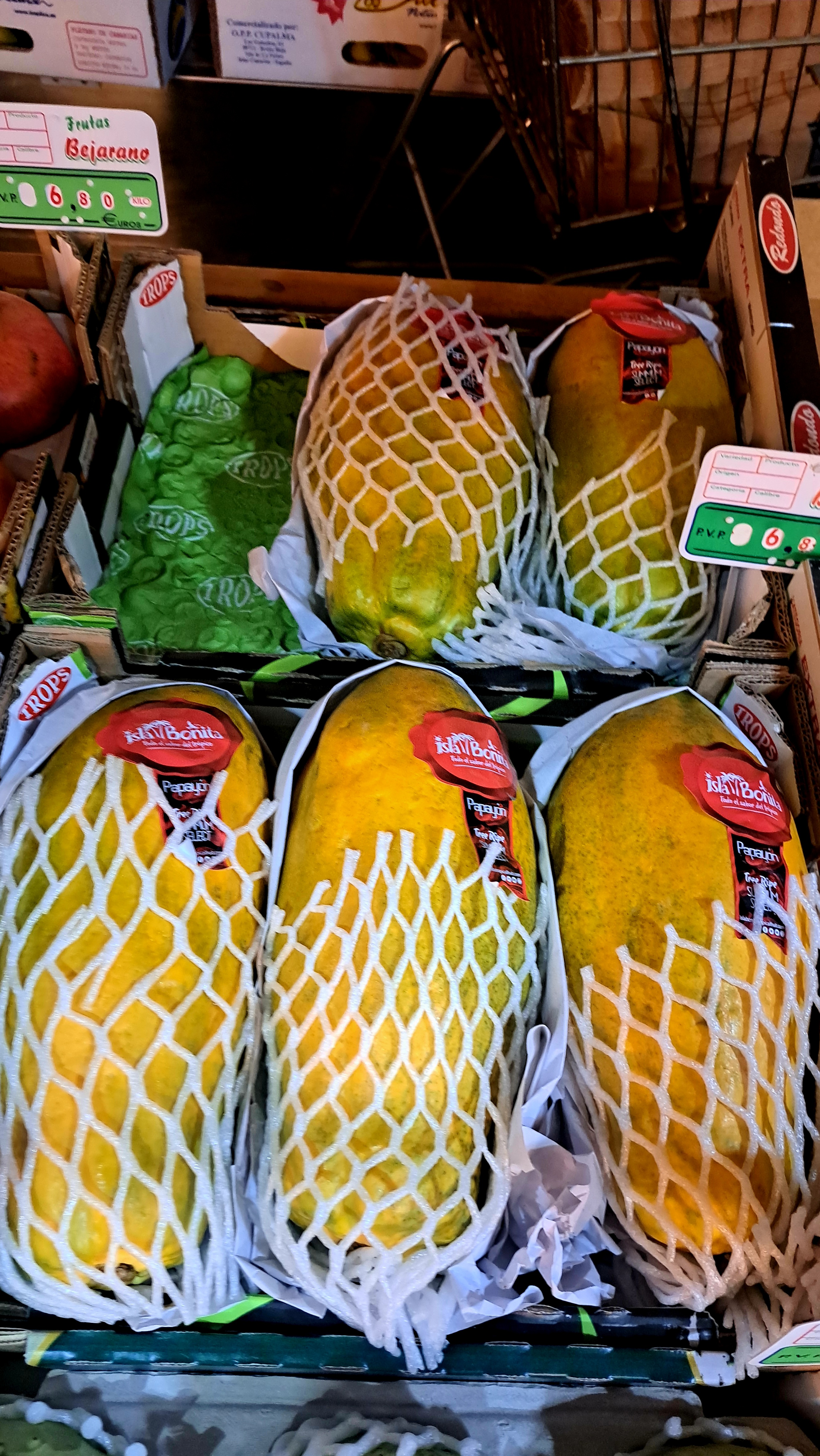
A papaya similar to the one I purchased in 2022, which went to waste.

The wonderful thing about the rest of the time in Madrid was that were no set plans. Pretty convenient, in a place where time doesn’t seem to be a thing. I adored being able to take my time breathing in the back streets: the cute cafes, the crafts and the inviting tapas bars that are ready to welcome you with a plate of local, mouth-watering jamón.

A place that made me realise, I actually do quite like shakshuka (although a home-cooked attempt a week later was nowhere near as nice). The video game bar where just the addition of cigarette smoke could have made one feel like they’d travelled back to the halcyon days of the 1990’s. The juicy green olives and peanut mix served with drinks. The world’s biggest Zara, where I bought some lovely beige trousers because – you know, I’m forty now. Even the Venezualan restaurant which H – bless her – had been incredibly excited to show me but at which I experienced an unfortunate case of food poisoning (the tequeños were still worth it).

I don’t always believe in visiting a place twice when there is so much of the world to see and – were it not for H – I’m not sure I’d have gone back to Madrid. But once you take the time to go beyond the crowds and tourist hotspots, and really get into the veins of a place, it takes a hold of you a little bit. Some places just know how to clutch at your heart and awaken your senses, even if all you’re doing is exploring their hidden sides. The bits that don’t make the guidebooks or TikTok.

I’ll definitely return.

But I’m not going to try and buy papaya again.

S-PEAKING WITH A MOUNTAIN

There is a particularly famous Chinese proverb which we are probably all familiar with:

“A journey of a thousand miles begins with a single step.”

We can probably all see it right now, written in a swooshy font, pasted over a picture of a mountain range or the sole of a battered old hiking boot stepping off into a sunset, and posted somewhere within our social media newsfeeds. It’s arguably so over saturated a quote, that the impact has probably been diluted over the years. Yet, as I stood at the foot of Moel Siabod – the tenth highest mountain in Snowdonia – looking up in slight dismay at the height of the summit I was aiming for, that very same proverb was one of the first things to spring to mind, and it set me on my way. Albeit quite gingerly at first.

I was walking the mountain alone, a context which I knew wasn’t ideal but which was also a driver behind the determination to do it. I had been debating with myself for a while and the internal dialogue had gone something like this:

“Could I do it?”
“…Maybe it’s safer not to. Go for a coffee and do some writing, instead!”
“Okay then, I’ll do the mountain.”

(Writing and coffee almost always win, usually)

I wasn’t completely naive to the challenge and risk of doing a mountain hike alone, and carried out a fair amount of research beforehand, equipping myself with all the right safety gear for if I were to get stuck: first aid kit, plenty of extra food, an emergency whistle, bright attire to be visible to rescue services, a power pack to charge my phone, and a headtorch for if I were to get stranded into nightfall. All the gear, and definitely some idea, although it’s also fair to admit that despite this I’d still underestimated quite how challenging the walk would be. Having done Snowdon several times I thought I’d have no trouble with a smaller mountain, and that was rookie mistake number one. The height is one thing, the accessibility is something completely different. In selecting to ascend Moel Siabod via the eastern Daear Du ridge I’d chosen a route which would involve a lot more physical challenge than I was expecting. This walk required hands as well as feet, but I wouldn’t realise that until way too late. Nor did I realise that I would be the only person climbing this particular mountain that morning. The security of there being other people around had been something I’d naively banked upon, but it was an off-season weekday and I may as well have had the whole thing to myself.

I left my car in Pont Cyfyng and crossed the river, past Rhos Farm, to begin my ascent to a peak I’d been told gave way to some of the finest views of Snowdonia. I’d naturally gravitated towards choosing Moel Siabod for my solo hike. It was close to where I’d been staying in Betws-y-Coed and the route back afterwards would take me past Ty Hyll – the famous ‘Ugly House’ – which a friend had told me was great for cake. Not only that, but it was also close to Dyffryn Farm, the subject of ‘I Bought a Mountain’ and home of the incredibly inspiring Esme Kirby who I had been writing about only a couple of months earlier. Moel Siabod. Alone. It just had to be.

The first couple of hours went by without too much drama, following a steep, boggy and almost waterfall-like in parts path that ran along the left hand side of the mountain. It was strenuous at times and incredibly wet, but I could see where I needed to go at least and that was half the battle won. I kept thinking about the peanut butter and marmite bagel I had in my bag and how despite my lingering hunger I’d save it for the summit, when it would taste even better than it would on terra firma. Food – fuel in more ways than one – the prospect of it keeping me going.


I reached the Daear Du ridge in tired but high spirits. Between lashings of heavy rain and snow there had been gorgeous outbreaks of sunshine that had illuminated the landscape and were able to transform the neighbouring Llyn y Foel lake from a pit of ominous bubbling treacle to a shimmering cobalt masterpiece. Now that I was at the ridge the summit was surely within sight, and that bagel would shortly be out of its foil and exposing itself to the elements… and my mouth.

Except it wasn’t that straightforward, as I had absolutely no idea how to progress along the ridge. A clear pathway was no longer visible; replaced instead with a bunch of rocks and boulders of numerous different shapes of sizes that made it harder to see the way beyond. All I could do to navigate my way was to try and move myself ever-further in the direction of the summit, and hopefully that would work. I pulled myself up the first boulder and just knew it was going to be a long couple of hours to the summit. I knew I was in roughly the right place, but had no idea if the particular boulders I chose to climb were right. It’s fair to say I went down a few proverbial rabbit holes: routes that turned out not to be routes, dead ends, insurmountable rocks, and numerous U-turns. And these seemed to go on for ages. In blizzards of snow which only obscured my vision and froze my fingers further. I was getting tired, frustrated and hungrier.

There were several points at which I sat down and sighed, and deliberated eating my bagel early. It was during these moments that I started to think that maybe I had made a massive mistake in trying to do this alone. At times I felt completely stuck and was convinced that this wasn’t going to end well; either a sheepish (no pun intended) call to Mountain Rescue or worse, my carrion-pecked corpse being discovered weeks or months later, a half eaten bagel disintegrated into the dirt beside me. I considered recording a note on my phone for my family, to explain what had happened and how I was sorry for being so stupid to have come on this walk alone. It sounds far-fetched now; yet at the time it felt so very real. My story had a (spoiler alert) happy ending but a lot of others don’t, and for all the wonders of climbing mountains, it’s important to consider at all times just how dangerous they can be too. Rescues are carried out across Snowdonia virtually every day, and tragically, not all of them are successful.

I had three options. Either I try and go back on myself and head home, call Mountain Rescue for assistance off the ridge, or I just carry on. I knew what I wanted to do, but had to consider whether it was the safest or most responsible thing. Almost immediately, I judged that it was the best option. To go back on myself would involve a risky and steep descent back to the main path and at least two hours walking back, not to mention a feeling of disappointment and failure. To call Mountain Rescue felt a bit unnecessary just yet, and could divert them from greater emergencies elsewhere. I had to just do this. I just had to do this.

At the same time I heard the voice of society within:
“You shouldn’t have done this on your own” it said, “especially not as a woman. What were you thinking?!”
It was hard not to see the point of the imaginary voice in my head. What had I been thinking? If I’d had somebody with me, we would have been able to problem-solve together. Maybe they’d have been able to see the path I’d clearly failed to see. Maybe a big, strong man would have been able to plough on ahead to work out the route and come back to give me a lift-up and encouragement when I needed it.

Or maybe those internal voices are just a manifestation of messages that have been pushed upon soloists – especially female ones – by society for decades. And maybe I needed to shove a dummy in its mouth. In my own head, at least.

I promptly sought out the biggest rock around me and dragged myself up onto it. Then the next one. And the next. I was tired, a bit delirious, and still not sure I was going the right way, but knew that to keep on going was my only choice. Bagel or no bagel, I had to keep moving. The summit may have felt like a thousand miles away, but with every single step west, I was getting closer to it. There would – nor could – be any turning back.

Heavy winds and further snow blizzards set in. They weren’t ideal but the feet and hands I’d previously doubted weren’t failing me, mainly thanks to decent boots and gloves. I was finally progressing along the ridge that I’d thought was going to be my nemesis. Step by step. Rock by rock. One step at a time – that’s all it needed to be. In weather I couldn’t control but just needed to endure.

And then there it was. The trig point marking the summit of Moel Siabod. The finest trig point I’ve ever seen, even if I was too frozen to appreciate it fully. I had made it – I think. My head was completely spun and didn’t feel too sure of anything anymore. Until I turned round and saw the most beautiful rainbow above a snow-capped mountain range:

This may sound a self-congratulatory post, it’s not meant to be. Thousands of people climb mountains every day. Instead, it’s about some of the concepts that arose from the trek and how they can apply to many things in life, something a friend recently described beautifully as ‘symmetries of nature’.

A mountain can seem huge and daunting but when broken down into single steps, not so much.
Equally, we can’t control the weather; but we can control whether we choose to carry on throughout. A glove here; a waterproof jacket there – there are things we can do to adapt – and the heaviest of rain and greyest of skies will often lead only to the most beautiful rainbows. One of the most aesthetically pleasing presentations of the weather is only able to occur because of another that is so often maligned – how wonderful is that? A tough climb makes for an even sweeter summit.

To descend from the mountain I followed a much simpler path on the western side that led down to the village of Capel Curig, affording wonderful views of Llynau Mymbyr and Dyffryn Farm looking down on it. By this point, the cake was almost in sight, and I was feeling that I had really earned it. I was proud to have reached the summit and arguably even more so for having done it alone. Had it really been unwise to do so? I’m not so sure it was. They say there’s safety in numbers but sometimes I think that’s a bit of an illusion; maybe company would have been a distraction, maybe we’d have been so ensconced in gossip that we misplaced a foot and took a nasty tumble, maybe we would have relied on each other too much and underestimated the scale of the challenge, leaving behind the safety gear. Maybe one of us would have slipped whilst trying to give the other a leg-up. Maybe that’s a lot of maybes.

Maybe it’s not always black and white.

I’ll think about Moel Siabod forever.