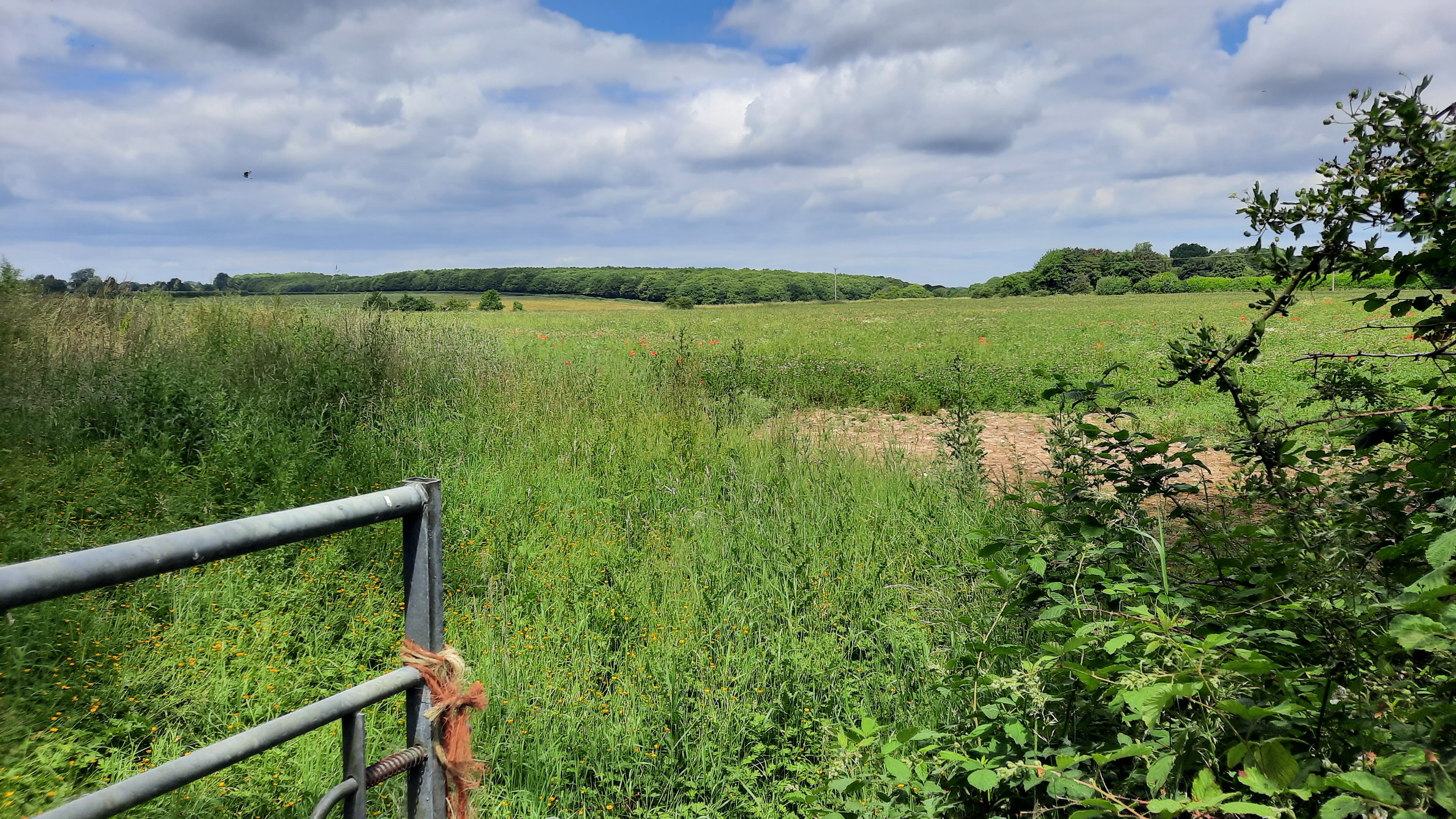
DELIGHTING IN FRENCH DE-LIGHT

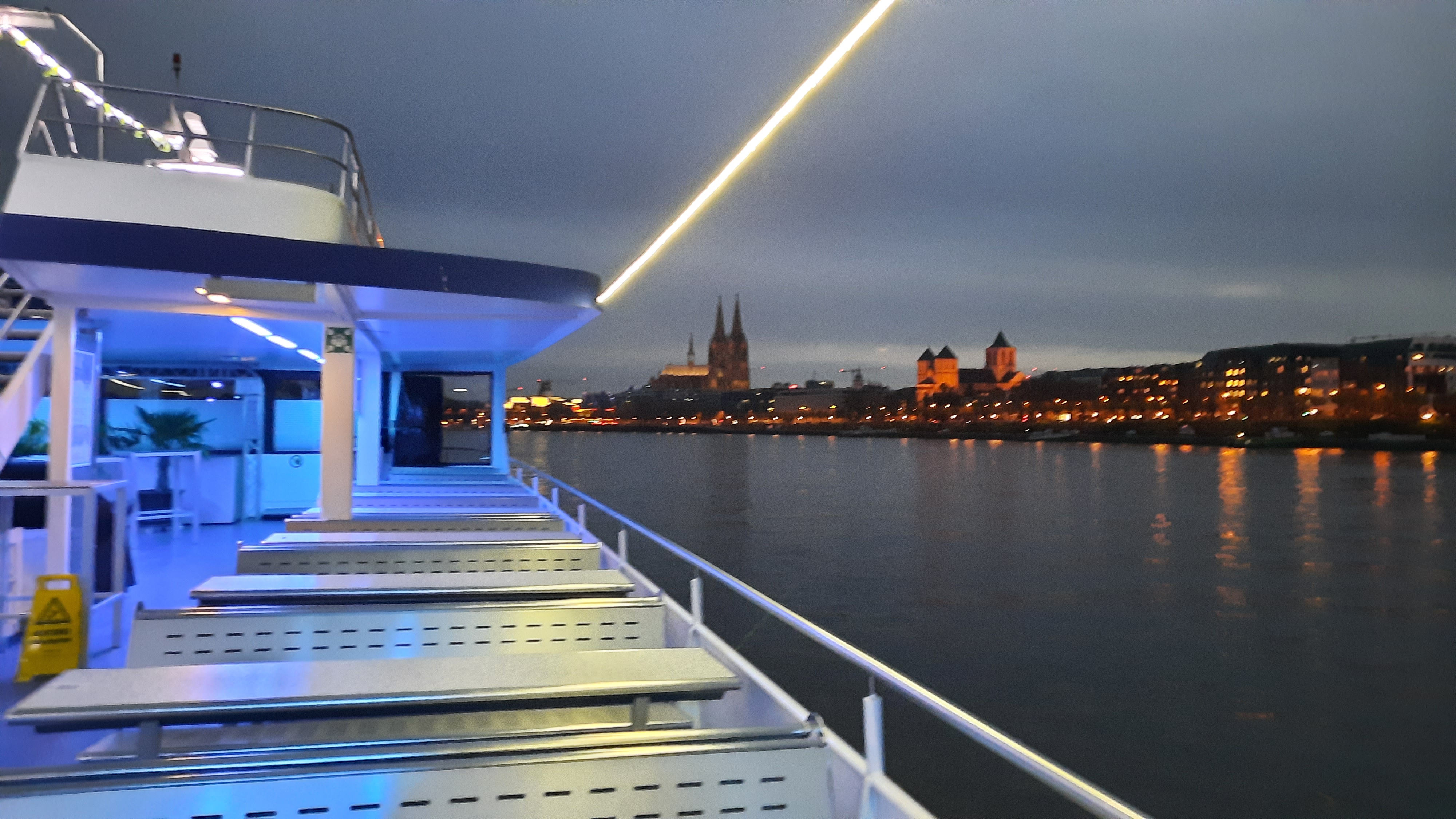
One of the most endearing experiences of natural light I’ve ever come across occurred last weekend, not far from Calais, France. A friend and I had some time to spare before catching our ferry back to England, and thought we should use the time to try and juice being abroad as much as possible, and see as much of it as we could see.

It was a Sunday, and most of France was typically shut beyond some vague signs of life at Cite Europe, a shopping estate reminiscent of a bunch of metal shipping hangars with an enormous car park where the painted arrows seem to have a mind of their own. We browsed around and found only a couple of uninspiring English-themed pubs and a Thai cafe – where we ended up ordering a quick snack from a very unobliging waitress – open.

It’s fair to say – after we finally received our food – that this experience wasn’t making us feel that we were making the most Frenchy use of France, so we took a look at Google maps and noticed an appealing streak of yellow on the coastline a twenty minute drive away. A drive there followed by a quick walk on the beach would then set us up nicely to get back to the port in time to catch our boat.

As we drove to Plage de Strouanne near the small town of Wissant, the enormous grey constructs of Cite Europe became smaller and smaller in the rearview mirror and were replaced with some of the brightest greens and blues I had seen in a while. The small village of Peuplingues that we went through en-route could have been right in the very heart of France, since it felt so far removed from the industrial environment we had been sitting in just a few minutes and kilometres earlier.

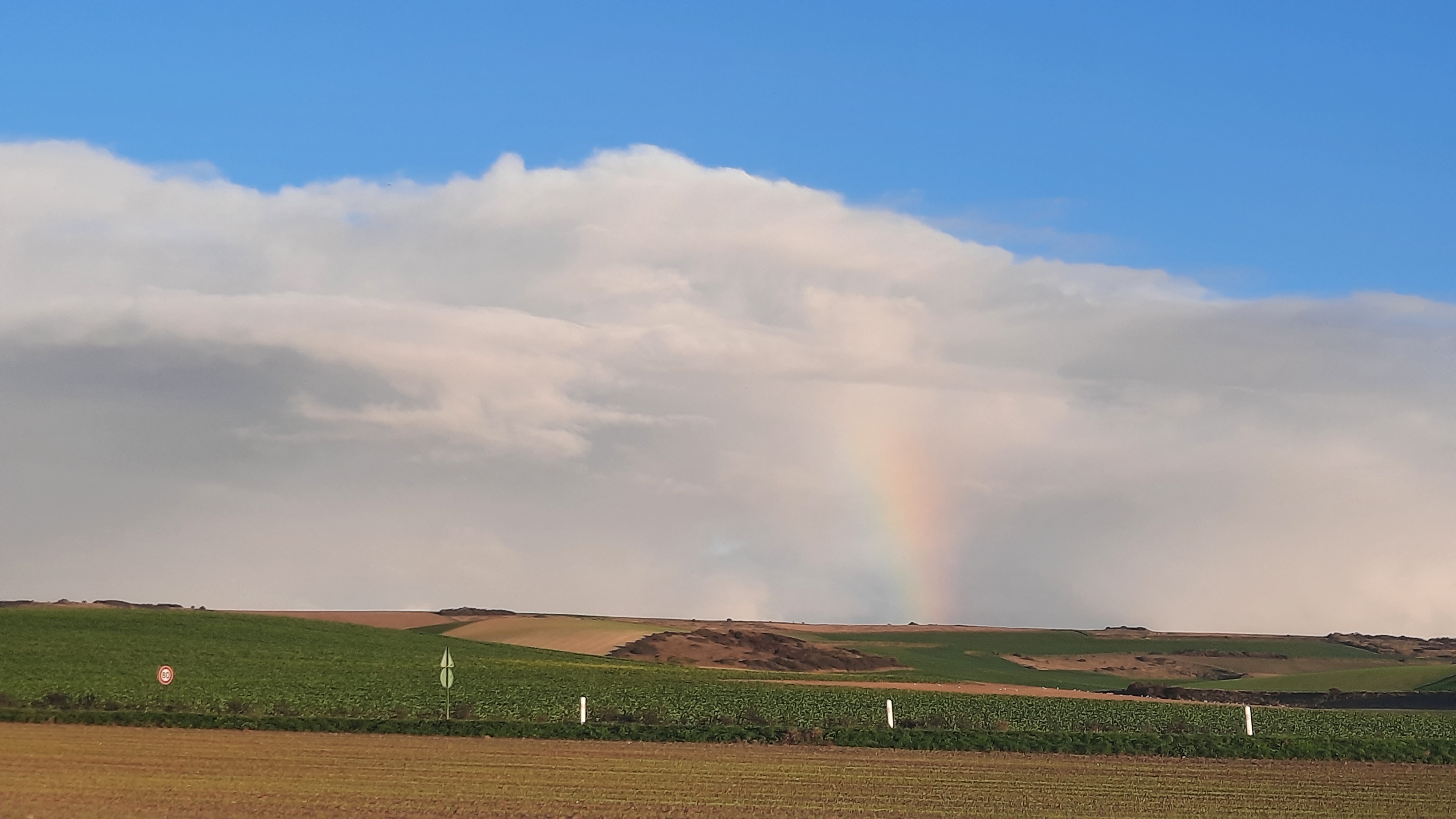
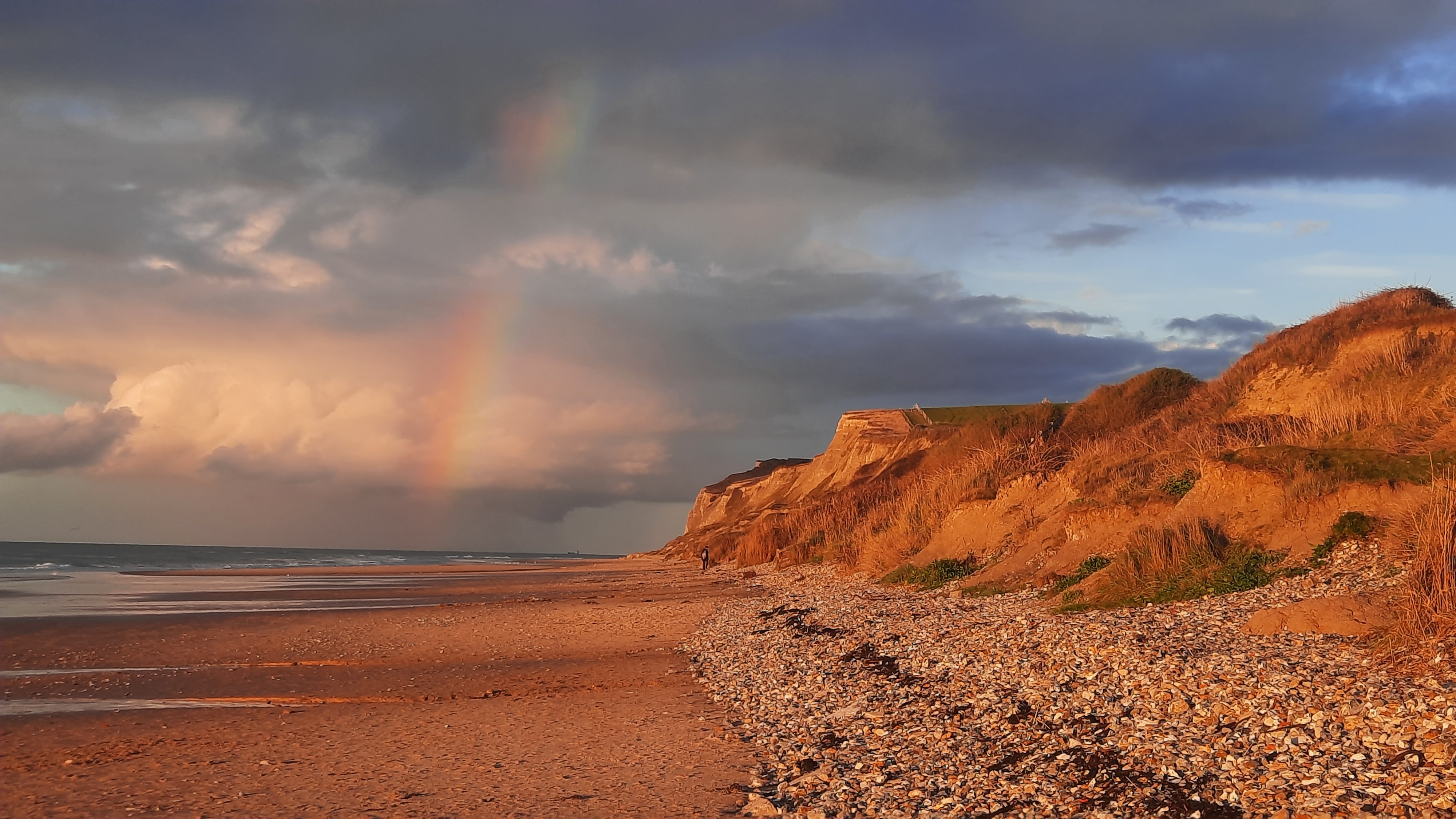
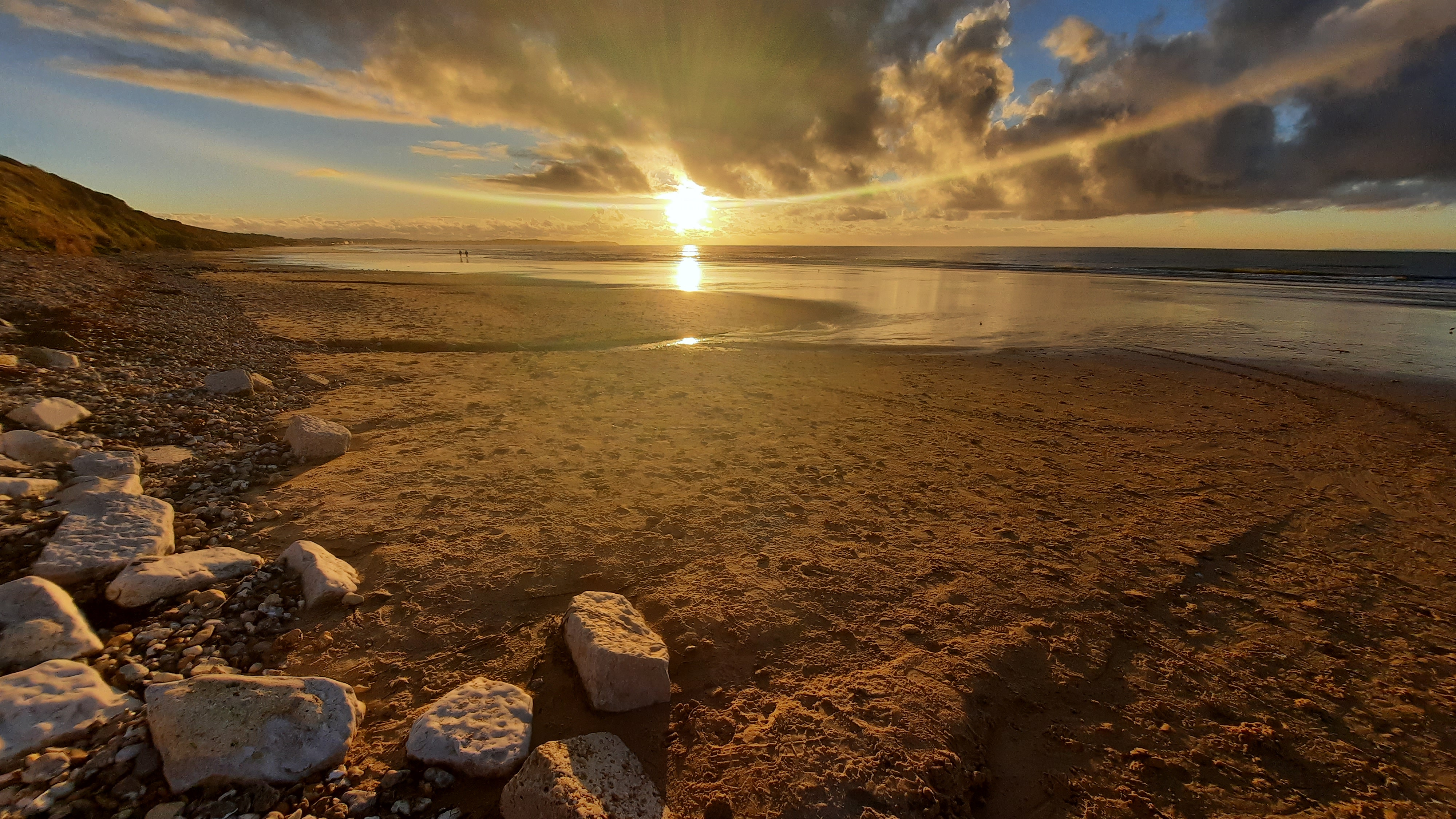
We were making our journey during that magical window of time just before the sun starts to set, a time when it seems to be saying to itself, “I know I’m about to disappear for a few hours, so let’s leave them all with a little parting gift.” The golden gloss it had lacquered across the French hills was accompanied by a rainbow that seemed to last for about twenty minutes. I’m not sure I’ve ever seen a rainbow as close to a sunset before, but it was the most perfect fusion of lighting and colour.

When we reached Plage de Strouanne we parked up and followed the footpath towards the water, eventually working our way down a steep set of sand dunes to reach the beach itself. From here the panoramics were pretty incredible, and though the photos don’t do it justice, I hope they’re enough to make you consider taking a little detour here if ever you have some time to spare before catching a ferry from Calais.

No sooner had we driven away to make our way to the port, dusk set in, the blinding lights of the A16 no patch on the natural lighting we had just experienced.

We reached the ferry port, took it in turns to seriously believe we had lost our passports evoking much panic, and then ate far too many Kinder Schoko-Bons in quick succession to heal said panic before catching the ferry home across a pitch black channel.

It had been a detour well worth making, and I was strangely thankful for the fact everything else had been closed.

Song of the Day: Siriusmo – Gummiband

Sticking with a continental theme for this month’s post I’m sharing this track from Berlin-based electronic whizz Siriusmo.

A COFFEE IN 1950’S SOUTH EAST LONDON

“Oh no, it’s no good, I can’t decide between the jacket potato or the panini…”

My attention was roused. Somebody nearby was experiencing a menu-related dilemma and I needed to hear the conclusion. What was it about the jacket potato that was creating doubt? Or, were they simply in more of a mood for bread? Were they going to opt for tuna, or cheese and beans?! I needed to know, and decided to take a pause from the various bits of life admin arithmetic I was scrolling out in my trusty green notebook so that I could listen in and find out.

It was a beautifully hot and sunny Wednesday afternoon in September and I was sat in a pondside pavilion cafe in a bustling and beautiful South London park. As much as people may malign London for being what they perceive to be a giant sprawl of dark concrete, little gems like this help to showcase how green it actually is. There’s a very good reason why it became the world’s first national park city in 2019, and as I take in the landscape around me, I’m full of appreciation for just how much brighter and emerald-like the biodiversity is when juxtaposed against the beige and greys of the ’60’s architecture on the other side of the railings. In many ways, it makes it sweeter.

I’ve plonked myself here because I full-on fancied the shade from the parasols – although – a particularly strong coffee has undone some of the remedial work and a light-headed feeling has come over me. I’m going to be here for a while, so the notebook has come out to accompany my pondside repose.

It’s hard to focus at first. On the table to my left are two screaming babies and their mothers’ ensconced in loud chat about irregular feeding times, toilet trips and somebody else’s “disastrous” engagement party. I’m somewhat relieved when they leave, because the sudden vacancy of sound amplifies the conversation to my right.

It’s this party of people, four older ladies (including the one in a quandary about what to order) who captivate my attention.

Once they have been served their lunches (with jacket potatoes prevailing, by the way), they perform grace. I’m not sure I can remember the last time I heard anybody say grace. It may not even have been within the last two decades, so this really stands out. The lady leading it pays particular homage to “our Tom, looking down and with us in spirit.”

“I really appreciated that part. Thank you so much.” says a lady in a green top and a headband who gives away her name several times during ensuing conversations, but let’s just call her ‘Dorothy’ for now. It becomes clear that she is recently widowed, and that she was very much in love with Tom.

Of the four ladies, it is Dorothy who speaks the most. There is a sense that these ladies go back a very long way, but also that there is a lot about each other they’ve still to learn. Dorothy talks at length about growing up in south east London – in Brixton to be precise – and how six people would routinely share a bed in their family home. Money was very tight back then, Dorothy explains, so much so that by the end of the week, she and her family would often be making a dinner out of bread dipped in gravy (I guiltily acknowledge my thought that this actually sounds quite appealing to me).

This part of the conversation prompts a lively discussion about today’s youth. Each of the ladies agree, that young people today “have it so much easier in comparison”. As somebody without children, who – at this point – is hearing a child in the background wailing loudly about not getting an ice-cream, I find myself inclined to agree, on the back of what I’ve just heard. But then I recall being a young person myself and hearing older generations say similar things back then, too, and they were never particularly helpful comments to hear and nor did I think they were right. In truth, I don’t think any generation has – or had it – harder than anyone else, instead I just feel that different times present different challenges.

Having said that, it’s hard not to feel a real admiration for these ladies and their experiences in life. Dorothy tells a fascinating story about how an older cousin she had growing up turned out to be her sister. The mother had been very young when she first gave birth, so her parents – Dorothy’s grandparents – brought her first child up as their own. It is hard not to notice the parallels with a particularly famous Eastenders storyline, and it is absolutely fascinating. The two ‘cousins’ grew apart over the years and only reconnected after Dorothy researched the family tree. This was the point at which the truth of the relationship surfaced, sadly long after the death of the sisters’ mother. Dorothy and her sister didn’t speak overly often, but would always send one another a Christmas card.

There is a lot of talk around family units and – in particular – the role of the patriarchy in 1950’s south-east London. A story is shared which illustrates this perfectly:

“She would prepare his suit every Friday, so that he could wear it to the social club on Saturday. She’d send her little daughter, Jackie, to the laundrette in Camberwell Green to collect it. One time when she was running this errand, little Jackie was struck by a car, and when the Police broke the news to her mum, she just replied, ‘But what about his suit?’

Another lady at the table talks about her grandparents. Nan and grandad. They never went on holiday together, because they didn’t actually like each other, but they stayed together:

“People did in those days, women were too financially dependent on their husbands to leave.”

“The husbands would sometimes leave the wives, though. My husband’s granny… her husband left her with nothing and she had to put the two boys into a home because she couldn’t afford them. People seem to think that kind of thing didn’t happen in those days, but it did. And then there were the workhouses, that’s where a lot of them ended up…”

Workhouses. A well-known characteristic of Victorian-era Britain in which those unable to support themselves financially would spend 12 hours a day carrying out the most monotonous and grueling labour, like breaking stones and crushing bones to extract the fertiliser, in exchange for a roof over their head, albeit a very cramped one with residents consisting mostly of the elderly and sick.

Though I maintain that different times present different challenges, I’m hugely relieved these things were abolished long ago.

After a fascinating fifteen minutes within this south east London time portal, the conversation shifts back to the present. They’re about to head off. They pull out their phones and share despondence that none of them have received any messages, except for Red Top, she’s had twelve, but most of those are from ‘Carol in the group chat‘. And there are some new pilates classes coming to the centre that they feel will be just as popular as the chair yoga, but it’s the impending electronic bingo machines that really excite Dorothy.

I feel so sad when they leave.

People often speak of eavesdropping like it’s a dirty thing to do. I’ll agree, there are times when it’s clearly not appropriate. But, in comparison to the talk of nappy habits and disastrous engagement parties that made my initial coffee a slightly testing experience, I know which conversation I’d prefer to overhear. I don’t think it does us any harm to sometimes sit and listen to people who we may never otherwise get to meet, to hear their stories and thoughts, to learn about different lives in different times. Different struggles, different joys.

As the ladies leave they excitedly remark about a heron on the opposite side of the algae-strewn pond:

“There he is, in his usual place!”

Thank you for letting me stay for this short and most memorable while in yours.

A SUMMER SYNESTHESIA

A hazy amber sunset
descended upon a grey, grubby town
during the late Saturday afternoon traffic.

And a polystyrene lid wheeled un-wheeling-ly into a drain.
Whilst the lady in the rearview mirror looked on in disdain.

But the green light smelt of “Go”! and of Summer and of barbeques.
Warm embraces, familiar faces…
And suddenly, there was no better place to be

Than driving through a grey, grubby town
One hazy Saturday afternoon.

Song of the Day: The Sugargliders – Ahprahran

Aussie representation of the genre of late ’80s / early ’90s jingly jangly indie more often known as ‘twee pop’. I first heard this song almost twenty years ago and loved it straight away. I’ve probably posted it a couple of times over the past dozen years or so of keeping this blog, but it’s a classic, and more people need to hear it.


BUS-PLORATIONS

A few weeks ago, we had our Summer. It was admittedly a little short-lived (though whilst large swathes of the continent are literally burning right now, maybe that’s nothing to complain about), but it was nice whilst it lasted.
One weekend, the local bus services were all running for free, and it made sense to make the most of this offer. I took a bus ‘out into the sticks’ and wandered around for hours in an area I’d otherwise only be able to get to by car, and maybe wouldn’t even have thought to go to at all.
There was something quite liberating about all of this; being able to look out the window properly during the journey there, not having to think about where to park, and not needing to worry about finding a walking-route that would get me back to my vehicle (plus the financial and environmental benefits of course!). In every way, this was a day to really feel free and explore.

There were some beautiful sights to take in. The vibrant purple hues of foxgloves flashing in otherwise eerie ancient woodland. Meadows spanning miles, peppered with the fluttering of families of Red Admirals. A freshly shorn sheep hydrating itself as it sipped from a trough. Tidy topiaries in the back gardens of homes which I’ll never get to own, but like looking at.

Eventually, taking heed from the sheep and feeling the need for some hydration myself, I went to the local village pub. Here, I was greeted with a warmth that was in-keeping with the day’s weather, and a lady telling me the tale of how her cute dog – that was sniffling around at my toes as we spoke – had been coming to terms with recently losing an eye. I then experienced another benefit of having caught the bus by being able to refresh myself with a beer whilst doing some writing in the pub’s pretty garden, before returning home.

All in all, a nice, easy little adventure for a Summer’s day, and I’m excited to do more ‘bus explorations’ in the future.

Song of the Day: Russian Red – This is Un Volcan

This is a beautiful new song by a Spanish folk singer whose real name is Lourdes Gonzalez. She’s been around for about 15 years now and has produced some incredibly emotive and listenable pieces, the kind you keep on loop and keep finding new layers to the more you listen. One of her earlier pieces, ‘My Love is Gone’, is another favourite of mine for similar reasons.

10,000 DAYS OF DIARIES

This is my collection of personal diaries, which are kept in a fire-proof box at my parents’ house. There is one for every year since 1996, and every single day’s entry has been completed in full, meaning around 10,000 days have been recorded among them. This only meant a few lines per day for the first four years, before an A5 page a day from 2000 onwards (I had no idea what to do with all that additional space to start with, but made it my mission to fill it up somehow, and once I’d started with that, didn’t want to break the sequence). I was inspired to start keeping a diary by my mum, who has religiously kept a diary for decades too.

My diary collection is one of my most valuable and precious material possessions. They are deeply personal, but I’ve often been happy to share excerpts with friends and family upon request, particularly the more historic they become! Many of their own memories are captured in there too, and often this includes things they had long forgotten about. As well as being an outlet for me each day, this is one of the diaries’ most important purposes. They ensure the preservation of special moments, special people and special things. Of course, there’s a lot of not so nice or more mundane moments stored in them too, but even those help serve perspective when reading them back.

Back in January 1999 I was incredibly upset about the fact my group of school friends had had a falling out, because there were more of us than there were members in the band Steps, and this meant not everybody could take part in the talent show performance, leading to some people feeling left out, and arguments occurring. We laugh about it now. In 2001, a classmate borrowed my felt pens but didn’t put the lids back on after using them, and the nibs dried out. I’ve deliberately selected some of the silliest examples here to help illustrate a point, but still I look back and realise how fortunate I was that things like that represented my biggest concerns. Life before mortgages and MOTs.

A couple of years later I was scribing grumbles about having to go and visit my grandparents after a night of one too many cider ‘n’ blacks. And you know how it goes; I obviously read that back too and think about how much I’d love just to have the option to visit them now. Then there are frustrating accounts of entire days being too busy playing Mario Kart or chatting on MSN to complete an application to something that I’m fairly sure I would have loved to do. Unlocking Rainbow Road and discussing plans for a night out felt way more important at the time. There were far too many daylight hours at University that were spent sleeping or eating instant noodles, and not enough trips to the Lakes. I spent a whole afternoon of my 2010 Indonesia stint ferrying around the city trying to find somewhere to access the internet just so that I could read some emails that I can’t even remember who sent them now or if I even had any at all.

In the more recent years, the contrast isn’t quite as extreme. Progressively throughout adulthood we learn a bit more about who we are, and what our values are. I stopped having entire days in front of computer games many, many years ago (though I do still shamelessly enjoy the odd bit of Mario Kart!) and though it probably would still irritate me if somebody caused my pens to dry out by neglecting to replace the lids, I doubt I’d consider it noteworthy enough to scribe into my personal history anymore. But that said, there are still things I read back on that seemed like such a big deal at the time and now seem like nothing, and it’s always so interesting to see that.

Making the most of any given day and realising not to sweat the small stuff are two of the biggest things that keeping a daily diary has taught me, and I think those are two lessons that I’m happy to re-learn over and over from every single page.

One day I hope these books will be useful to somebody else too; how that’ll happen I’m not really sure, but even if they just give some descendants something to read for a bit and laugh over then I guess that’ll be something.

Song of the Day: Yamar – Dry Bread

A nice, Summery toe-tapper of a tune with Caribbean infusions.

https://www.youtube.com/watch?v=bx9P5lW2c5M

FIVE THINGS I LOVED ABOUT MOROCCO

When I told people I was heading to Morocco, it was often responded to with words of warning:

“You’re going to have to be so careful!”
“Alone? You’re crazy!”
“Prepare to be heckled!”


With these words ringing in my ears, I touched down in the country somewhat nervously expecting to be accosted as soon as I left the airport. In reality the welcome was much less eventful. My first exchange was with a young female compatriot who was off to a yoga retreat as we tried to work out how to use the ATM, before exiting the airport and being met by taxi driver who was very polite but didn’t speak much as we drove along the coast to the riyadh where I spent my first few nights.

I am very appreciative to those who meant well by recommending I stay vigilant, and whenever you’re travelling alone – regardless of whether you’re male or female – it’s important to keep your wits about you at all times and not be too naive. But when I came away from Morocco after eight enjoyable days, the imprint it had made within was far wider ranging than the preconceptions I had gone there with.

By listing five things I loved about Morocco, I hope this will serve as a more balanced picture of what it’s like and some of the things that make it special:

1) It’s more laid back there than you think


This may vary depending what part of the country you’re in. Marrakech, as a major city, felt a bit less laid back, but along the coast there were numerous times when an efficiency of informality caught me by pleasant surprise. A classic scenario is buying coffee from one of the sellers on the beach, for example, and realising that you don’t have enough cash:

“It’s okay, just pay me tomorrow”

And the very next day, you see the same seller and they can’t even remember that you owe them cash until you point it out.

I was also impressed when it came to booking a taxi to the airport, which I did at the hotel front desk two days before departure (how very British of me). The man behind the desk asked me my room number but didn’t appear to write anything down and said that all was booked. With some doubt in my mind about whether he had actually booked one, especially since I’d paid up front, I went to the front desk the next day to confirm that a taxi was arranged.

“Room 113? It’s all confirmed” said the receptionist – a different man to the previous day – without even checking anything. The following morning I walked into the lobby and the security guard knew that I was Room 113 instantly, and that I was due to be getting a taxi, and pointed outside towards where it was there waiting for me. Turns out I never needed that receipt or confirmation email I had expected.

2) The landscape is utterly gorgeous

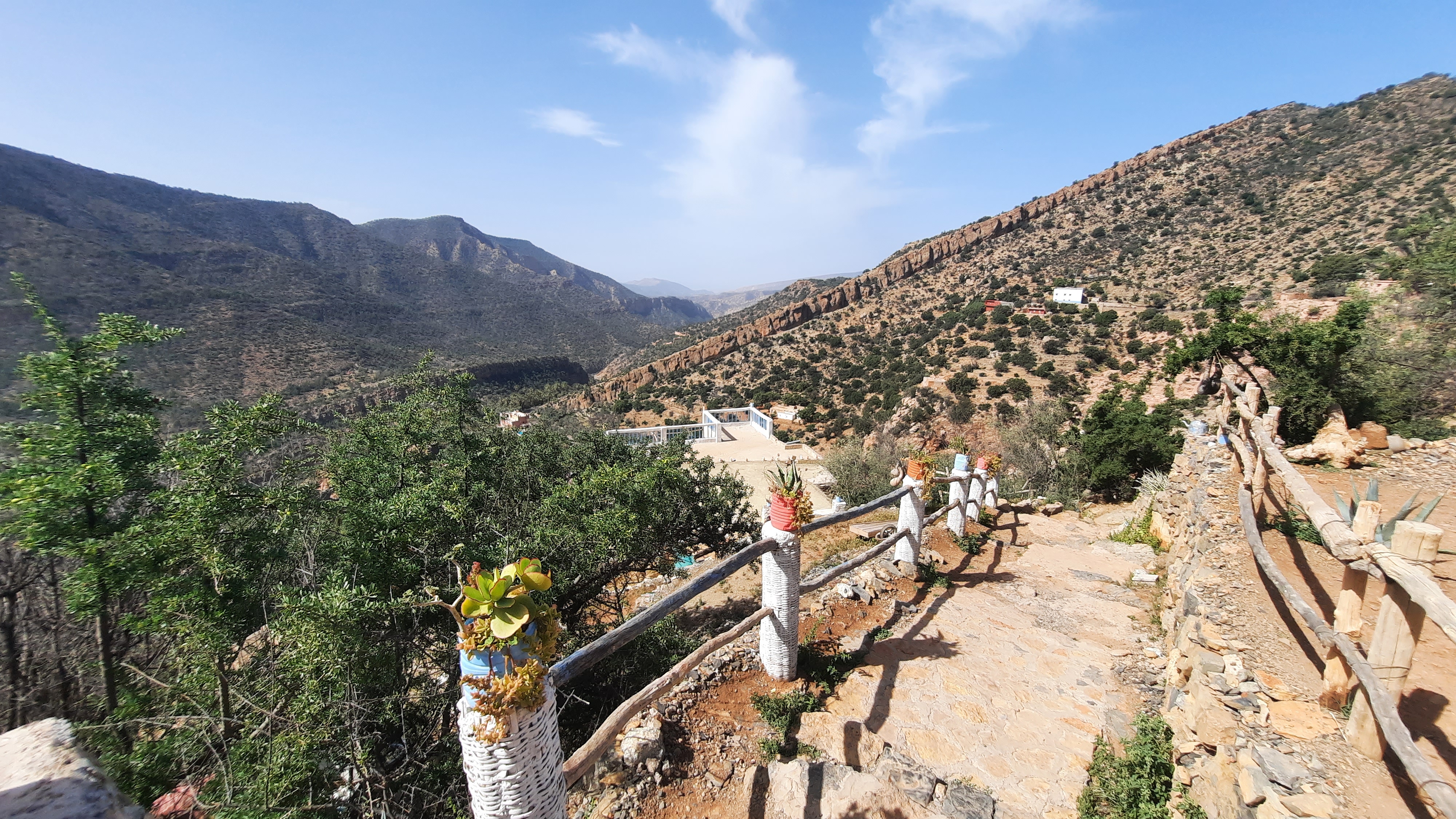
Place the images of intimidatingly bustling souks to one side and you realise that there is so much more to the geography of Morocco than instinct may suggest. Staying predominately by the coast filled me with an appreciation for the white sandy beaches and bright blue water that forms a large part of the country. Meanwhile,the bus to Marrakech afforded distant views of the snow-capped Atlas mountains, ancient honey-coloured apiaries and gaping caves. Paradise Valley, a well known tourist attraction, lived up to its title with its collection of secret waterfalls, natural pools and virid palms. Morocco is an extremely photogenic country, and there are views round every corner.

3) It is steeped in tradition

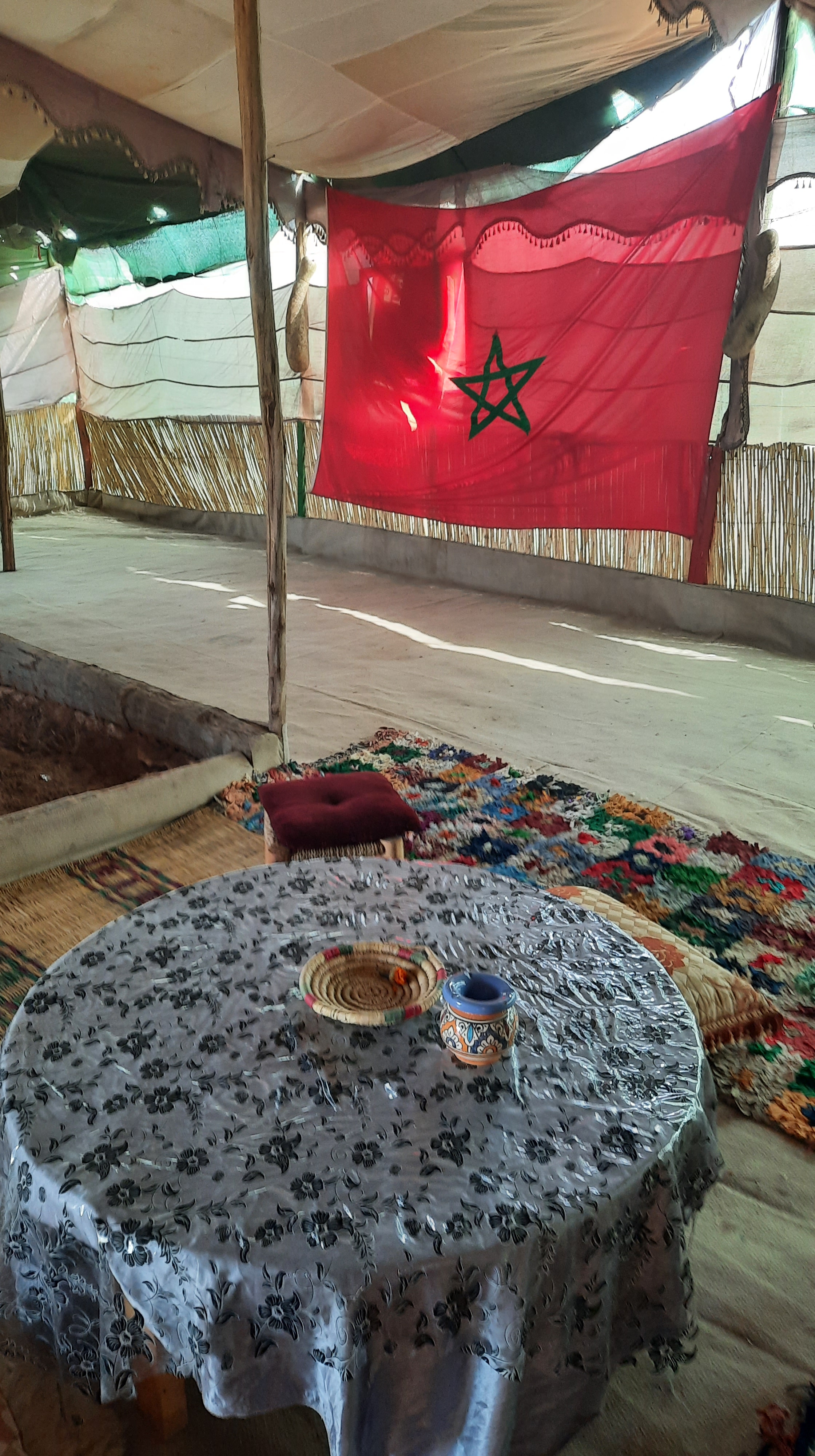
Berbers – also known as indigenous North African natives – are still living in communities across Morocco, and they have a well established reputation for being incredibly friendly and hospitable. During a quad biking activity, we took a break to head into a Berber village where they provided us with complimentary Moroccan biscuits and sweet mint tea. This is a common experience for tourists visiting Morocco, and was a lovely way to experience a culture so very different to our own, which has always got to be one of the primary purposes of travel.

4) The people are friendly

Everybody I encountered during my week away – without exception – was polite and smiled. I especially recall a taxi driver – Hassan – who drove me from Agadir bus station back to my hotel and spent the whole time talking about his wife – Sara – and their four children. With a sense of real pride, he told me all about what they were studying in school and their dreams to work overseas in time. He also spoke of his life as a taxi driver in Agadir, and how his bilingual skills have enabled him to help out many a lost tourist at the bus station over the years. These are the stories you don’t get to read in the guidebooks, but they form a large part of the Moroccan fabric.

5) The colours

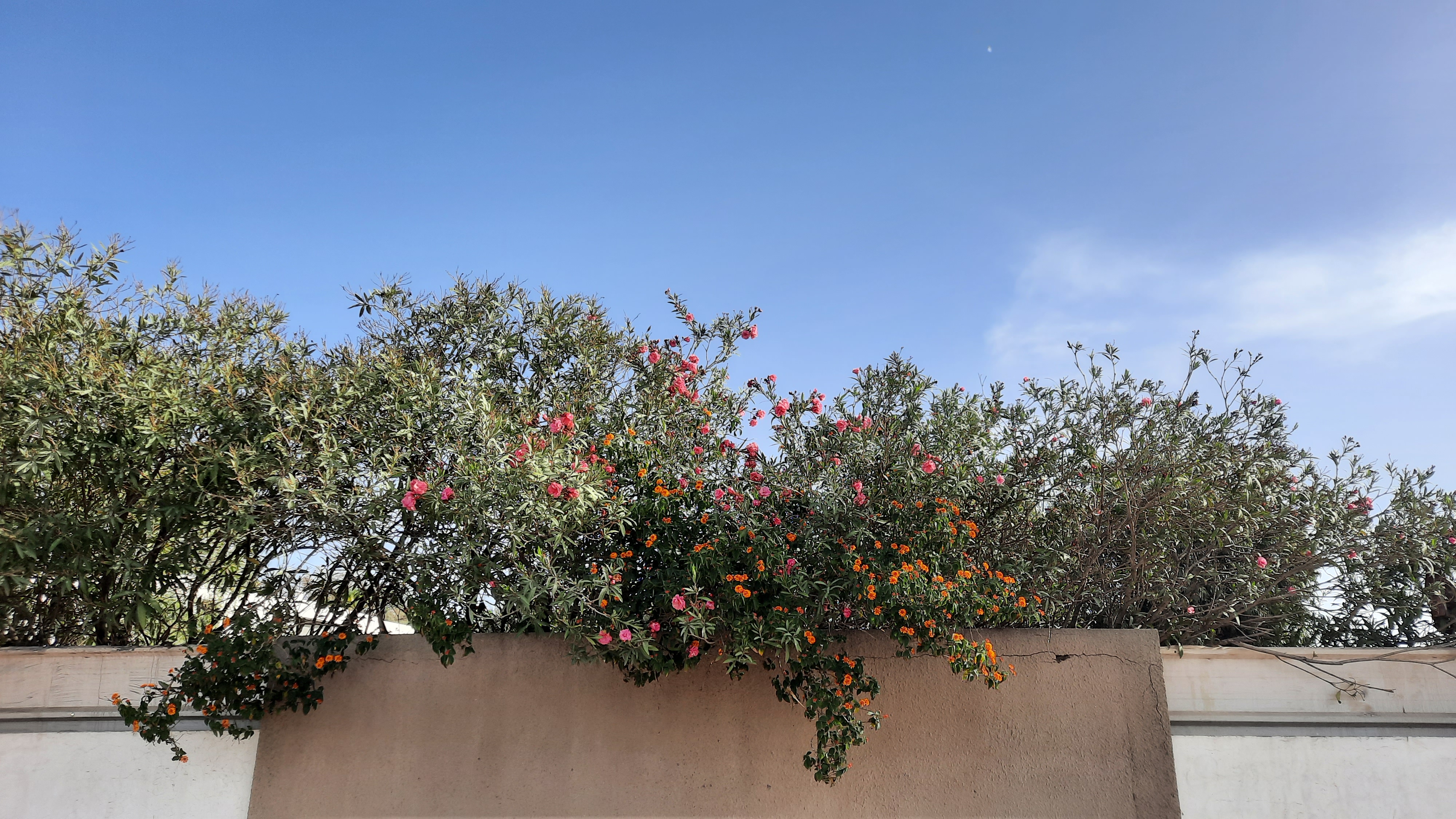
A botanical garden we visited on the way back into the city from Paradise Valley was as beautiful as you’d expect it to be, but even beyond dedicated space like this, bright floral colours could be seen all around. I was particularly struck at how they managed to breathe life and joy to the otherwise grey, concrete facade of this random, everyday wall:

There were lots of other things that I loved about Morocco that didn’t quite make the list, like the salt-cured black olives and various other foods, but I also acknowledge that in eight days I’ve barely scratched the surface of the country. Hopefully one day I’ll have an opportunity to get back out there and continue scratching.

Song of the Day: Havana Swim Club – Lagoon

“Sample based instrumental dance”. Many will recognise the sample used in this song as the theme to Desert Island Discs.
A nice piece for this time of year.

THE MYSTERY BOX

My microwave blew up the other month.

It was all very chaotic.

The turntable was smashed to smithereens, the food inside splattered everywhere and – perhaps worst of all – lunch was completely lost. A bowl of soup now fodder for the kitchen bin. Serves me right for cooking it the lazy way, I guess.

After fooling myself for about three hours that I could manage life without a microwave I succumbed to ordering a replacement, and for a somewhat halcyon period after it arrived, all seemed right and merry with the world again.

But joy eventually turned to despair when this new microwave too, started going a bit crazy. After a few weeks, it would turn on by itself and start rotating about, as though a ghostly apparition was in my kitchen heating up a big bowl of invisible ghost food. Now I may come from a family that loves to eat, but I couldn’t think of any of my dearly departed relatives who would choose to re-emerge just to use a microwave. Many of them spent their whole lives without a microwave for god’s sake.

No. The somewhat less exciting reality was that my new microwave had a known manufacturing fault and needed to be returned, but the explanation behind the plight of the microwave is not the point of this post.

The point of this post is to showcase examples of the hidden impacts from what can sometimes seem like trivial, insignificant things.

To cut out a long and really boring bit of detail, I needed to post my microwave off within the next few hours to be able to get my refund, as I was only a couple of days from the end of the Return period. Taking it to the Post Office was no problem, but securely packaging it was. In all the joy and merriment of receiving my new microwave, and to save space in my flat, I’d thrown away the original box, which just so happened to be absolutely massive and tricky to replace.

I visited a number of shops to try and buy a replacement box so that I could hurriedly ship Micky M II back to Amazon in time, but nowhere sold ones anywhere large enough. I went to almost every shop in town to see if they had any boxes they wanted to shift, but it seemed I was out of luck.

A supermarket on the outskirts of town was my final hope and by that point, I had explained my request so many times that I was spluttering out my words with the same complete lack of panache as a faulty microwave launching lunch all over its insides.

“Hi, errere bleurghy bleh looking microwave box” – or so I’m sure it sounded.

The gem of a lady on the Customer Service desk politely endured my incoherence and disappeared for what seemed like quite a long time. She returned with a massive cardboard box that to my delight, was not only the size I was after but had also once been a receptacle for packs of Roast Beef Monster Munch. She explained that it had taken a while because she had needed to shelve its contents first.

After offering my profuse thanks, I took my box to the Post Office and had a long date with some sellotape and bubble wrap before posting my faulty item off forever.

Though it may sound extreme, I’m fairly convinced that by going out of her way to help somebody who wasn’t even a customer in supplying a surplus to requirements box, this lady saved me £80. There was no way I was going to be able to get the item sent off in time if not. So whilst she may have felt she was providing me with something of very little meaning or value, the hidden context – that she wasn’t aware of – meant that actually, she really was.

It made me think more generally about acts of kindness and how what may seem like small gestures can have a massive meaning and impact that we won’t necessarily ever get to know about. I am (fortunately) not £80 away from being bankrupt, but what if I had been? In these challenging economic times, it’s clearly not an amount people can just throw away.

In the town I live we have a thriving freecycling and sharing community where people give items they no longer need or want to people who do. It’s a wonderful initiative that is becoming country-wide and I’d love to see the impacts of the exchanges looked at in further detail, and hear the stories behind them. A top that no longer fits one person that may make another feel like a million dollars. An old karaoke set that was taking up space in somebody’s lounge and then brought a surprise form of entertainment to another family’s Saturday night. Functional stuff like food or USB cables that made somebody else’s day that little bit easier.

What might be of little value or seem a small gesture to some, can have massive meaning for somebody else.

Sometimes what’s in the box is much more than meets the eye. A true mystery box.

Song of the Day: Tears for Fears – My Girls (cover of Animal Collective)

The experimental music of 21st century US act Animal Collective may not to be to everybody’s taste (though it definitely is mine). But then how better to make a tune appeal to the masses than by drafting in a well loved ’80’s pop band to make a cover of it that sounds akin to something that would manage to get everyone – without exception – on the dancefloor. This cover sounds exactly how you might anticipate it would and it’s awesome.

MUN-YAY-NITY

Whilst idly scrolling through Insta recently I came across the above sentiment, and it instantly resonated.

That same morning I’d found myself getting way more excited than is probably normal about the delivery of an Amazon package containing a grout reviver pen (though I would still challenge anyone unconvinced by this to buy one and see for themselves their power to transform the bathroom…), and then about eating a hot-cross bun with some nice blueberry jam I’d recently bought.

I realised at this point – and not for the first time – that I’m probably pretty boring. But the nice thing about getting to your late thirties and being a bit boring is that you don’t really care whether you are or not.

It’s a bit like that moment during the nights out of yesteryear when you would finally get to take off an uncomfortable pair of heels after teetering around awkwardly all evening, and put on a pair of trainers instead. How much more comfortable you would feel from the change of footwear more than compensated for any loss to presentation that may have ensued. When we shift focus from the big and exciting stuff we notice the magic in all of the things in between, and often feel way more comfortable for having done so.

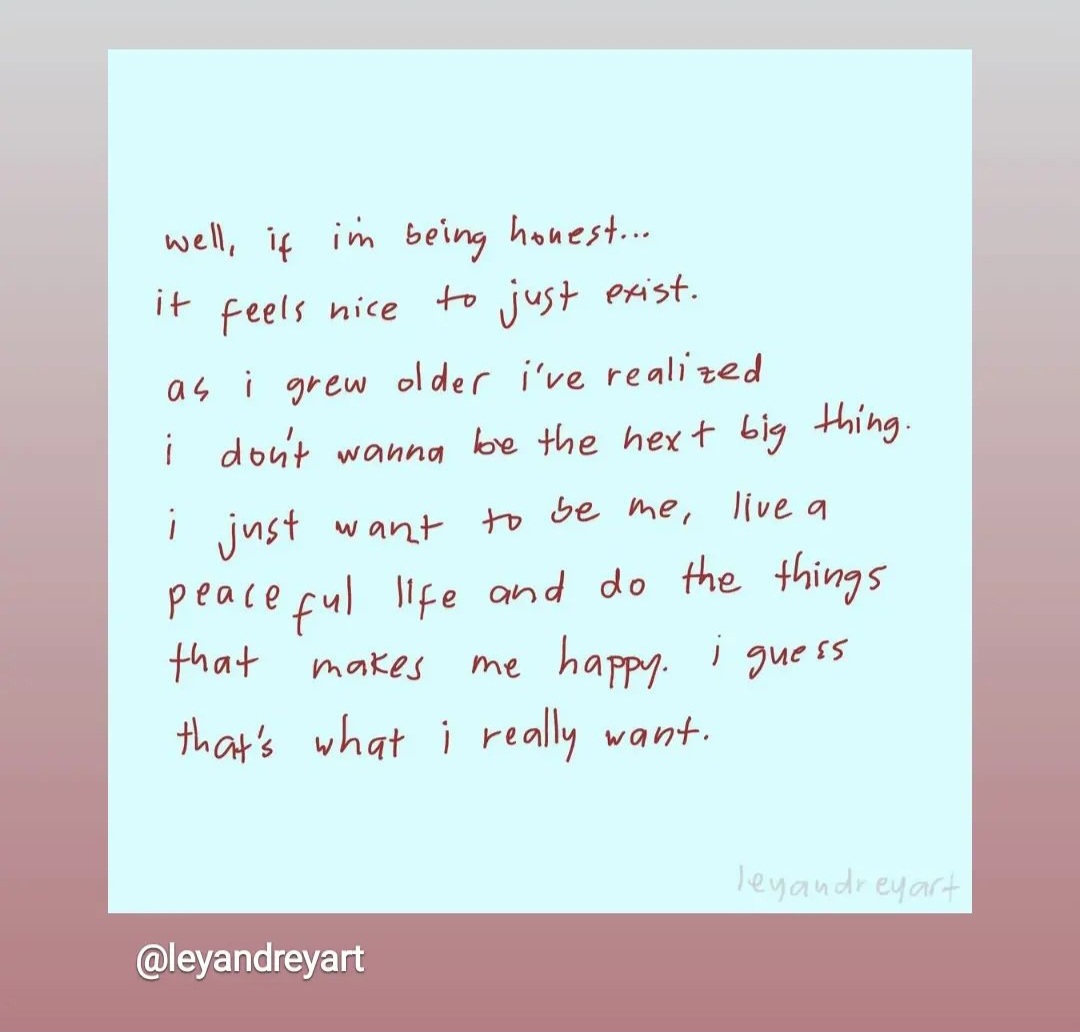
Life is short. This club does permit trainers. Do what makes you happy.

Now, I’m off to continue grouting the bathroom tiles and marveling at the difference a simple little stick of grey paint can make. Mun-yay-nity 🙂

Song of the Day: La Strada – Mean That Much

A song that just sounds like March. Maybe it should be called Mean that March. Ho ho.

THE TALKING TATE

I’m not usually one for an art gallery. If you were to plonk me in a random city and ask me to pick from a list of local attractions, I’d prioritise: a) anything that involves moving on water, b) anything that involves interesting food, or c) anything that will make my ears happy and my legs want to dance. I don’t think you can usually do any of these things in an art gallery (but if you can, please tell me about it!)

The Tate Modern is one of the UK’s most famous art galleries and I have been twice throughout my entire life. Once with a couple of friends (all I have is a fleeting memory of something we were chatting about as we descended an escalator), and once when I needed to quickly make use of the facilities whilst drinking from the pop-up places on the South Bank. I have often heard and read about how wonderful this place is supposed to be, yet I’ve probably never really embraced it properly. I love the concept of art, but mostly as written or musical forms as opposed to static ones. When it comes to the prospect of art galleries, I just don’t always get them.

On a recent day off work, I was in London with some time to spare and thought I should try and broaden my horizons by making a proper visit – alone – without the distraction of catch-up chats with friends going on in parallel, and with the time to move around on my own terms. To read what I wanted to read. To pass by what I wanted to pass by.

I ended up covering every square meter of the Tate within about 50 minutes (the recommended visiting time is 3-4 hours). I guess I just don’t have the sort of brain which is always receptive to what I’m sure are genius feats of creativity. During my trip, I was confronted by: some fluffy drapes hanging from the ceiling in the entrance hall that resembled something from the dodgy Ghost Train at Cassiobury Park funfair in the 1990’s, Cezanne’s paintings of a few discoloured apples that looked like something from a yellow-sticker haul, and a picture frame sculpted into the wall that just looked like somebody made a mistake with a chisel then tried to make it look intentional by completing the rectangle shape. Each of these things are no doubt way better than any ‘art’ I could produce and I mean no disrespect to the artists, but they just didn’t make me feel anything at all.

But, there were a few exhibits which really did make me stop, stare and think. Tracey Moffatt’s ‘Up in the Sky’ collection of photographs designed to capture indigenous and non-indigenous lives intertwined in a deprived town in the Australian outback, Martha Rosler’s representations of American airports as channels of the human body and transience of life, then this one, Cildo Meirele’s ‘Babel 2001‘:

It’s a tower comprising of 800 vintage radio sets ranging from the oldest at the bottom, to more modern ones at the top. They are all playing at the same time; different frequencies, at only slightly different volumes. “No two experiences of this work are ever the same”, reads one of the only exhibit descriptions I have ever been interested enough to read in full.
And that’s entirely the point of it. Meireles’ exhibit aims to remind us that as soon once we reach information overload, communication fails. Read one hundred random facts and you’ll maybe remember ten percent of them. Read three and you’ll probably remember one hundred percent.

Out of 800 radio sets that were all playing at once; I could only really recognise one song, an ’80’s number I never remember the name of. There were dozens of voices, but I couldn’t make out what any of them saying. A friend of mine went to the same exhibit a few days later and heard something else entirely. I found the whole thing incredibly clever, and very powerful. When one person speaks you’ll hear every word but when everybody is doing so at once, in different frequencies but similar volumes, nobody really gets heard, and that’s a shame.

We live in an age where technology has advanced so much, even since 2001 when this work was completed. The parameters of choice have become so broad, that we’re far less likely to be hearing or seeing the same things anymore. I have previously written about the impact of the likes of Freeview and streaming services on the day to day chats we used to have about television, but it doesn’t end there. These methods of communication and entertainment are designed to make our lives better and our minds more informed but I’m not always entirely sure that they do.

The more we have of something, do we still make the most of each individual component? Do we really remember each episode we’ve watched if we’ve binge-watched several series? Each book we’ve read if we’ve almost exhausted the Library? Or each stereo we listened to if there were 800 to choose from? Does knowing that we can pretty much find out anything we want to know within minutes thanks to the internet make us really feel more intelligent as a society or does it only make us set a higher bar for ourselves? I remember sitting in front of the computer in my early ’20’s, fresh out of Uni with no idea what to do next, knowing that in the hidden corners of the internet right before me I could probably find an opportunity that would change my life or kick-off my career, but feeling slightly pressured by that same knowledge, and simply having no idea where to start looking. I think I searched for a bit of advice, only to find dozens of people sharing a billion contrasting opinions that only added to the confusion, and ended up giving up and looking up recipes for interesting curries instead.

Among the vintage radios forming Babel, I recognised the Sony stereo that accompanied my school homework and thought back to the days when you couldn’t simply skip a song you didn’t enjoy, only manually fast forward. And though something like Spotify would have seemed the stuff of dreams back then, I felt some nostalgia for the days when you’d just have to listen to a song regardless, and would often grow to like it in time. We are very lucky with what we have now but there is definitely something to be said for keeping it simple, too.

I left the Tate, bought a coffee, and spent some time thinking about what I’d just seen. I then realised what I was doing, and acknowledged taking a step closer to realising what all the fuss about art galleries is about 😉

(But seriously, if you know of an art gallery on a speed boat, that serves unusual world grub and plays Weezer as you walk around please let me know)

Song of the Day: The Shins – The Great Divide (Flipped)

This is the sort of anthemic song you feel should have been around for years, but in reality it’s only a couple of years old. It’s just lovely. That is all.

“Ooh, the blind
Collective mind of man is all they’re offering
Then you bring a breath of life out of the emptiness
Your hand in mine, oh-oh-oh (your hand in mine)

The great divide”