THE “UK’S WORST HOTEL”, A DESERVED TITLE?

I have a really strict criteria when it comes to hotels. Since they’re not cheap, when the rare opportunity arises for me to stay in one, it absolutely has to be one of two things:

A little bit quirky

OR

Have lots of terrible reviews

I know it might seem like I’ve made a typo in the latter, but I mean every word. Unless I’m travelling with friends or family – when I’ll comply with more ‘normal’ choices – I’ll always choose budget and character, over nice, but expensive and boring.

I haven’t always felt this way, but then in 2017 I needed to book into a hotel opposite the train station in Stoke on Trent, and it changed everything. Say what you will about cleanliness and quality (neither of which that hotel particularly had), but I’ve never stayed in a hotel I’ve spoken about more. I can’t even remember most of the others. My stay at the North Stafford Hotel prompted much laughter, and conjured bizarre stories and anecdotes in abundance.

It also gave birth to a dream of visiting terribly rated hotels all over the country and writing a book about them, but I never pursued that dream due to both time and financial constraints. Now, a vast number of writers and YouTubers have beaten me to it, and probably do it better than I could anyway.

But there’s always been one hotel here in Kent that’s been on my list of places to experience before I die. Maybe it would be in poor taste to name it, so let’s just say I’ve been burstin to go ever since I found out it earned the grand title of the ‘UK’s worst hotel’. For several years running. Perfect.

I finally got to tick this item off my bucket list (no, not ‘sick bucket’!) in April 2025, when a Folkestone-based friend was having some birthday drinks. I could have found a way to get home that evening if I’d tried to, but I didn’t try. At all, in fact.

It was time.

Beautiful Folkestone, a town I always enjoy visiting

After a delicious lunch on the Harbour Arm and an hour reading my book on the dreamy seafront, I finally make my way to the hotel to check-in. The automatic door opens, so already my expectations have been exceeded.

“I like your green shoes, love!”

The group of men in the lobby start laughing. Maybe I should be offended, but I’m not. I’m too excited to be fulfilling a dream, and am eager to check-in. The service is friendly, professional, and hassle-free, and this would be the case in every encounter with staff during my stay. Before heading to my room, I take a little tour of the building. It’s everything I hoped it would be. Hypnotic carpets. Worn leather seats. Yellowing ceilings. I feel like I can still smell the many B&H’s that would have been smoked in these rooms in the 1980s, and strangely, I don’t actually dislike that fact.

The whole place brings back memories of some of the best nights out in my life. Only those who attended Lancaster University before 2010 will understand it when I say this is like Morecambe’s Premier Venue – the Carleton (R.I.P) – but for those who didn’t, the Carleton was basically like this, but with stickier floors, cheesy music, and people throwing up everywhere (not always me) after one too many of the venue’s signature cocktails, named ‘stiff’uns‘. Maybe that’s what happens to this place at night, too. That’s something I’ll have to find out next time.

I head to my room and elect to take the stairs over the elevator, on account of only being on the first floor. Room 151. If this was the North Stafford Hotel – which incidentally belongs to the same chain as this one – Room 151 would probably be between rooms 312 and 543 on floor 7, but here, the numbers do seem to run in a logical order. On my floor, at least.

Room 151 is in the very regal sounding ‘C Wing‘, although some odd kerning on the signage makes it read more like ‘C WIN G’. To get to C WIN G I must walk down a very long corridor. A very long corridor.  One which I’m not sure even has an actual ending, and quite possibly doesn’t. I walk along and am enveloped by a smell that evokes memories of visiting my much missed grandmother in her care home shortly before she passed away. It’s both a comfort and a discomfort and it leads me to ruminate, but I’m quickly detracted by a piece of paper stuck to a door on which a note has been scrawled and highlighted with a blue Stabilo marker pen:

“KNOCK BEFORE ENTERING PLEASE

I make a mental note to keep my door locked, and wonder what sort of commotion has been ensuing along this very long corridor recently.

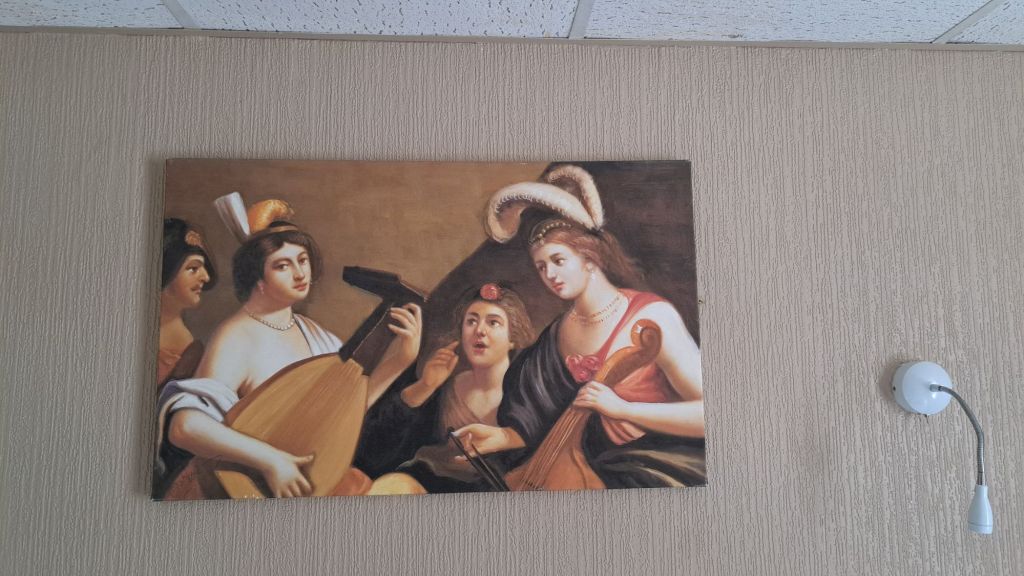
I enter my room, and am pleasantly surprised. The reviews and articles I’d read had evoked visions of walking into some sort of bog with bricks for beds and stained underwear for curtains. Instead, I walk into a light, bright space which upon first inspection seems clean and tidy, although the artwork is a little terrifying:

Lute, or weapon?

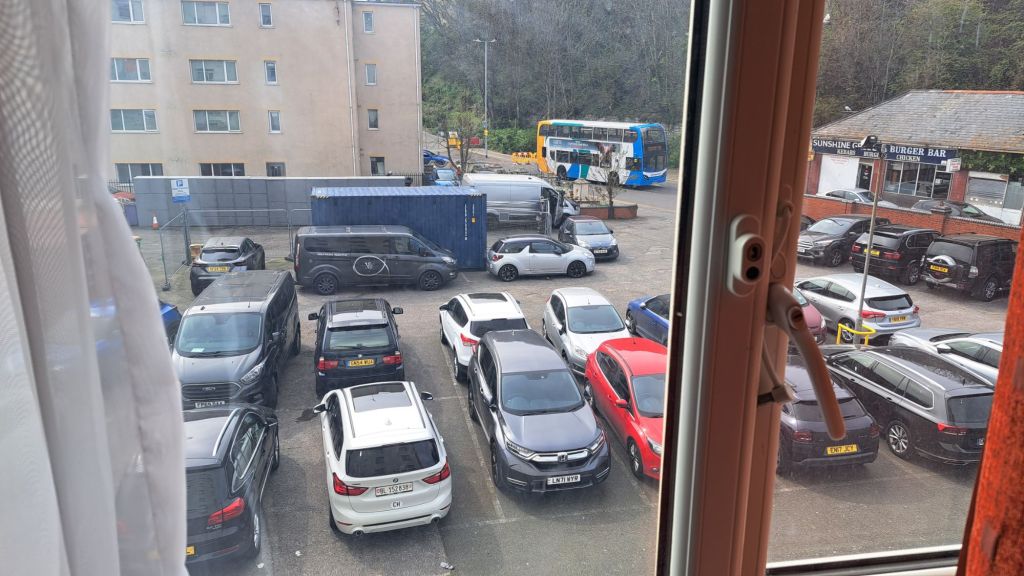
My room is – unfortunately – on the wrong side of the building for a sea view. Instead, I am proffered stunning views of the car park, and the Sunshine Bar and Grill over the road. Still, it’s better than the view of vents and discarded Styrofoam containers I had at the North Stafford. Another thing I have here, which the North Stafford didn’t offer, is a full on ironing board and iron. Just in case I fancy straightening out any creases in my luggage whilst absorbing the beautiful panoramic:

I make myself a coffee and notice what appears to be Pot Noodle dust peppered around the spout of the kettle, but it’s nothing a little wipe can’t fix.

I’d been hoping to use my time pre-party to check out the sauna, but the swimming facilities were closed due to staff sickness, so I decide to have a bath instead. It’s during this initial venture into the bathroom that I discover the previous occupant has failed to flush the loo (I wonder if they had been burstin, and just forgotten to flush in the wake of overwhelming relief), and there is no sign that there has ever been any shower gel in the shower gel receptacle. I draw a bath anyway, and become perplexed at how the bath tap seems to activate the sink tap too. Multitasking! The running water alternates between trickles and full on downpours, but we get there eventually.

Bathed up and dressed, I decide to head down to the bar area for a coffee. And to be honest, it’s all absolutely fine. It’s busy – proving that even in spite of the reputation, the hotel remains popular – and I appreciate the range of dialects I can overhear. Scottish. Irish. American. I’m proud to live in a county so attractive to tourists. It makes me feel like I’m on holiday, too.

I choose the comfiest looking piece of worn furniture and am shortly joined by a noisy group next to me, where one lady in particular is enjoying herself and appears to be a little inebriated. She starts to empty the contents of her handbag all over the table. One of the items is some lipbalm:

“Sharon’s never seen me without my Carmex, and we’ve been friends for 20 years!

She then cackles out an incredibly loud innuendo about the lipbalm that’s too filthy to put into print, and people turn to look for from whom that exclamation came from. She doesn’t care, she’s enjoying her own joke too much, and I actually quite admire the hubris. Good for her, I think to myself.

Coffee consumed, I decide to venture out in the sunshine to grab a sweet snack and test my theory that everybody always looks deadly serious when eating ice cream cones. I return a few pounds heavier, having witnessed no challenges to my hypothesis.

Back in my room, I make a phone-call, and whilst gazing ahead notice what appears to be a blob of snot affixed to the wall. Of everything I’ve experienced in this hotel so far, this is the one thing that crosses a line, and makes me physically gag. I reassure myself I’m only here for one night, and by the time I return from the party it’ll be hopefully too dark to see it. Or not. It’s pretty fudging massive, like it came out of the nostril of a hippo, or some other megafauna. It’ll probably even illuminate the room overnight with its green glow, I guess I’ll find out later.

A short while later my ‘neighbours’ arrive. I don’t see them, but I can definitely hear them:

“No, please don’t, you’ll set off the alarm. You’ll set off the alarm. YOU’LL SET OFF THE ALARM!”

“Oh, alright then, I won’t!”

Phew.

I then hear them comment on their impressions of their room. They, too, are in awe of the ironing board. They also rate the beds, and have an early start in the morning. A sheet of toilet paper dividing the rooms – like the one I found in the loo perhaps – would provide more sound insulation than the existing walls, I’m sure.

***************************************

I return from my evening out around 11.30pm and walk over a pile of crushed tortilla crisps that have integrated into the hypnotic carpet. No salsa. The bar is busy and full of life, and accents from all over the world. I love it. It feels like the entire planet has compressed itself into this little tatty cruise ship shaped building in East Kent, frozen in time since the ’80s. The nautical theme also makes it feel like the cross-channel ferries I used to take with my grandparents around the same time, watching the ashes from Nan’s fag drip down into an aluminium ashtray whilst nibbling on a Toblerone too big for my infant-sized mouth.

Back in the present, I hear only laughter, people conversing with strangers, others burstin into song, and the likes of ‘Time of my Life’ emanating from the ballroom. I see people smiling and enjoying themselves within the craziness of it all. I hear an American comment that life is not about money, but community, having fun, and eating tasty food. Last night, he ate the best prawns he’d ever had in his life. He “even took a photo.” I love him.

If this hotel is ‘bad’, then I’m not sure I really care about ‘good’.

Character over perfection, every single time. I’m burstin to tell you, that places like these are so much better than you think they’ll be, and they will almost always make you smile, and even laugh a bit. They’ll also save you a fair amount of money, so you can afford to come back again.

Now there’s an idea…

WANDERING. WONDERING. WHEREVER.

I could try, but I’m not sure I’d ever be able to put it more clearly and succinctly than Jessica Vincent in the opener to ‘The Best British Travel Writing of the 21st Century’:

“The essence of travel isn’t to move, it‘s to feel”

In my younger years, I had a very – in hindsight – generic and somewhat quite privileged view of travel. Get away from Watford! Go as far as you can go! See as much as you can see! Base the bucket list on a collection of landmarks so often read about – Niagara Falls, Angkor Wat et al – all out there to tick off like some kind of checklist from the Dorling Kindersley atlas that had fascinated me as a young child.

Yet, looking back, it was never the famous landmarks or the ‘ticking things off’ that made the biggest impressions during the more intrepid trips of my younger years. More often than not, they were impersonal experiences featuring crowds, tacky souvenirs, and overpriced ice-creams. It took me a long time to understand why these outings – though lovely and memorable in their own way – had seemed a bit underwhelming. I realised that the curated nature of these experiences – all designed to draw in and satisfy baying tourists – had led to an absence of feeling. I saw, but I didn’t really feel, to be honest, as it seemed like all the true facets of the culture I was visiting had been cloaked by consumerism. And for something to make a lasting impression, whatever it is, you need it to be authentic. That’s why nature never fails:

Over time, I’ve realised that distance – and even place – won’t necessarily determine how much of an impact a trip will have.  The only reason we think they do is because invariably when we head further away than what we’re used to, we are more likely to see many landscapes and cultures for the first time, and this evokes the same level of intrigue as when we ever experienced anything else for the first time, home or away. Consider how excitable infants get over the smallest and most mundane things when they first see them – a curtain to hide behind, the way toilet paper unwinds if you roll it along a floor, a lifelike image moving on a flat screen. We get older and these things become less exciting, and it becomes harder to find anything new in the day to day, so instead we might turn to maps and identify all the places we haven’t seen yet.

And to some degree that works, but when it comes to it, it’s never really the places that matter but the special moments they’ve conjured, as those are when you really feel things. Away from home, these moments may look like inspiring conversations with people you’ll probably never see again, the scents of local spices, getting lost at night and managing to navigate your way back to an air bnb with an awkward lock, or the heartbreaking sight of a young mother placing her wailing toddler into the doorway of a bus that sits stationery in the traffic which chokes an Asian capital. She rhythmically shakes a plastic bottle filled with uncooked rice to make her little girl ‘dance’ – although it’s really a tearful stomp – in exchange for cash from commuters who pretend not to notice that either of them are crying.

These moments affect us because they stretch our senses to places they’ve never been, and see things in a way we’ve never seen. These moments are – as Vincent describes – ‘the essence of travel’, when it’s not just our feet that our moving but most crucially our minds, too.

And when you put it this way, it’s not wrong to think that ‘traveling’ should be about going somewhere far away, but it’s also not wrong to think that you can experience it much closer to home, too. Even from your lounge. An open mind and a few dashes of curiosity is all it takes. A willingness to let those same senses be stretched, even if it’s uncomfortable at times.

To open the eyes to their fullest. To welcome in sights and sounds that may forever change the way you think. To never say never, and to keep wanting to see more in order to open up these opportunities.

Because, like Vincent says, if travel isn’t about movement but about feeling, then let’s go and feel it all, now, wherever we are.

Song of the Day: Hey Marseilles – Rio

I think this is a really beautiful song and probably one of my all time favourites. I first came across it many years ago and loved what I interpreted it to mean. Older now, I interpret the meaning in a different way – which closely aligns with the content of this month’s post – and love it even more.

THE WHEEL THING

Photo by Erik Mclean on Pexels.com

In a couple of weeks’ time, I’m going to be saying goodbye to the car I’ve been driving around in for almost eight years and saying hello to a new one. And though – on the surface of it – this is just a case of trading in one costly clump of metal, rubber and plastic for another, I think it’s going to feel a bit sad pulling up the handbrake for the final time and stepping away.

ThecarthatIalwaysintendedtonamebutneverdid and I have had a lot of adventures together over the years. It’s enabled me to get to many destinations for many different purposes, from rubbish dumps to mountain ranges, and all the places in between. It’s been privy to the worst of my language and the worst of my singing (which is also my only singing). It’s put up with my varied taste in music without casting judgement, and has never really let me down.

In recent weeks I’ve been driving a little more than usual (apologies, environment, I promise it’s just temporary) to enable some final adventures with TCTIAITNBND, and some of my favourite times to do this have been at night, when the roads are emptier. There’s something quite stimulating about it, and when you get a good long stretch of motorway it can almost feel quite meditative. No choice but to focus on the road ahead and nothing else. No phones. No emails. No aimless scrolling. Just the warming glows of blurring lights and the names of nearby destinations passing by, with the occasional illuminated views of people eating burgers in service stations overhead. You think about each of their stories – where are they heading to, and why? – and wonder what the wildest reasons are.

You are locked in the present in ways which can be hard to achieve during other activities, practicing mindfulness without even realising. It’s not always about breathing or colouring.

And when the tunes are blaring there’s the temptation to skip the junction that will take you home and just carry on driving, no particular destination in mind, and just seeing what happens. And you won’t, because you need to get back and fuel costs are still ridiculous, but you promise yourself you’ll definitely do it someday.

When’s your favourite time to drive?

WHO’S A FAN-UARY?

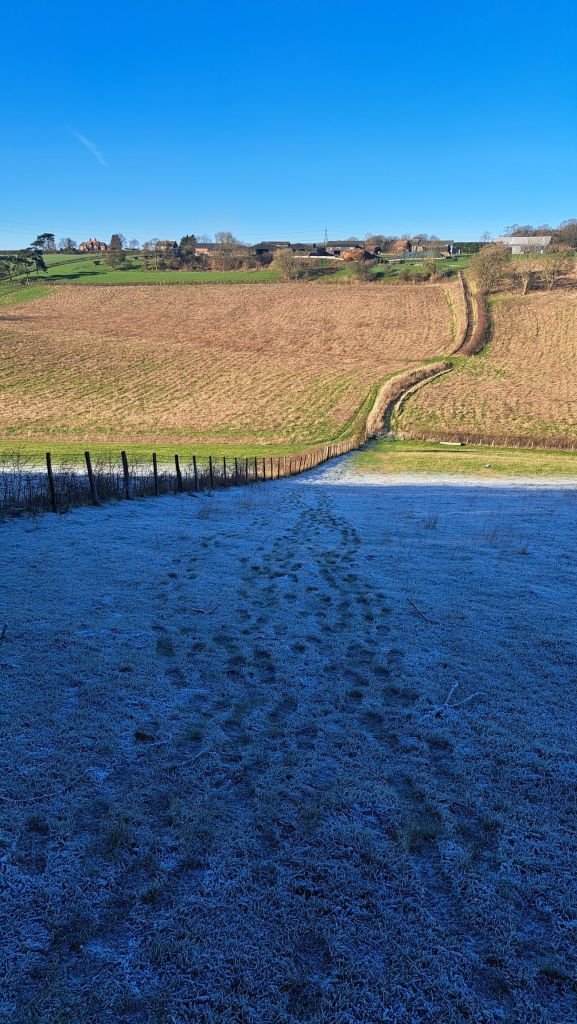
This is such a January image. And not just because it was taken in… January.

People seem to hate on this month a lot – a bit like how they hate on Wetherspoons and pigeons (see previous posts) – prematurely and unreasonably sometimes.

And yes, there’s a few things we can rightfully accuse January of doing wrong. Making us feel poor – yes. Being freezing – yes. Having to listen to people who chose to do Dry January moan about it for a month – yeees!

But put these things to one side and I think there’s a lot of nice things about January too.

Winter sun – like what appears at the top of the photo above – might just be my favourite of those things, because I think – like a lot of things – it shines brighter when it’s unexpected. During Summer we’ll moan if it’s too hot – or not warm enough – whereas in January we’re just grateful to see it at all. A welcome break from the grey, and a sign of longer days to come.

And then there’s the frost. Sure, it might be cold to the touch – a bit slippery even – but I love how it makes the fields sparkle in the mornings as they reflect the light from the sky. Maybe we didn’t get the white Christmas we wanted, but maybe we’ll get the white January we need instead. It might not be snow, but they look pretty similar. This iced hill in Kent was the nearest I’d get to mountains this winter, but it helped!

It also feels like a month where you can feel permitted to nest more. To focus on trying to keep warm and save money. To read inspiring books and make soup. Lots of soup. (How do you know you’re pushing 40? Well, you and your friends get massively excited about making different soup combinations, and a growing proportion of your phone gallery looks like bowls of steaming goodness served with bread.)

January is a month of two sides, and one of those is so wonderful it makes the other one worth enduring.

I’m a fan-uary. Are you?

WHY I’D RATHER BE IN WETHERSPOONS

If I could go back in time and tell myself that there’d come a day when one of my favourite ways to spend a Saturday morning is in Wetherspoons, there’d be two kinds of response, dependent on how far back we’d gone:

18-23 year old me: “Ahh wicked, pitcher of Blue Lagoon and some Apple Sourz to welcome the weekend innit!”

23- sometime in the mid-30’s year old me: “Well, that’s just depressing. What a waste of a Saturday.”

I’d assume I had turned into one of those people I pass spilling out of the local establishments having a pint at 9.30am and regretting my life choices. Yes, that would feel depressing if it were so. That’s still not a point I’d ever like to reach.

But that’s not the reality.

I very rarely drink alcohol in Wetherspoons, but I’m here a lot. Usually with a £1.56 refillable coffee and a notebook, and on the really special occasions if I want to treat myself: a bowl of nachos, made to a recipe that hasn’t changed in at least 20 years.

A thoughtful gift from a friend

To me, Wetherspoons is about so much more than the historic connotations with cheap drinks and sticky tables. It’s a cornerstone of the community, a national institution, a place where people from all walks of life can feel that a decent meal out is a bit more within reach than a lot of other places.

Wetherspoons is a place for everyone… except the more snooty among society perhaps. And who wants to be around people like that anyway?

It’s a place that leaves you to it. A place that doesn’t pressure you to leave as soon as you’ve finished your drink so that a new customer can occupy your seat. A place where even the backs of toilet doors will encourage you to stay for as long as you like – undisturbed – if it helps you to feel safe. And often, when I look around, I sense that a lot of the clientele come here for that quality. Like the octogenarian – we’ll just refer to him as ‘G’ – who frequents my local branch for lunch every couple of days and explains how for him, it’s a place where he can come and feel in good company compared to the loneliness he feels at home.

“It helps me feel connected here” G once shared with me, “I love to see familiar faces… there are so many people my age who come here and have so many great stories to tell about their lives. You’d never know just from looking at them just how many remarkable things they’ve done. I’ve found out all about them just by chatting here.”

G tells me his own life stories as we sit and chat. We’ve spoken a few times because our favourite tables are next to each other (by the windows, to enable the act of people watching outside). Although 80% of the dialogue is from G’s side of the script, I find him a joy to listen to, and he always thanks me for the chat as he leaves, even though I’m not really sure I’ve said that much.

A recent study found that around 30% of UK residents experience regular feelings of loneliness. Whilst Wetherspoons may not be the solution for all, it’s important to acknowledge this value when critiquing the place. As somebody who lives alone in a quiet estate and predominantly works from home, I find that an evening coffee trip (decaf by that time) to ‘Spoons is an important injection of life, people and reality after a virtual day, and can understand why many feel similar.

The chain has a lot of critics, for various reasons. One of the more common concerns is that through its cheaper prices, it takes valuable custom away from the traditional, independent British pub. This is a particularly valid concern at a time when the hospitality industry is under enormous pressure – not least from recent rises in alcohol duty – and many of our beloved ‘locals’ are pulling their final pints left, right and centre. 

However, what many often forget is that the two places are very different. The top two selling drinks at Wetherspoons aren’t even alcoholic. They’re Pepsi Max and coffee/tea. More to the point, it’s entirely possible to both support your local pub with your custom, and appreciate your local Wetherspoons. I’d usually pick my cosy local if it was something alcoholic I was after or if I was meeting a friend, but I’m not sure my local would necessarily appreciate a whole table being taken up for a couple of hours by someone who’s just after a coffee, and that’s fair enough. You can make the most of both, it doesn’t have to be a case of either or.

The food is another characteristic that often attracts criticism, whether it’s the fact that the chip count can vary (as attested by the 250k strong membership of a particular Facebook group where members share / compare / condemn counts) or that it all tastes like it’s been “made in a microwave.”

Well, so what? I mean really, so what! Quite frankly, if it’s produced in a hygienic environment, is hot, tasty and edible, then I couldn’t care less if it was prepared by a teenager monitoring a microwave or Nigella Lawson poring over her aga oven. At least you always know, no matter what branch you’re in, what you’re going to get. Wetherspoons is a complete opposite of Forrest Gump’s infamous box of chocolates, (unless you’re focusing on the chip count). There may be better quality meals available elsewhere, but the reality is that they’re a lot more expensive, and most people can’t afford this as regularly. Sometimes you just want to have a break from cooking without breaking the bank. Sometimes you just want cheap stodge.

And where do we start with the iconic buildings themselves, and their carpets? It’s a little known – but absolutely incredible no less – fact that each of the 850 Wetherspoons establishments in the UK has its own unique carpet, designed around something to do with local culture, history or heritage. Take a look the next time you go into your local ‘Spoons. I am in awe of the likes of Kit Caless, who visited hundreds, set up a website and even released a book to document them. A book I proudly own and which has taught me a lot about notable figures and history from other areas:

The book really exists, and it’s amazing

As for the buildings, you’ll often find that those now hosting the chain once served a purpose as something entirely different, and the history is usually palpable upon entry. One of my favourite Wetherspoons buildings is The Palladium in Llandudno, Wales, not least because it means I must be near Snowdonia, but just because of the general feel of the building. Before it became what it is today, it was a 1920s theatre, and as you gaze at the various boxes and balconies around you, you can almost hear the echoes of decades of historic performance. You order your scampi, chips and mushy peas thinking about how the people a few decades in front of you in the queue were ordering their ‘ices’ at the interval, and not only does it feel exciting, but it also feels like a sentimental connection to the local past.

The Opera House in Tunbridge Wells has a similar history, and the reverberations of a former art deco cinema are felt immediately as you enter The Peter Cushing in Whitstable (a branch which recently won platinum prize in the UK’s Loo of the Year awards, in what I’m certain was a ‘sparkling’ ceremony). I’m not entirely sure what my local branch, The Leading Light in Faversham, used to be, but I believe it was a carpet store, which is a little less exciting than those above perhaps, but also quite fitting when you consider the pursuits and passions of Kit Caless and Co.

Should this have piqued your interest in your own local branches, then it’s worth checking out the Wetherspoons website, which contains a lot of contextual information about each branch, including explanations for the name.

Additionally, it’s a firm belief of mine that there’s a Wetherspoons for every occasion, but to take inspiration from the menu and add some variety to this post I’ll represent this as an amateur poem as opposed to a paragraph – a small plate compared to a main – if you will:

Turning 18 with a pitcher of Purple Rain.
A bowl of nachos before catching the train.
A pre-holiday pint before boarding the plane.
A cheap breakfast whilst taking shelter from the rain.
Buying a cup of coffee, and filling it again and again…

There’s just one more characteristic about Wetherspoons I wish to praise, out of a raft of many more which I could possibly feature, and for this I’ll tell a true story:

It’s February 2020. Storm Ciara has swept up the UK and caused carnage everywhere, not least cancelling all the trains to London from Lancaster, where a friend and I have been visiting our former University haunts. We’re cold and miserable about it and have had to book an extra night’s accommodation and buy emergency underwear in Primark, as well as inform our respective works that we won’t be able to come in on Monday. Once we have accepted this fate we head to The Sir Richard Owen, which just so happens to be next to our hotel. In the spirit of student memories we order a Smirnoff Ice each and my friend tells me about a trend whereby people post their Wetherspoons table numbers on Twitter and people order food for them via the app. I struggle to believe this is true, and so she offers to try it.

Within minutes of her posting on Twitter, a side of baked beans arrives unaccompanied by anything else, sent by a mystery donor. We laugh. A lot. And then try and work out the best way to distribute them. British tapas.

It’s utterly bizarre, utterly hilarious and also utterly Wetherspoons. Which is a way in which I’d also describe the pandemonium of Summer 2024 when a bird flew into the Faversham branch and mesmerised an audience of a couple of hundred customers, who all got on board with the rescue attempt of encouraging it to fly safely back out, which it eventually did.

And really, there’s so much more I could possibly say, but I’m making myself hungry, so instead I’ll shawarmachickenwrap up this post to include a soft drink. £5.70 each. Ordered via the app.

Never, ever change, ‘Spoons.

A SMIDGEN OF APPRECIATION

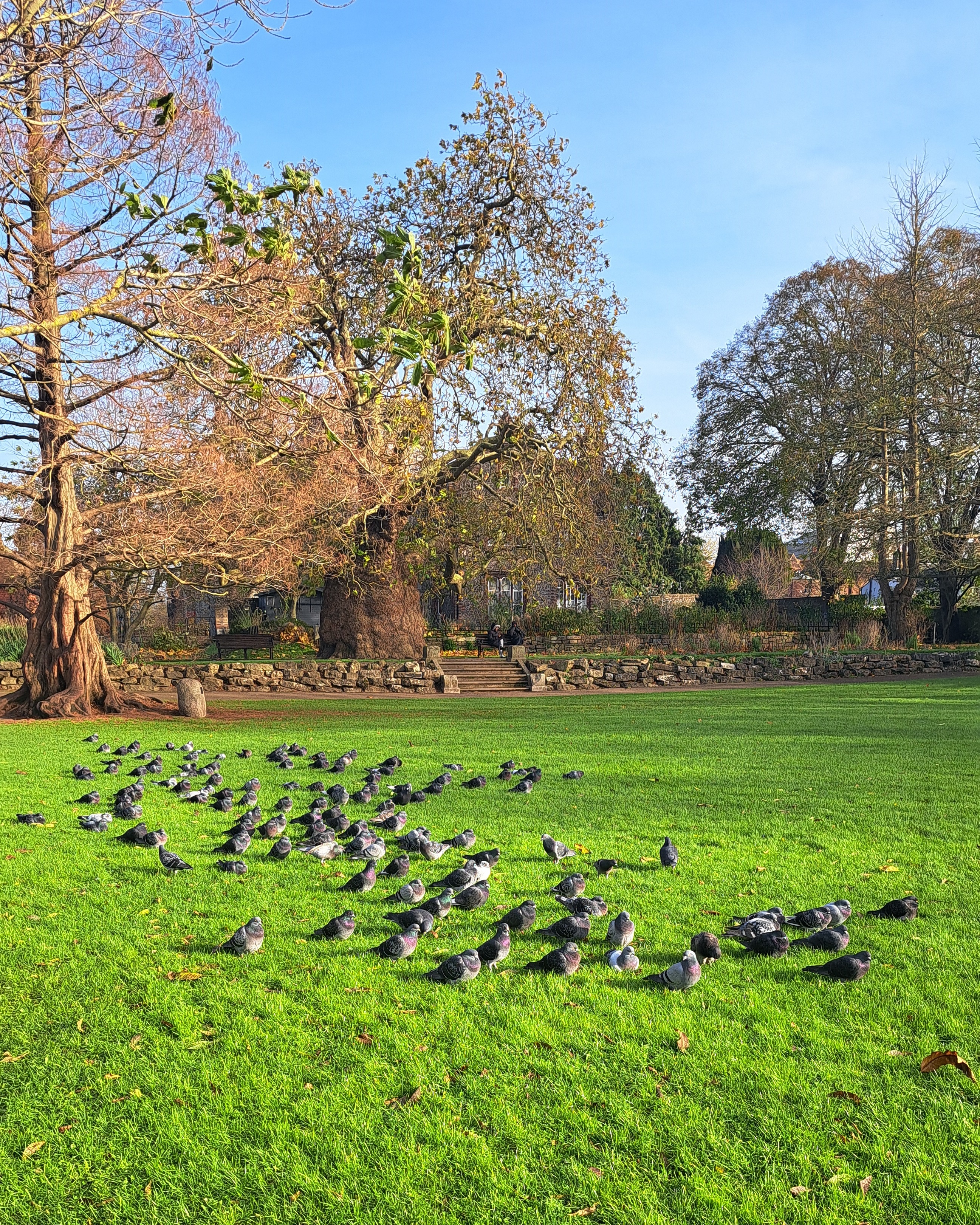
Last week, as 40 mph winds swept up the country and kept swathes of people indoors, I passed a massive flock of pigeons just sat chilling in the park, chattering away to one another whilst some of them waddled around. They seemed to be appreciating the lower numbers of humans hanging about, and had pretty much commandeered the whole place to themselves. In the context of wider chaos caused by the weather, it made me smile.

I often feel a bit sorry for pigeons. I think they get quite a hard time, through no fault of their own. That’s not to say I’m about to go picking one up for a cuddle anytime soon, but I’m more than happy to co-exist on this land with them, and don’t find them as irritating as a lot of other people do. They’re just living beings at the end of the day, and aren’t we all capable of being a bit of a nuisance at times?

Last Summer I came across a pigeon that had been badly injured and was limping around in circles on a footpath, looking really pained. It was impossible to just walk by, and I spent thirty minutes phoning around local organisations for advice, trying to reassure old pidge that help would be coming and he’d be flapping those wings again soon. Nobody was really interested, and though I can absolutely understand the concerns around the potential to carry disease, it did break my heart a little that I ended up having to walk away from something experiencing clear distress. I’ll never know what happened to my little pigeon pal, but I can pretty much guess.

So call me silly, call me soppy, call me a 39 year old woman who likes cats (which I appreciate is slightly ironic), but now, every time I see pigeons who are bumbling about aimlessly – but healthily – my heart smiles a bit. Just let them be.

Plus, with all those jazzy greens and pinks on their necks, I think they have a pretty funky fashion sense too.

TEA (OR IS IT DINNER?) WITH MARCEL IN NORTH WEST ENGLAND

The clocks went back an hour last night and the consequent earlier onset of daily darkness will be the main topic of conversation between British people for the entirety of this week. It always has been, and always will be.

It’s been less than twenty four hours and we’re already feeling it. LED strip lights rising from the ground and suddenly appearing everywhere we turn. A black velvet curtain drawing the days to an early close. Menacing orange and black paraphernalia everywhere, and the inexplicable smells on the streets of metal and smoke.

For me, this time of year often makes me think back to my time as a student at Lancaster University in north west England. I’d heard the expression, ‘It’s grim up North’ numerous times prior to making the move and was determined to see for myself if this were true or not. It definitely wasn’t. Yet whenever I think about the place, it’s usually in the context of a Winter evening, much like this one.

It’s November 2005 and I’m sat on the top floor of a double decker Stagecoach bus that smells of Wrigley’s Orbit, wee, and diesel oil. The wheels on the bus are going round and round, and the lights on the bus are making my hungover head pound and pound as they illuminate the harsh orange zig-zag seat patterns. A Sainsburys bag, fill to the brim with representatives of the Basics range (soups, garlic breads and pastas aimed to last the week), is hooked on to my wrist threatening to cut off circulation to my hand as I cling on to both the bag and the seat for dear life.

Inertia flings me towards accidentally nutting the bell each time the bus brakes. I find comfort in seeing the neon red letters that spell out BARGAIN BOOZE, because it means we’re finally at the bottom of the hill from hell in the Bowerham part of town, and the ride home should become more smooth from here. I may even be able to safely place my shopping bag on the floor before it rips from the weight of all the soup cans and sends them rolling down the aisle like the barrels hurled by Donkey Kong in the retro arcade game (yes, that did actually happen once).

I finally reach campus and step off the bus to walk to my halls of residence, but first I have to have a fag, after all that hard work clinging on to heavy shopping bags and trying to keep upright. As I puff away my student loan (the current me still hasn’t forgiven the younger one for this) I look up at half a dozen kitchen windows and see several episodes of a student drama tv series all screening at once. A couple of lads in striped polo shirts with emo hairstyles are chucking the entire contents of their food cupboards into what appears to be some sort of stir fry. The girls upstairs are dancing around in brightly coloured rara skirts and drinking out of fluorescent beakers. One of them is swapping the CD around in the stereo that sits on the windowsill. There’s another kitchen where the window is covered in a collection of handmade paper snowflakes that gets bigger with each passing day, and a couple of others where the lights are out. All the occupants are either out on the town ploughing through vodka Redbulls, or in their rooms graffiti’ing the reincarnations of forests with neon Stabilo highlighter pens.

I head up the internal stairwell towards my flat, being careful not to step in the congealed puddle of Dolmio sauce that’s been there all week following a drunken dare gone wrong. The unmistakable scents of the tomatoey residue and washing powder fill the air. As I push through the heavy fireproof doors to my flat I’m overwhelmed by even more senses. The smell of Heinz spaghetti and garlic bread being cooked away in the kitchen. The audience of Deal or No Deal gasping as the infamous 1p box is exposed on a flatmate’s tv. Another flatmate on the phone to her mum, assuring her that she’s eating well. The wisps of somebody else’s cigarette floating out from underneath their bedroom door. Somebody listening to Binary Love by The Rakes. The smell of burning garlic bread.

Shit. The smell of burning garlic bread.

The shriek of the fire alarm which ensues. The cackle of students, most of whom are half cut, trying to evacuate the building as the porters arrive to shout instruction in loud, northern tones. We shiver in the cold air of a northern Winter, watching each others’ exhales under the streetlights, whilst waiting for various risk assessments to be complete. Eventually, we’re able to file back in.

“So, what shall we have for dinner?”
“Garlic bread?”
“Fook off!”

**********

‘The Proust Effect’ is the name of the phenomenon whereby certain senses can evoke sudden nostalgia. The novelist Marcel Proust coined the expression after feeling transported to his childhood following consumption of a particular tea-soaked cake in his later years. It’s a legitimate effect backed by science – all to do with how we process memories – and something I find particularly staggering is how it can appear out of nowhere, all encompassing. Stepping back to a former life. Have you experienced The Proust Effect recently?

This post is dedicated to R.G. 19 years after our shopping rolled out all over the bus as we returned to campus. How we laughed that day x

Song of the Day: The Rakes – Binary Love

SAY-SUN-ARA, SUMMER?

This Summer seemed to go as quickly as it came, but there are still hints of it here and there (if you search hard enough!).

The other week I particularly admired the resolute energy of this ageing sunflower in a nearby field. It was clearly a bit beyond its best, a bedraggled, hump-backed figure swaying in a lilting September evening breeze, ochre petals that were once lemon yellow wilting and reluctantly falling to join all the decaying neighbours on the ground.

Gastropod inflicted holes. General bit of a mess. I think we’ve all pretty much felt like how this sunflower looks at some point, I felt myself developing a hangover just by looking at it.

But what I liked about it is that it stood tall anyway, desperately seeking out what final remnants of sunshine it could to prolong the time it had left to dance. And dance it would, even though everybody else had already headed home. Even if once steady sways were now somewhat more wobbly.

And maybe – at this time of year especially, as clouds increasingly come to nudge blue skies away – we could all do with being a bit more sunflower. This particular one, ideally.

Looking up, dancing on.

SUNSET SWOONS…AGAIN

A couple of years ago, I had a chance encounter with what would end up being retained in mind as one of my favourite ever sunsets, and it reminded me why I needed to try and take the time to see them more often – dazzling light shows on our doorsteps that don’t require a hefty entrance fee or overpriced snacks and ad-filled programmes – what’s not to love?

The amazing sunset at Conyer Creek

Here in Swale (Kent, UK), I’m convinced that there’s something particularly special about our sunsets (the one featured above took place only 5 minutes up the road). This is said without bias – I’m not originally from here and haven’t felt the same about the sunsets in other places lived – but I’ve been visiting Swale all throughout my life, and a great many memories of the place seem to be set against the backdrop of that blushy pink, tangerine and lilac sky that led to me falling in love with the area. I remember first marveling at it as I fed the ducks at Faversham pond with my Grandad in around 1990; I remember seeing it forming silhouettes out of the Victorian streetlamps on West Street one Summer evening round a similar time, and I remember it tenderly contrasting against the sludgy surface of the creek during another brilliant performance a few days after I moved here six years ago.

And countless times in between.

These days, I mostly see it as it crowns the rooftops of neighbours’ homes whilst I wash up at the kitchen window, and it prompts an internal smile each and every time.

There’s probably some geographical explanation about why it looks the way it does here, something to do with the proximities to marshland and the Swale Estuary perhaps, but I’m not sure I necessarily want to understand all that detail. I’m happy for it stay in my head as a piece of magic – nothing more, nothing less – because as with all good magic, when you understand too much about the ‘how’, it stops being as enjoyable.

A friend who feels similarly about Swale sunsets (see, it is a thing) and I were really keen to catch a good one from a particular part of the creek this Summer but at one point it felt like that it was never going to happen. The plan was postponed multiple times due to gloomy weather forecasts, but when the opportunity finally arose earlier this month we hoped it would be worth the wait, and it was. Proof below. Among the multitude of reasons why I love sunsets is that they can bring out a beauty in whatever they illuminate within their path, even something as austere and oppressive-looking as the National Grid:

In remembering why I’d like to make an effort to see more sunsets I thought about how the average lifespan of an individual living in the UK is around 80 years – 29,200 days – or rather, 29,200 sunsets.

I’m not entirely sure that’s enough of them…