In a couple of weeks’ time, I’m going to be saying goodbye to the car I’ve been driving around in for almost eight years and saying hello to a new one. And though – on the surface of it – this is just a case of trading in one costly clump of metal, rubber and plastic for another, I think it’s going to feel a bit sad pulling up the handbrake for the final time and stepping away.
ThecarthatIalwaysintendedtonamebutneverdid and I have had a lot of adventures together over the years. It’s enabled me to get to many destinations for many different purposes, from rubbish dumps to mountain ranges, and all the places in between. It’s been privy to the worst of my language and the worst of my singing (which is also my only singing). It’s put up with my varied taste in music without casting judgement, and has never really let me down.
In recent weeks I’ve been driving a little more than usual (apologies, environment, I promise it’s just temporary) to enable some final adventures with TCTIAITNBND, and some of my favourite times to do this have been at night, when the roads are emptier. There’s something quite stimulating about it, and when you get a good long stretch of motorway it can almost feel quite meditative. No choice but to focus on the road ahead and nothing else. No phones. No emails. No aimless scrolling. Just the warming glows of blurring lights and the names of nearby destinations passing by, with the occasional illuminated views of people eating burgers in service stations overhead. You think about each of their stories – where are they heading to, and why? – and wonder what the wildest reasons are.
You are locked in the present in ways which can be hard to achieve during other activities, practicing mindfulness without even realising. It’s not always about breathing or colouring.
And when the tunes are blaring there’s the temptation to skip the junction that will take you home and just carry on driving, no particular destination in mind, and just seeing what happens. And you won’t, because you need to get back and fuel costs are still ridiculous, but you promise yourself you’ll definitely do it someday.
It’s not that I suddenly shot up in bed one night with a burning urge to visit Podgorica. In fact, prior to this year, I’d never even heard of it, and probably would have assumed it was some kind of jolly eastern European wafer snack as opposed to the Montenegrin capital.
Our chance encounter occurred because I’d booked onto a group trip to explore the Durmitor National Park to the north of the country, and was advised that I should fly into Podgorica airport to join the starting point. Not knowing much about Montenegro at all, I thought it’d make sense to spend a couple of days in the capital before beginning the trip. The first impressions were good, as I booked a lovely looking hotel in the heart of the city for a mere £38 a night. With the accommodation arranged, I started to do a bit more research.
To say the results yielded from internet searches were disparaging about the place would be a complete understatement. Apparently, I’d just booked a couple of nights in ‘Europe’s most boring destination’, a ‘not particularly interesting’ place to visit, and – better yet – ‘Podgorica is a hole!’. Well. Happy holidays to me! But none of these articles succeeded in convincing me to change my itinerary. Opinions are just opinions, I wanted to see it for myself.
The plane descended from above red-roofed houses that looked like Monopoly hotels scattered over a green mattress and touched down into the airport on one hot Monday in July. The first thing that struck me upon landing was the smell of cigarettes. With the terminal building seeming to be only the size of a saucer, I wondered if I’d landed in an ashtray as opposed to an airport. After the shortest passport control line ever, I stepped outside into stifling heat – a welcome break from the exceptionally wet British Summer – and spotted a guy who looked like a Montenegrin version of Harold Bishop from Neighbours holding my name on a piece of paper. The hotel had arranged a taxi for me, and here was my driver. He walked me over to the taxi and offered me a cigarette on the way, to which I shook my head. At least, I think that’s what he was doing. If he was checking that I was okay with the smoke in the car, he certainly wasn’t paying any attention to my headshake, but – terrible though smoking is – there was something somewhat endearing about the casual nature of it all. I held my breath and gazed out the window at signs adorned in unfamiliar Cyrillic script, and thought to myself, “I have officially arrived in a place some consider to be the most boring in Europe. Hello, Podgorica!” It will take me a few days to learn that the correct pronounciation rhymes with ‘pizza’.
As we reach the city centre, I begin to hear a growing chorus of car horns, and Harold does not hold back either. Beep beep beeeeeeep. We stop in a random street, where another vehicle is blocking the layby Harold wants to pull into, and I realise we have arrived at my hotel. Harold presses his horn firmly, but the driver in the vehicle ahead is playing on a tablet, and has no intention to move. This goes on for a while until Harold is within a fingernail of the rear bumper, which is the same point I notice large dents in virtually all the vehicles around us, including one with its entire front grille peeled off. It doesn’t take long to identify that this is not a city in which I would wish to drive.
Parking melee eventually overcome, Harold kindly carries my suitcase to the hotel reception where I am surprised to see a doppelganger of somebody I work with at the front desk. “Oh, hi! Sorry I haven’t replied to your e-mail yet” I start to say. Well – not really – but it wouldn’t have felt too amiss if I had. Nonetheless, there’s something comforting about this small fraction of familiarity. Entering a new country for the first time can sometimes feel incredibly strange at first, and this was no different, but it would very soon fade.
The receptionist’s name is Teodora, and she is very helpful. Treating her a bit like a genie arising from a magic lamp, I am keen to restrict my number of questions / wishes to three. Not being able to speak a word of Montenegrin, I am reliant upon her years of studying English for our communication to be a success, and don’t want to take advantage of that. I die a little inside every time I see a British person abroad start reeling off demands with no attempt to check that the recipient understands English, and I don’t want to be ‘that person’. I select my questions carefully. Teodora says that yes, I can leave my luggage at the front desk whilst I go and explore, as it’s too early to check into my room, and yes there’s WiFi, but no, they don’t have any print-out maps. I have many more questions, like where’s the best place for a wander, but feel I’ve put Teodora through enough, and head out to work the rest of it out for myself.
I step outside and having no map – either physical or on my phone – make a mental note of whereabouts I am: downtown Podgorica, right opposite Independence Square. I head down a busy road which from memory of Google Maps would take me towards the old town, something I’ve read up on as a place to see. After some welcome moments under the shade of trees in Kings Park – built to commemorate the coronation of Nicholas I in Montenegro – I follow a stony staircase down towards the Moraca River and cross a bridge from which I see bathers dipping into the water. I make a mental note to return here after my trip to the old town, which is now only a few hundred metres away, up another stony staircase.
The old town really is an old town, but not quite the sequence of cobbled squares and Lipton parasols in which I’d been expecting to enjoy some sort of luminous, carbonated citrus beverage. Instead, it’s a scattered arrangement of small houses – some of which are completely dilapidated – and a couple of mosques. I later find out that this is an Ottoman-era neighbourhood which served as the hub of the city between the 15th and 19th centuries before being heavily bombed during World War II. I am struck by the amount of Argentinian-themed murals on display, including a homage to Diego Maradona captioned, ‘Adios El Pibe De Oro’. It transpires that the two countries have long-standing good relations, and that the South American country has the largest communities of Montenegrins outside of Europe. This isn’t something I’d ever have imagined to be the case, but feel so grateful to learn.
The heat is immense and I can start to feel sweat beads roll like rivers down my back, so take temporary solace in a nearby supermarket to stand near a fridge. I use this as an opportunity to officially the declare the start of ‘Crisps Around the World’, which is basically a fancy name I give to the act of ogling savoury snacks in foreign supermarkets and trying to select the most bizarre and unusual to try. Within a few moments of reviewing the offerings I feel I’d have more choice if I were playing a tobacco-themed version of the game… and there are plenty of crisps on display, just none that seem particularly novel. I wander out of the supermarket and begin to worry that I may have lost my bearings, until I see The Hilton hotel up ahead, which I recall passing on my way here. ‘Good old Paris and family‘, I think to myself in a moment of relief. I’m reassured by the fact that if I were to get completely lost and need to ask someone for directions, there’s at least one building here that I know how to pronounce.
I stop in the city centre for a tasty lunch of beef cream soup, bread and Montenegrin Niksicko beer that come served with a bonus waft of Lovcen cigarettes from the people next to me. Again, though part of me thinks it disgusting, another welcomes the sensory reminder of a bygone era, when all holidays smelt like sunshine, chips, and tobacco. I look back over Independence Square and wonder what the name means. Montenegro is a tiny country which could fit into the UK 18 times. Its population is only a little bit over that of Leeds, at 617 thousand. Surely a country of this size has a history small enough to quickly digest? Well – yes and no – but in its briefest form, it was part of the Kingdom of Yugoslavia for most of the 20th century. When the Socialist Federal Republic of Yugoslavia was dissolved in 1992, Montenegro joined hands with Serbia to become the Federal Republic of Yugoslavia, later known cunningly as ‘Serbia and Montenegro’ from 2003. In 2006, a referendum of Montenegrin independence took place with the results in favour of the country breaking off from Serbia, and in the Summer of that year it joined the UN as its 192nd member state.
After going back to my hotel to officially check-in and change attire, I head for another walk around the city. Njegoseva Street is where it all appears to be happening, and I stop off to refresh and do some journaling in a random bar with a waitress who looks less than thrilled to see me but is polite enough. I find myself thinking back to the spot by the Moraca River where people had set up a makeshift beach and feel it’s time to go back and check it out properly. I’m so glad that I do. By the time I return, the numbers have grown, the music is in full flow, and a bar framed in fairy lights has started selling drinks and t-shirts. A number of people – including some German tourists – swim in the river towards the Blazo Jovanovic bridge whilst their friends sit on the shingle smoking cigarettes, sunbathing, and enjoying loud conversations. A guy with dark, deep set eyes – like that of an albatross – serves me a Niksicko before returning to the riverbank to fish for trout – a favourite on Montenegrin dinner tables – and I sit on a stone wall, taking it all in. It’s strange to think I was waking up in an airport near Horley this morning. Right now, I couldn’t feel further away. The soft air, the excitable tingle from strange surroundings, the setting sun shimmering on the water – this is peace.
I think about what those Google searches said about Podgorica, and already I’m coming to the conclusion that they were a load of rubbish. I fully admit that what I’m experiencing is no Paris, no London, no New York, but there is still something quite sublime here – a city making the best of itself, in an understated yet enjoyable way. I walk back to my hotel via the 17th century clock tower that was framed as one of the key sights to see in Podgorica, a symbol of historic Turkish rule. As with many famous landmarks, it’s somewhat underwhelming, looking exactly the same in real life as it does on Google. You’ll visit Podgorica for reasons beyond this, I swear.
It’s the end of day 1 in Podgorica. Am I bored? No. Do I think it’s “a hole”? Absolutely not.
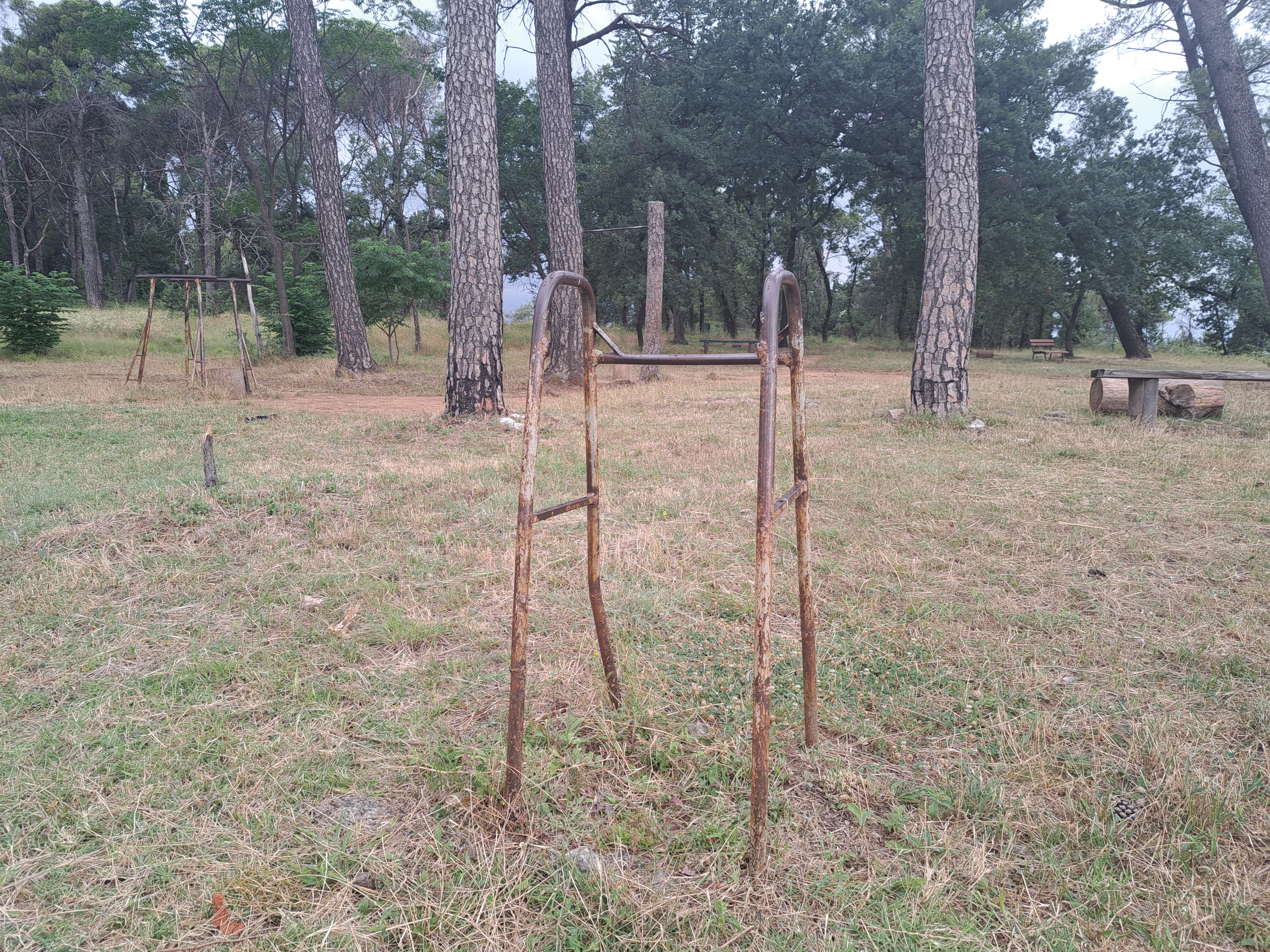
Day 2 starts with a hotel breakfast of random cold meats, cheeses, olives and pickles. The weather is slightly cooler than yesterday, and I choose to head to Gorica Park, a massive forested hill in the north of the city from which Podgorica gets its name (‘under the hill’). I am quite taken by Gorica Park. There is something quite alluring about its range of green shades and panoramic views of the city, reached by its seemingly endless trail paths. A wire-fenced, brutalist looking football pitch sits at the brow of the hill and opposite is an outdoor gym formed from corroded iron bars affixed to trees, looking a little like something straight out of Pripyat. I give a couple of the pieces of equipment a go before concluding that I should desist; I’ve a physically demanding week ahead, and shouldn’t go breaking my ankles on the second day.
Before long, there are flashes of lightning, and heavy rain sets in. Becoming a bit scared, I retrace my footsteps for about thirty minutes, back to the log-cabin style cafe in the centre of the park where I can take shelter with an apple and peach juice recommended by the English-speaking waiter. Heavy flumes of rain cascade from the awning and a ferocious wind blows menus across the outdoor seating area. It’s quite a contrast to yesterday’s heat, and an ever so slightly welcome one. Likewise, when the heat returns, it will be welcome back, and maybe there’s room in life for both. I sit tending my juice for an hour or so, literally waiting for a storm to pass, and think about how a swooshy font somewhere on Instagram is telling me I should be dancing in the rain. Although that’s a lovely sentiment, in these conditions it’s a pretty dangerous one. It later transpires that two men – one a Turkish construction worker in Canj, and another a Montenegrin enjoying a game of golf on the coastal Lustica bay – are killed by the lightning I watch from the safety of the cafe.
In the afternoon, once the rain has subsided and sunshine returned, I head back to the ‘beach’ at the Moraca River. My new happy place. I sit in a small cove, welcoming its shade, and write whilst looking out over the water. I am very tempted to swim, but on this occasion the voice of caution within prevails. The water moves rapidly, and though it looks nice and clean, I don’t know enough about what’s in it or how fast the current moves. Instead, I watch as a small turtle crawls over the pebbles, basking in the heat. A lady in floral dress then passes by, looking very wistful.
“She’s having a nice moment”, I think to myself, before seeing her partner following a few metres behind her, recording her with his phone.
Instagram influencer.
As for me, I’m just a novice writer whose most regular reader is my mum. I can’t influence you in the same way these perfectly curated Instagrammers can, but hey, at least I can give you a .JPG of Podgorica’s most famous attraction that you can print and pin on your fridge if you feel so particularly inclined.
At this reflective moment, a massive filling dislodges and I have to take a temporary return to reality in order to arrange a dentist’s appointment for soon after I return home. It wouldn’t be a holiday of mine without a dental-related drama! I purchase Panadol and mouthwash and hope for the best for now.
That evening, I head for a dinner of chicken in hazelnut sauce in Njegoseva Street before returning to Gorica Park. It’s still light and the settings are ripe for a beautiful sunset walk, especially with the storm having finished. I am surprised to see another turtle, a Hermann’s tortoise, crossing a path near to the ironwork gym I’d sampled earlier. Gorica Park is full of surprises, and I find myself liking the place more and more. It’s mysterious, it’s understated, and it’s beautiful. As I later make my way out of the park, I notice a small cafe bar – Klub Bocara – decked out in fairy lights and showing the Netherlands vs Romania game, and identify it as a perfect pit-stop. I sit on a table next to two girls who are smoking and playing a game of poker dice, and sip on another fresh, cold Niksicko lager. This place has a real vibe, one that just clicks. The evening warmth, the international football, the multiple languages being spoken, the fairy lights, the swing jazz on the radio, and A CAT! I stay there for a lot longer than planned just taking it all in and absorbing the moment (and taking every opportunity I can to stroke the cat). There’s tonnes I need to do to prepare for the next few days, but it can all wait.
Prior to moving on in the morning I reflect upon the last two days in Podgorica, and think back to those Google reviews. Is Podgorica the most vibrant, exciting place in the world? No. It’s not even the most vibrant and exciting place in Montenegro, as later trips to Durmitor and Budva alone would attest. But, does that mean it’s boring? Certainly not. And it’s certainly no ‘hole’. I’d go as far to wager that if you think that strongly about a place, it’s probably not the place that’s boring, but you. A lot of tourists need to understand that places don’t necessarily have to peacock to please those that visit. If they did, they’d all start looking the same, losing their unique identities to whatever algorithms constitute ‘amazing cities‘. Instead, it’s far better to take the time to really explore somewhere, and see and appreciate it for what it really is. What I particularly liked about Podgorica was that it didn’t pretend to be something it wasn’t. If it did, it probably would have felt like a lot of other places in the world.
Instead, it felt like Podgorica, Montenegro. And I absolutely loved it for that.
A couple of years ago, the watch manufacturer, Timex, took a swipe at the Smartwatch phenomenon by advertising an analogue watch (with actual moving hands!) that could ‘tell the time without seeing you have 1,249 unanswered emails’. The advert won a huge amount of plaudits and was considered to be very clever, whereas once upon a time – not so long ago – the reverse version of that statement would have been what impressed.
Promoting what a product lacks as opposed to what it provides has seldom been the foundation for excellent marketing technique, but in this instance it worked. It got people talking, and considering whether or not society is venturing into an era of digital malaise, in which our dependence on all things electronic is becoming as much of a pain as it is a convenience.
It’s something I have been thinking about more and more recently, triggered in part by the weekly notification I receive on my phone promptly at 9am each Monday. “You spent xxx more time on your phone than last week” it typically honks at me, and I’m never entirely sure if it’s trying to chastise me or for that or instead congratulating me for becoming further immersed into its features (and closer to 1984). Perhaps I should Google it, and see what other people think the intention of this notification is. All I know for sure is that it alarms me every time it includes the word, “more”.
Introverted extroverts like me can often make no sense to those who sit only one side or the other. You’ll think of us as chatty or shy, depending entirely on when you’ve met with us. We love nothing more than to feel connected with those we care about – in fact, we struggle if we don’t feel that – but we also crave regular access to personal space, and sometimes just don’t want to be ‘seen’. We view our phones as both a friend and an enemy at once, and since we need such devices for more and more things these days, we have to continually learn how to manage this somewhat complex relationship.
There are a lot of positives to it all. I think back to friends made in earlier parts of life and how as we diverted paths our friendship was restricted to the occasional letter received every few months (if that). The letters gradually stopped over the years and I could barely tell you anything about what they’re up to now, but had we been able to connect on social media, maybe we’d still be in touch to this day, and that would’ve been nice. I also think back to the times in which I’d only be able to resolve a bit of life admin if I was physically at home, on my computer, logged on to the internet. In many ways, I relish the fact that nowadays, you can tick things off your ‘to do’ list instantaneously, before they start weighing on the memory and mind. Transferring the money you owe to a friend whilst waiting for a plate of loaded fries to arrive. Applying for a postal vote whilst sat on a bus… digital technology is – without doubt – extremely useful.
At the same time, I also worry that with a phone around, there’s never any real escape. We think about breaks – as a general concept- as a bit of an occasional necessity. They are. But is it really a break if you still feel compelled to respond to emails by way of the fact you have access to them 24/7? Or if you’re still reading all the same things that you would at home? I often recall being abroad a few years back and having a particularly lovely day out in which all I really thought about was what was around me in the there and then, throwing myself into the local culture and eating delicious food. I was feeling extremely relaxed and content, at a time when I had really felt I needed such a break.
Then, once I was back on WiFi, I stupidly opened up the Facebook app, and saw posts on local residents’ groups about people bitching about bin collections and the new charges for plastic carrier bags. I also had a couple of emails which prompted some anxiety. Within seconds, a small screen had transported me back to my day to day, the very thing I was trying to take a break from. I felt I may as well have been back at home, and then carried out a further act of self-sabotage by attending a yoga class. Two poor choices in a row!
You’d think the lesson from this would simply be to just not take your phone out, right? And a few years back, that would have felt possible to do, but nowadays – not so much. Going for a walk in the countryside? Better take a phone in case you get stuck or endangered. Breathe in that fresh air and panoramic surroundings!
Then see that text pop up about how your car insurance is due for renewal, and is likely to cost a limb (even switching off your data won’t have with that one!).
Heading to meet a friend? Better take a phone in case your train is delayed. But once you’re there you can put your phone away in your handbag and focus on your friend!
Until said handbag starts vibrating against your leg for too long to ignore, and you have to take the call because you don’t recognise the number, and it could be something important…
Up until it got soaked to death in a storm last year, I used to be one of the few remaining species on the planet who used MP3 players. Remember those? Just music and nothing else. It came with me everywhere for over a decade, and prompted many jokes from others alluding to my apparent love of antiques. Since phones can act as MP3 players these days and that’s what most people use, my traditional one was pretty impossible to replace, and so I succumbed to the trend. It’s been better in many ways, having no end of music to access thanks to Spotify and a decent data plan, but do I miss the days of being able to zone out to music whilst on the go without the fear of intrusion from emails and nuisance callers? Yes. Very much so.
If I sound like I’m bashing on technology too much, know that I believe the pros of it fully outweigh the cons. I would feel quite stuck and probably quite isolated if I didn’t have my phone.
But that’s precisely the problem.
Song of the Day: thenightsky – Lost Ocean
I can’t tell you anything about this band, as when I tried to find out more about them I got taken to a bunch of websites about custom star maps. Anyway, this is a nice Summer tune recommended to me by Spotify this week, so here you go.
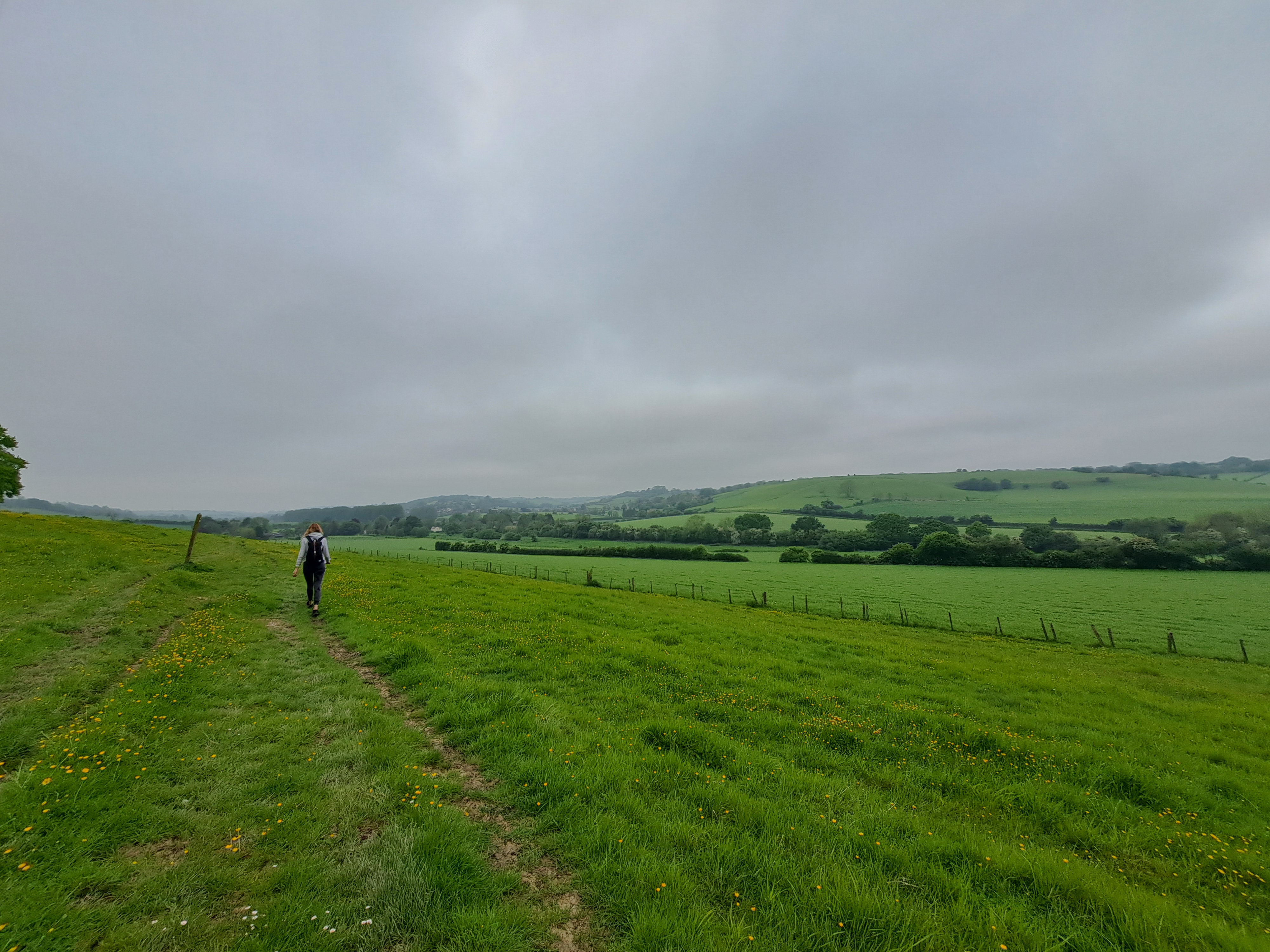
When a friend recently asked me if I fancied doing ‘a really long walk’, it didn’t take much convincing. Not only do I really like walks, but I particularly love ‘really long’ walks – the sort that make your legs feel totally jellified by the end – and at 35km, the Elham Valley Way walk is exactly that. We would walk and walk and walk, from Canterbury – with its impressive Cathedral backdrop – to Hythe, before celebrating with a mini pork pie and tin of beer by the sea. Perfect.
Our route followed the trail of what had once been the Elham Valley Railway, a commuter line which had ran between Canterbury and Folkestone from the late 1800’s until the 1940’s. The line is known by most for the role it played during the second world war, when it temporarily stopped its passenger services to assist with national defence. Three guns were mounted at various locations along the old track, the largest of which (known as the ‘Boche Buster’) was capable of firing shells a distance of up to 20km and could – and did – cause damage to many nearby homes when set off.
I’m no railway buff by any means. I leave that sort of thing to my Dad, who relishes in it. Yet, something about the Elham Valley Railway – or rather – the remnants of it, has always intrigued me. Not far from where my parents live in south Canterbury, down a litter-strewn alleyway that otherwise seems to lead into a rural nothingness, can be found a glorious old honey-toned Victorian railway bridge at the bottom of a steep verge. This was one of the first bridges that trains would pass through having departed from the city centre, and the fact it’s still pretty much intact today – albeit clad in litter, graffiti and discarded Vapes – feels incredibly romantic to me. Absorbing historic architecture – viewing the same bricks as those who came before us – is probably the nearest we will ever get to travelling back in time, and so it’s important that we preserve what we can of it.
My friend shares similar sentiments. She likes to imagine that when walking along a former railway line, personal artefacts may emerge from the earthy banks: an engagement ring, hastily tossed out the carriage window following a fractious conversation between lovers; a pair of binoculars dropped by an excited youth leaning out the window to take a closer look at the rolling hills of Kent; an old shoe – because they somehow manage to get anywhere – or any other signs of an Elham Valley Railway passenger.
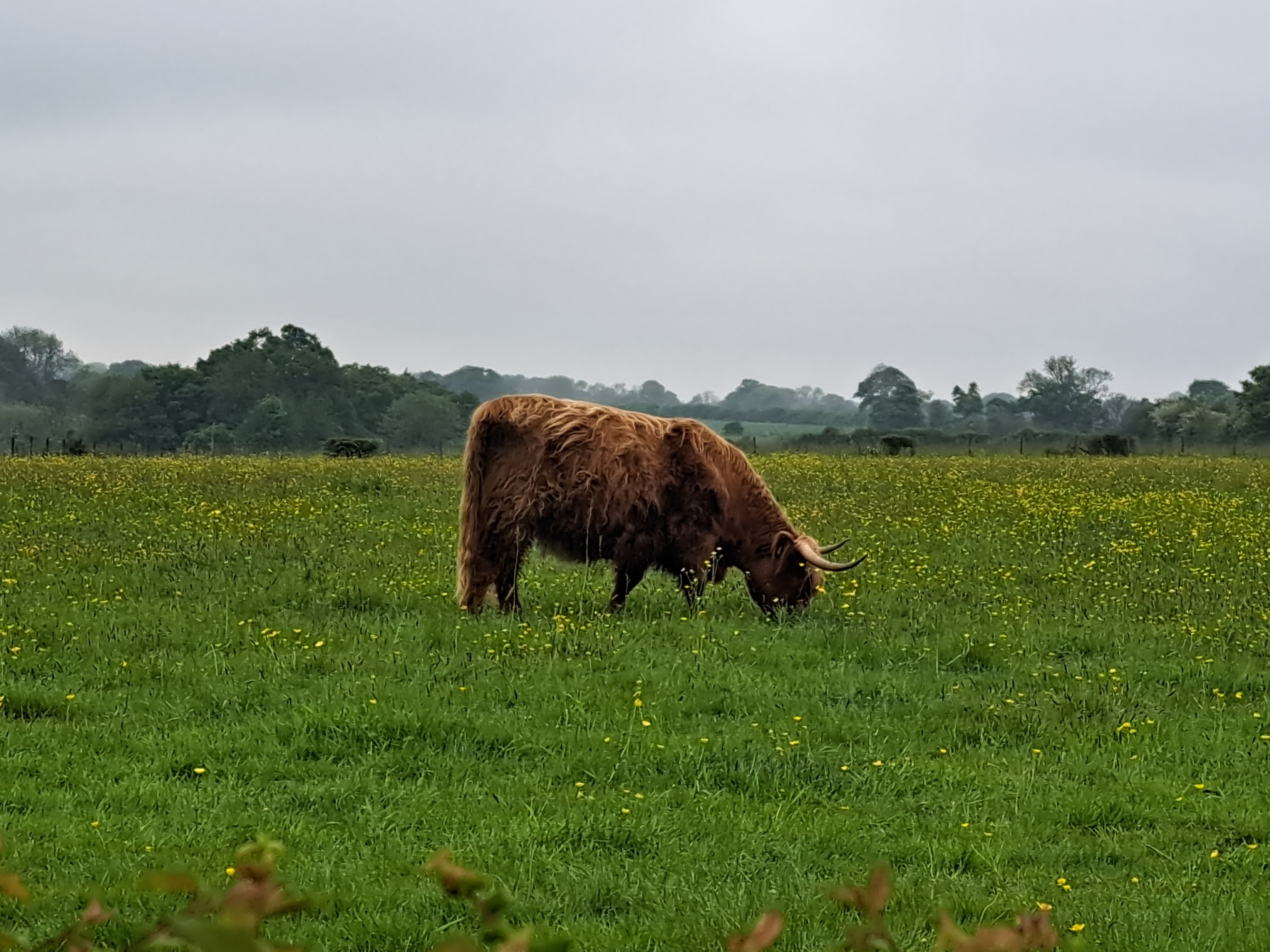
In reality we found no such things during our eight hour trek, but that in itself felt remarkable. Today, there is stillness in coordinates that were once the site of so much movement; peace in a place once associated with war. The Elham Valley Way is one of the most beautiful walks in Kent and a virtually bottomless trove of delights, boasting panoramic views, ancient woodlands, butterflies, cowslips and bluebells, among many other goodies! We ate our packed lunches rested upon a fallen tree surrounded by sheep and spring lambs, most of whom surveyed us carefully as we entered the field, before turning away nonchalantly. A few moments beforehand we had also come across some highland cows on a hillside, their horns silhouetted against the grey skies as they grazed on grasses several hundred miles away from their home. Neither of us had expected to see that.
In the villages that punctuated the journey we passed numerous cottages that gave us house-envy, a former home of Audrey Hepburn in Elham, an ancient well in Lyminge, and a friendly old man in Newington who approached us with an offer of help and a smile after observing us looking a bit lost. The railway museum in Peene had just closed up for the day when we passed but given the lack of engagement rings, binoculars and shoes en route, thank goodness it’s even there at all, to help keep the history of the former railway alive.
Our experiences on the outskirts of Hythe included being out-stared by a group of stern-looking cows the other side of a fence we were looking to cross, and wandering through a misty golf course, fearful of being concussed by a mis-shot. That wouldn’t have been a great ending after the best part of 35km, but fortunately was not to be the case. As we finally heard the lapping of waves and smelt the sea air we knew we had accomplished our mission for the day to reach the coastline, and both the pork pie and the beer lived firmly up to expectation.
Not only had this been a lovely and long walk, but it had surpassed all expectations in terms of what we would encounter along the way. In an age where digital technology attempts to simulate on screens as much of the world around it as it can, walks like this serve as a timely reminder of why it will never be able to fully do so. All the YouTube, Streetviews and online guides in the world cannot replicate reality, no matter how much you zoom in, nor can they tell you everything about a place. There will always be room for wonder and surprise.
There is always so much more beyond the map, just itching to be found.
Song of the Day: Kettel – Duck
Kettel is an artist from the Netherlands who specialises in playful and melodic electronica. Perfect for accompanying Summertime exercise!
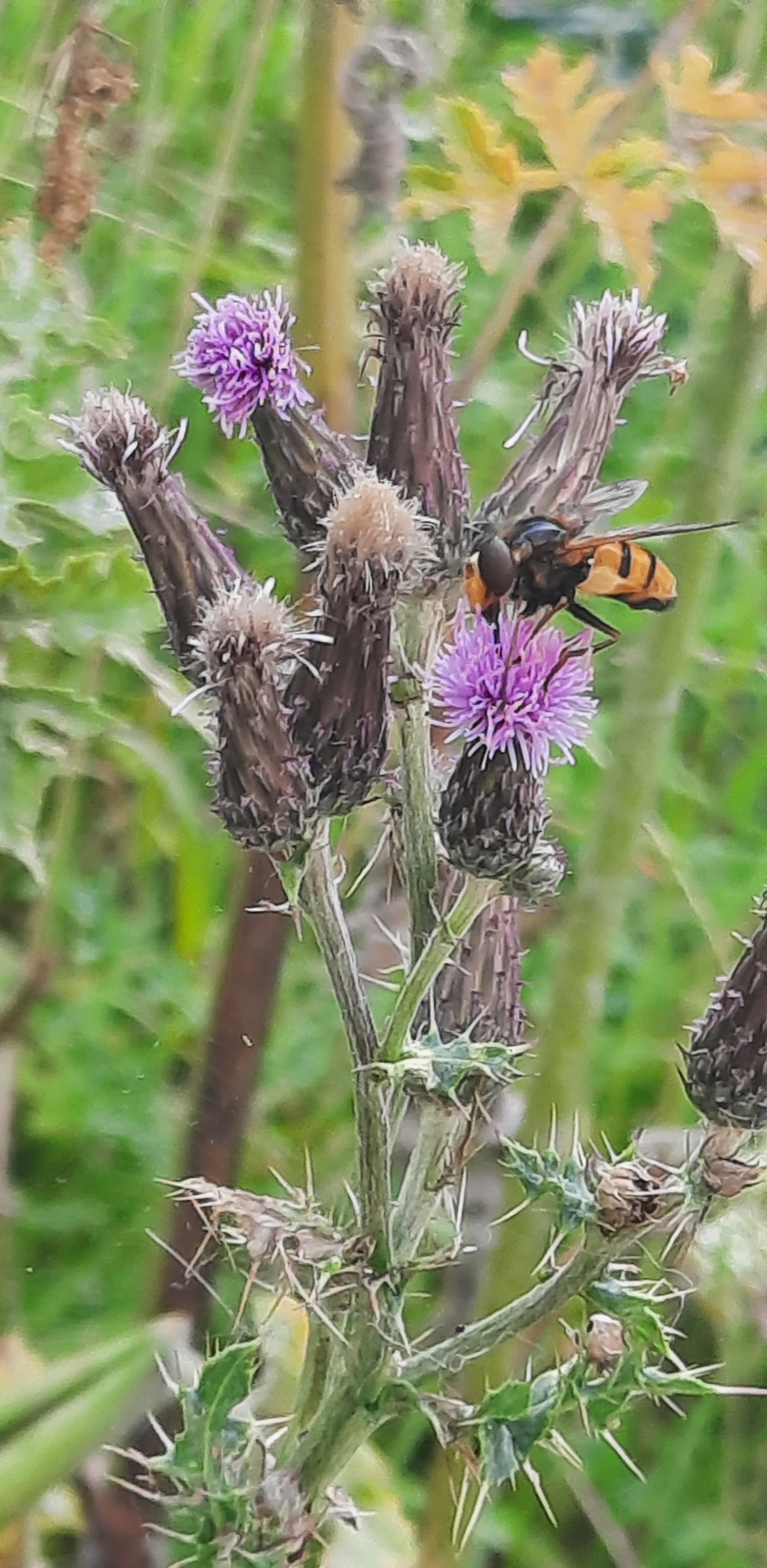
Last week, it finally became my turn to catch that wretched Covid bug that has sent the world into a spiraling state of chaos so much over the past two and a half years. It was inevitable, and I feel incredibly lucky that I made it this far without experiencing it, yet still, the feeling of being suddenly exiled into isolation upon sight of a double-line, will never be fun. And so came about a prolonged period of virus-enforced rest during which very little was done that required use of a brain. Reading the television guide and making accurate use of the remote was probably the extent of it, certainly on the days when I felt at my worst, but sometimes there is value in being so still, and taking time out of the ordinary. Whilst taking some time to bathe in the fresh air outside, I noticed things that in normal circumstances I’d perhaps be in too much of a hurry to notice. This bumblebee for example, fastidiously gathering nectar from a wildflower:
I was transfixed by this for a good while, watching it move from bud to bud, taking it for everything it could get before flying on to find more. I was impressed by its determination and ability to scope out what it needed, and lamented the fact the species is in decline whilst appreciating the efforts of conservationists to reverse this. In this moment, I realised I hadn’t actually thought about bumblebees for quite a long time. Why would I? But why shouldn’t I?
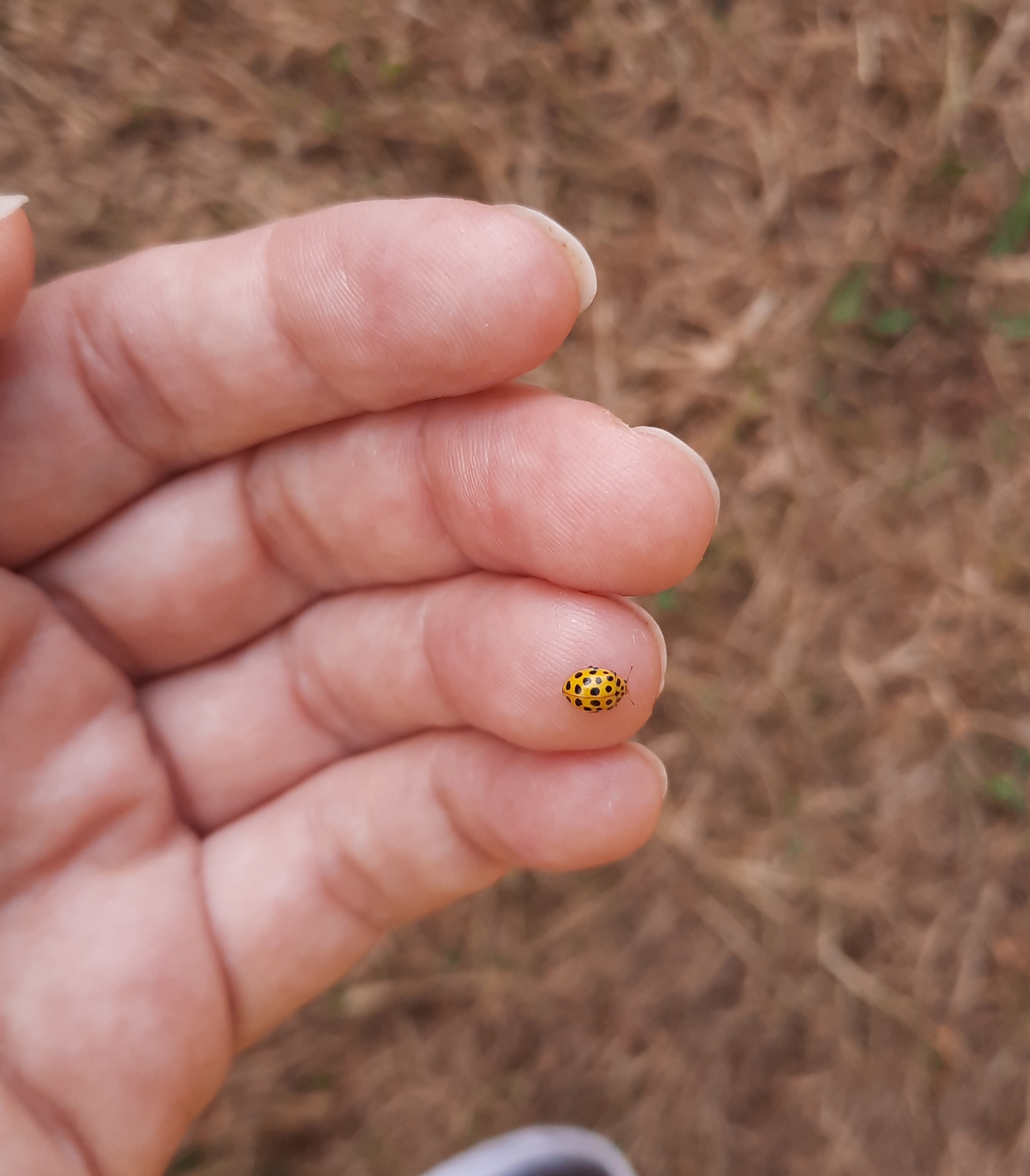
And then appeared this yellow ladybird, which I was equally in awe of:
I couldn’t remember the last time I’d really seen a ladybird, let alone a yellow one! I’d virtually forgotten they existed, and momentarily wondered in my viral haze if one of the more common red types had just been exposed to too much sun during the recent heatwave. I was intrigued so I – of course – googled it, and realised I had been holding a Psyllobora vigintiduopunctata(or in other words, 22-spot ladybird). I also learned that ladybirds, incidentally, are named after the Virgin Mary. Historic farmers would pray to Mary and request that she protect their crops, and felt those prayers heard when ladybirds appeared and consumed the insects that threatened them. It is a neither sun-blanched nor rare species, but why did it feel like the latter? If one were to land upon my shoulder as I walked to the car on my way to get somewhere, would I even be giving it this much thought, or would I just sweep it away and carry on?
I am not going to pretend that if I had the choice between staring at ladybirds and bees, or being around loved ones, that I’d make the same one imposed upon me last week, but the time did remind me that being still and silent enough to really observe things can sometimes exhume joy and awe from the slightest, most unexpected and hidden sources.
We spend so much of our time rushing around from place to place, ensconced in task to task. I promised myself after lockdown never to take that for granted again, and I won’t, but there’s never any harm in being reminded of the benefits and importance of time to pause. To stop. To notice. To enjoy.
To… bee 😉
Song of the Day: Mighty Mighty – Law
This is a classic example of a genre known as ‘twee pop’. Twee pop emerged in popularity in the UK in the mid-’80’s as result of a compilation cassette – C86 – issued by NME magazine. Sometimes known as ‘jangle pop’, twee pop is a subgenre of indie characterised by simplicity, harmonies and upbeat melodies. In other words, exactly the kind of music you want to listen to when you’re poorly. This track, from Birmingham-based band Mighty Mighty, was one of the songs on the original C86 cassette.
There’s a field near to my home which I first encountered on the same day that we were plunged into lockdown for the first time, in 2020. It seemed to pop out of nowhere and I remember that initial view so well, a golden field of rapeseed baking in the unseasonable warmth of a Monday teatime in March. It somehow seemed to bring instant comfort. I had been strenuously trying to “walk-off” the anxiety surging within about the prospect of weeks blocked from everybody I cared about, whilst also trying to process unfathomable stories of death worldwide, and the only thing I knew I wanted to do in that moment was to keep walking and to take any turn I’d never taken before, and see somewhere new. That’s how I ended up discovering my “yellow square of hope”.
During such a dismal time, nature served as the most wonderful nurse. Like many, I felt that the daily walk we were permitted to do served as a bit of a lockdown lifeline, an opportunity to get into the fresh air and to see other living things, even if we couldn’t engage with them: Fellow walkers. Joggers. People walking dogs. Swans and ducks. It was as close to normality as one could reach back then, and it meant everything.
It was also a time during which I discovered – and fell in love with – much more of the area around me, especially my yellow square of hope. There was a particular route around it which I enjoyed doing each day for the first few weeks of lockdown, a route also including a pond favoured by swans and a gorgeous view of the church spire, but also one twinged with the lingering regret that I wasn’t able to share its beautiful discovery with the people I was missing. I longed for the day when I would be able to retrace that route with them, the day when all of the fear and sadness would be over, the day when I’d be able to take a moment to reflect back and be even more appreciative for their company than I ever had been before.
It would happen some day. The bright colours and soft, warm winds convinced me of that every single time I went on that walk.
Yet despite (fortunately) having plenty of opportunity to have since made that moment, I’ve found myself not really wanting to walk that route again because of its association with a really sad time. Perhaps others have found this with their equivalents. It’s a time nobody really likes to think about though on the second anniversary it’s only natural that we find ourselves doing so.
Nonetheless, the other day, I decided to go there. It was my first real walk in days having been in bed for a week following some surgery. Nurse Nature, with her fresh air-filled inoculations, was needed again and I was prepared to finally resist the mental block that had prevented me from returning previously. I was so excited to see it.
Yet despite it being exactly the same time of year, I was to find that my yellow square of hope looks markedly different now. Still a square, but somewhat bare, almost as though it only glowed when it knew the world needed some sunshine.
But though we are no longer in lockdown, the world still needs some sunshine, perhaps even more so, as it faces a war-shaped battle at a time when people are weary enough from the previous one.
This wasn’t quite the return I had in mind during those 2020 daydreams, but I’ll keep returning and perhaps that yellow square will appear once more. I certainly hope so.
Song of the Day: Weezer – Say It Aint So
During an anaesthetized slumber last week I found myself able to search for only the tried’n’trusted on Spotify: enter Weezer’s Blue Album, which I’ve been enjoying since I was ten years old (thank you to my older sister for having such a great taste in music and buying the cassette in the ’90s). Every single song on this album is amazing to be honest, but if I had to choose a favourite, it would be this one. What an incredible band.
A celestial-sounding melody echoed around the dark hostel room as rain pattered relentlessly against the window. As the phone from which the sound was coming vibrated against a vinyl floor, sleepy eyes widened to see a square of black glass, peppered with raindrops and the silhouette of the mountains of Snowdonia.
We are in Llanberis, North Wales, at 5.30am one Tuesday in August, 2021.
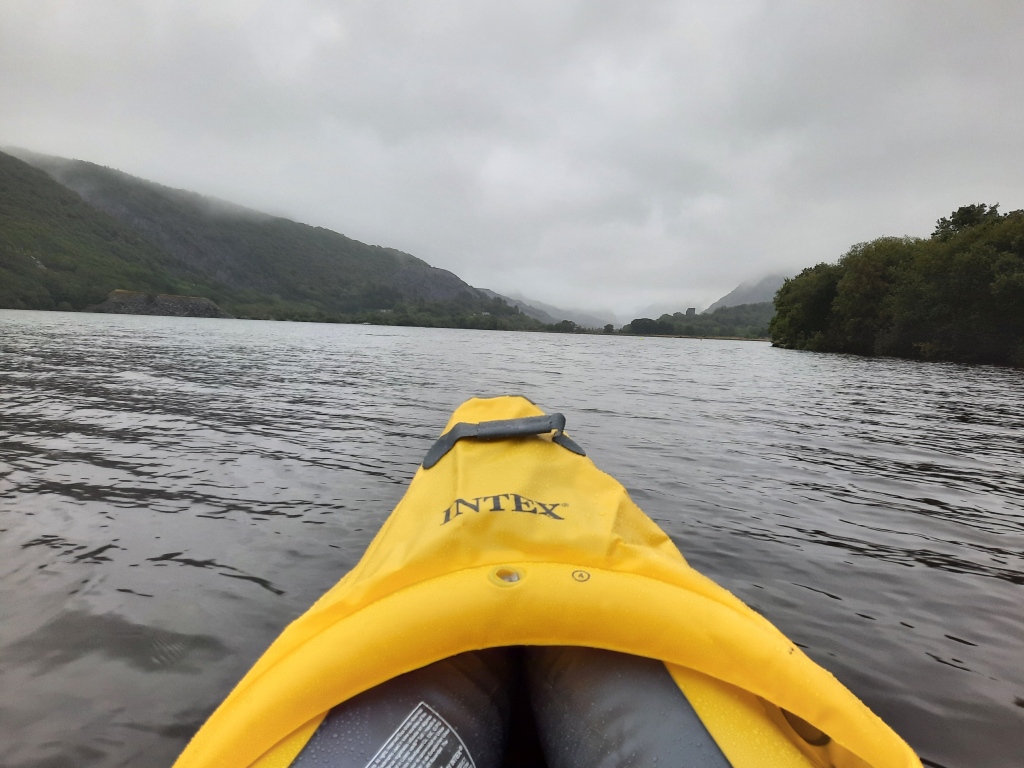
My friend and I had set our alarms with the intention to take a sunrise kayak trip across Llyn Padarn, a breathtaking, glacially formed lake which stretches two miles in length and twenty nine metres in depth at the foot of a host of rocky peaks, Mount Snowdon being the most famous.
However, a combination of Samsung’s contemporary cock-a-doodle-doo and the prospect of getting completely drenched was enough to make us reconsider the idea we had conjured whilst basking in the heat of the previous afternoon. But, if the last couple of years have taught anyone anything, it’s that you have to do these things when you get the chance. There haven’t been many opportunities to wake up away from home in the past year, and if you postponed all of your plans until the arrival of better weather you’d barely do a thing.
So there we stood, a few minutes later, shivering hands stoically inflating our kayak by the side of the lake. The skies were fading from black to a watery, charcoal grey and there was absolutely nobody else about, beyond a lone swimmer who offered us a chirpy greeting about having the lake to ourselves as she stepped out into the water and started gliding about contentedly.
By the time we were out on the water the sky had turned into a sheet of off-white wool and there was just enough daylight to make out the mountains behind the clouds. We paddled in a southeasterly direction, taking in stunning views of Snowdon behind the thirteenth century ruins of Dolbadarn Castle. To our left were a cluster of features symbolic of Welsh heritage and history: the National Slate Museum, the Llanberis Lake Railway, and the former Miners’ hospital building. With virtually the whole of this impressive body of water to ourselves, and so much around us to see, the early start had gifted us the kind of mentally energising experience which can completely shift internal paradigms and conjure new dreams. I want to do this every morning, and just who exactly says that I can’t?
We savoured this moment for as long as we could though it was only a matter of time before the weather caught up with us. It was a beautiful morning but it was also extremely cold, and the water – whilst calm in its demeanour – had managed to find its way into our shoes and soak our clothes. Teeth were beginning to chatter. Fingers were starting to freeze. Minds were being seduced by the thoughts of warm hot chocolates and cooked breakfasts. It was time to get out, and shiver on the banks for thirty minutes whilst waiting for the kayak to be deflated enough to fold into the boot. Maybe I shouldn’t do this every morning. Or maybe I wear ten fleeces, boxing gloves, and a spacesuit next time!
After what was the quickest turnaround ever back at the hostel to get changed (nothing challenges the concept of time like the prospect of a massive hot chocolate with cream and marshmallows) we were stood on the pavement in the rain forming the queue for the cafe, Pete’s Eats. Each of the tables inside were occupied and we were still in a pandemic, so “budging up” could not be a thing in this instance. I watched through the window and willed the diners to eat up quickly, though my friend had assured me that it would be worth the wait, and she was right.
Behind us in the queue stood a man with his young son, discussing what they were going to eat. The rain was falling faster at this point, and whilst it seemed a sauna in comparison to shivering on the banks a short while earlier, it was still bitterly cold. I kept thinking about swirling my spoon round a receptacle of molten chocolate, and how the marshmallows would melt into a fluffy goo that would ooze down my throat and radiate heat round my icy insides. As transfixed as a dog by a bone I watched a pair of diners finally stand and take their jackets from the back of their seats, and when the waitress simultaneously approached the door we knew our turn had finally come. The newly vacant – and only available – table sat six, and it made no sense for just the two of us to occupy it, so we invited the man and his young son to get out of the rain and join us.
The breakfast exceeded expectation, and neither of us held back. After the early start, the freezing temperatures and all that paddling, we deserved our massive hot chocolates and our morning feasts. Whilst eating we started engaging in a fascinating conversation with the man. He explained how they were traveling around North Wales in a camper van with uncomfortable seating, reliving his childhood holidays and giving his son an experience to remember. He also shared with us his voluntary work rescuing chickens and the values behind it, an incredibly eye opening conversation about an issue I had known very little about before we met. As we chatted and chatted, his son contentedly dined quietly on his toast. The pair of them consumed very little compared to us, and were gone within about thirty minutes, bidding us goodbye and wishing us a nice day as they put on their jackets and walked back out into the rain, back to their van and back to South Wales. My friend and I remarked about what a nice pair of people they were. The inspiring, kind-hearted man. His well behaved young son, who just let us chat, no screaming, no fuss.
We stayed in the cafe nursing our warm mugs for a little longer to bring our fingers back from the dead, then motioned the waitress over to pay for our banquet breakfast. She seemed a little stuck for words:
“Erm, well actually, there’s no need. That man who was at your table. He paid for you.” “What? All of it?” “Yes. All of it…he said he enjoyed the -“ (unfortunately we’ll never know exactly what, as her vocals were doing battle against the clattering of cutlery in the background at this point, but it’s fair to guess that dining with us had obviously not been the worst experience in the world).
Now it was our turn to be stuck for a words! But why? We had ordered so much more than them. We didn’t even know their names. We thought back to the moment the man had gone to pay for his bill. He had gone up to the counter, outside of our earshot, obviously not wanting us to know what he was doing. He clearly wasn’t after praise or anything in return; he knew he’d be long gone by the time we found out about his gracious act. He knew that we would never be able to contact him to say thank you, or identify him as a hero.
He was just genuinely, purely and beautifully kind. And after eighteen hard months of this pandemic, during which as a society we have seen some of the worst examples of human behaviour ever and been challenged in ways beyond comprehension, these acts of genuine kindness mean so much more than they ever would before. This was about way more than saving fifteen quid each, it was about just knowing that people like that exist, people who infuse the mantra to “be kind” into the world around them not just by posting those couple of words online to look good but actually by being kind. If I ever happened to meet this man again, I would thank him for that first and foremost, and then I would thank him for the breakfast.
We were still speechless as we returned to the car and looked out over Llyn Padarn again, taking in the same stunning views as the morning but this time appreciating the warmth of the heater and human kindness. Not every stranger we share a table with in life will pay for our meals, in fact the vast majority won’t. The vast majority might even snap at us to move, scrape their cutlery loudly against their plates, constantly curse, or use the last of the ketchup before it’s our turn.
But it’s not always about the vast majority, and a majority is still not everybody. The most inspiring and memorable people you will come across in life won’t always be those you have the most exposure to. They’ll often be the ones you encounter by chance, in tiny cafes in tiny towns on rainy days, strangers who aren’t after reciprocation, strangers who are just peaceful and kind, strangers who will always be strangers but who raised a smile and left an impression that you’re still thinking about several months later as you reflect back upon a year. Strangers who inspire a blog post.
Llanberis, North Wales, at 5.30am one Tuesday in August: the morning nature and kindness breathed optimism into the midst of a pandemic where it had so often seemed scant.
The other day, I was taking a sunny stroll along the Grand Union Canal when a family of ducks caught my eye and made me smile. I loved how fluffy the ducklings were – like five little buns gliding across the water – and how the mother managed to keep them alongside her as they ventured to a destination that presumably only she knew.
It’s been three years since I last published a “Little Things I Love” post, to follow on from the original, and so I think it’s time to write another – particularly after the past twelve months.
So, along with ducklings and the things already written about in 2016 and 2018, here are some more of the little things I love:
…The satisfying sound of a hoover whooshing up bits you couldn’t even see but will certainly feel better without…
…Discovering a new food which you think about for days and days after consuming for the first time…
…Being so engaged in something that you forget to look at your phone for a while…
…The smell of seaweed on days when you can feel the sun against your skin…
…Sunsets on the East Kent coast, a burning peach sinking into the sea…
…The first day of the year when it feels so warm you can just slip-on a dress and be fully clothed by free-flowing fabric…
…A buttery plate from where the spread has seeped through the crumpet…
…Staring competitions with sheep and lambs…
…People who manage to craft puns out of nowhere at all…
…Applying the ink from a brand new marker pen to flip-chart paper. A symbol of meaning business...
…Victorian-style lamp-posts. Generally…
…The smell of old, family photos and fond memories they trigger…
…Moments when you lose yourself in a good piece of music…
…Big, tall pine-trees and the smell of barbecues…
What are yours?
Song of the Day:Weezer – Aloo Gobi
This is one of the best songs I’ve ever heard from one of the best bands I’ve ever loved and if I had to pick one song to listen to for the rest of my life it would be this one, which is pretty funny when you understand the meaning behind the lyrics.
Today’s National Day of Reflection marks a year to the day that we sat nervously in front of our television screens to be confronted by the directive that would change our lives quite dramatically. An issue which had been bubbling away on the side for weeks was becoming increasingly vociferous, and with that evening’s press conference in March 2020, the switch was finally firmly pressed, and the lights went out in an instant.
The resounding message absorbed within the deafening silence which followed?
You can’t see your family or your friends until further notice, and no, there’s no time to just go back and fetch your jacket. Settle down and get comfy; you’ll be here a while.
I umm and ahh about how much I want to include in this post. I documented most of my thoughts here at the time, in order to refrain from turning totally insane during the period when the only people I spoke to face to face were dog-walkers or shop assistants. I think we’re all suffering from pandemic lethargy too much at the moment to really go over those things again; but one day, when we’re much less muddy and feeling more confidently in the clear, it’ll certainly be an interesting few months to reflect on.
However I think it’s important today to differentiate between the lockdown and the pandemic – hand in hand though they may be. A lot of us will think of this past year in terms of the myriad of effects on our day to day lives. We have missed out on so much, and it has been utterly heartbreaking at times, but I don’t actually think all of the effects of lockdown have been negative, and I will write about why another day.
For now though, for today, it’s about reflecting on and respecting the worst affected victims of this pandemic. The ones who don’t get to reflect back over the past year at all. The ones who were unable to live as fully as people should be able to, before they had to leave. The hundreds of thousands (or millions worldwide) of their relatives who lost somebody special this past year in the cruelest of ways, who couldn’t grieve in the way people need to, who couldn’t say goodbye or hold hands a final time, and who couldn’t feel the comforting hugs of friends and relatives as they mourned alone.
The other effects of this pandemic, heavy though they may have often felt, somehow also feel so light against this.
Thinking of everybody who has been affected in such a cruel way today, and wishing that each individual within the startling figure we have seen rapidly rise over the last twelve months, will be remembered as exactly that, an individual.







 sophiekemsley