A BOWL OF IRISH CHARMS IN KILLARNEY, CO. KERRY

Before visiting for the first time,  the image in my head of Ireland was always a fusion of greens and greys, Celtic symbols, and a language containing an abundance of b‘s, h‘s, and n‘s strung together in sequences that I have no clue how to pronounce. Shbhnnhsh. All set against some backing music provided by Enya.

Did my trip to Killarney, County Kerry, change any of that? No, but it certainly added a number of new features to that internal vision, and I fell in love with it instantly.

Even as soon as I alighted the plane I sensed something sweet about the place. Literally. The concourse of Cork airport smelled not of aviation fuel but sugar, and I couldn’t work out why. After spending the following days witnessing more rainbows than I’ve ever seen in such quick succession, I deduced that the air was full of Skittles, which we must have been tasting (or smelling), as per the tagline. I’d later find out the real reason and I’ll tell you that later, but in coming to Ireland, I had seemingly dived head first into a sugary bowl of Lucky Charms, and there were lots of those charms to find.

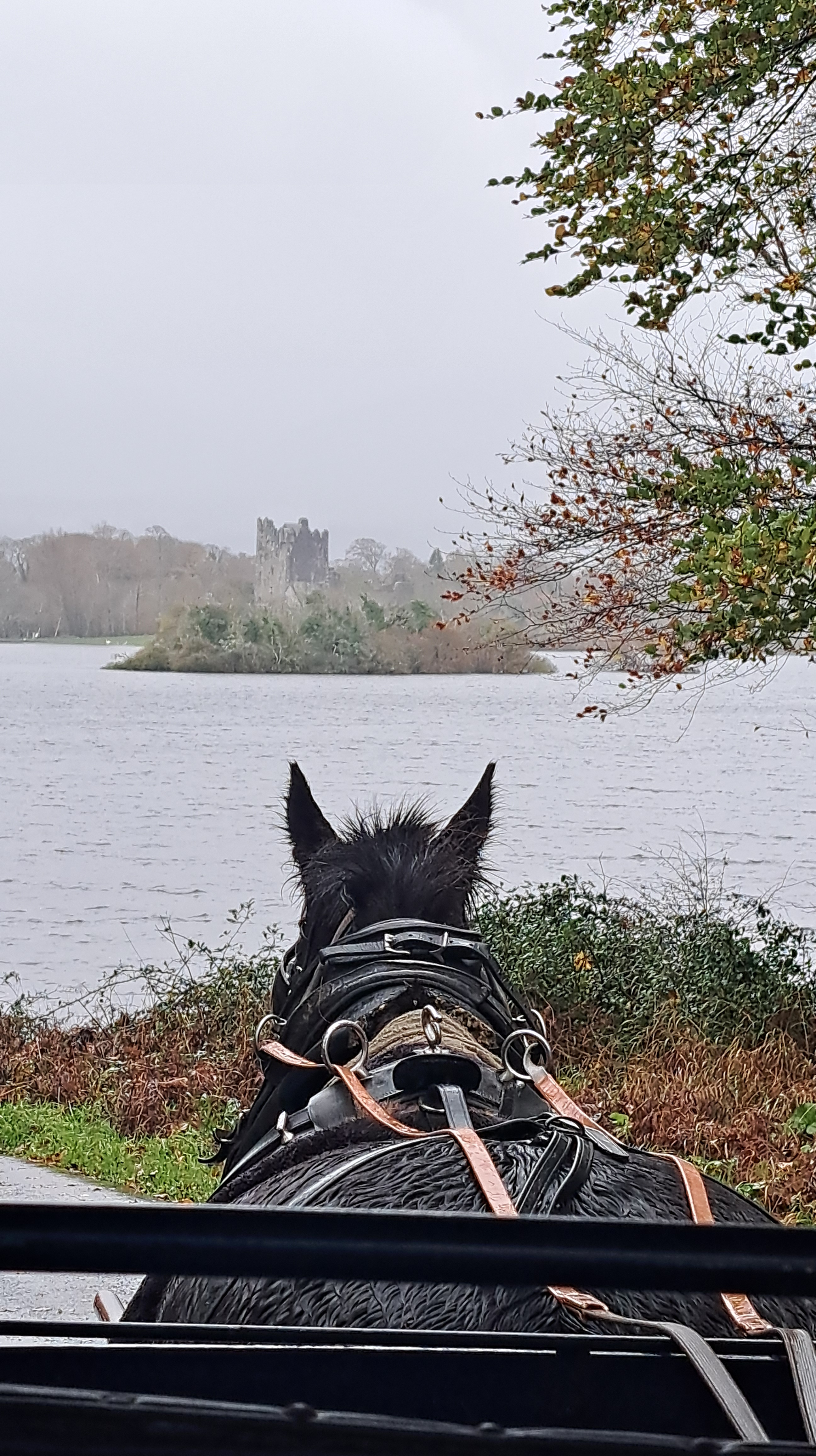
Sally being one. She was the 12 year old piebald horse that clip-clopped our traditional jaunting car through the crispy orange leaves of Killarney National Park under the instruction of her owner, Mikey, who was the third generation of guides in his family.

“She works two days then has a day off”, explained Mikey. I quite liked the sound of Sally’s working pattern, and briefly thought about becoming a horse, before being distracted by the sight of Ross Castle in the distance. There must be people who exist with the name Ross Castle. I expect it drives them around the bend – or moat – when people come to visit, particularly if they start asking about entrance fees.

I doubt that there’s anybody out there called MacGillyCuddy Reeks, though (and if there are I feel more sorry for them than I do Ross Castle). These unusual words form the name of the local mountain range which is home to the highest peak in Ireland, Carrauntoohil. My original plan had been to spend a day scaling Carrauntoohil, but on this occasion I gave in to sense, on account of not being sure if there’d be enough hours of daylight in mid-November to complete it. Instead I settled for Torc Mountain, the just as impressive 329th highest, and home to a waterfall that is one of the many must-see points along the Ring of Kerry, for which Killarney is the perfect place to base oneself for a few days.

The geography informed our choice to come here out of everywhere else in Ireland. People speak of ‘moving mountains’, but it’s always the mountains that move me. They make me weak at the knees, in both senses. On mountains, time disappears. Things disappear. The entirety of the wider world disappears, along with all its ugly parts. It’s just you and the product of a tectonic plate collision that’s been there for a billion years before you, and will be there for billions of years after. The mountains have seen everything there is to see as they look down on us (probably in more ways than one), yet they do not ever judge. Which is very kind of them.

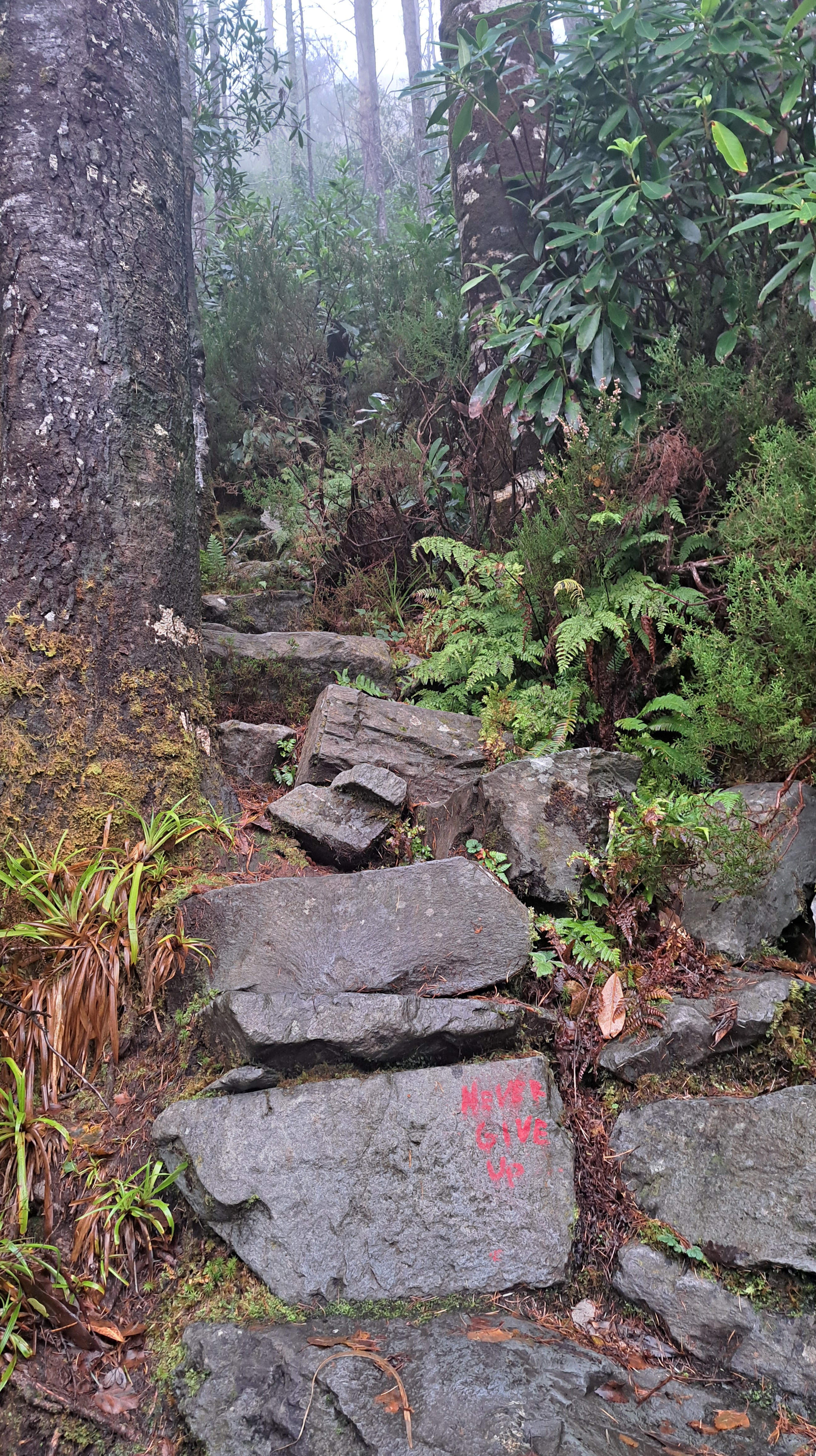
I’m about three quarters of the way up the ‘prolonged climb’ of the Red Trail and starting to wonder if I should have just stayed in the town and drank Murphy’s in one of the warm taverns before I notice some pink writing painted on to one of the large stones that make up the ‘staircase’.

“Never give up”.

Clearly many before me have experienced similar feelings to those I’m feeling now: tempted to retreat back down, get back in the car and go back to bed. There’s comfort in knowing this.

I thank the anonymous scribe and obey the pink scrawl and I’m so glad that I do so, because I’m soon at the top and able to enjoy the plateaued ridge that runs along the top of the mountain affording misty yet magical views of Muckross Lake below. It’s at this point that a particularly heavy rain-shower occurs, and my thoughts immediately turn to the food in my non-waterproof bag, which wouldn’t taste nice wet. Somehow, just somehow, to my right is a stone shelter complete with a bench inside, the only one of its kind that I’ll see along this entire route. Is this what they mean when they talk about Irish Luck? Either way, I’ll take it, and enjoy the shelter for as long as is needed whilst the clouds get the rain out of their system.

The rain would feature a lot during our time in Ireland, as you would expect from an island in the Atlantic, yet Irish people don’t tend to bother with brollies, a stoicism underpinned by the strong winds that render them impractical. The equivalent of trying to heat a house with a single tealight. I overhear a rain-related joke that evening in the pub:

“Who ordered the rain?”
“I don’t know, but send it back”

The women laugh over their Dingle gins, a homegrown product from a peninsular just a bit further north here in County Kerry. Lady 2 is clearly very pleased with her quick-witted reply to her friend, but I get the feeling she’s maybe used it a few times before. There’s regular opportunity to do so in Ireland, afterall.

For every rain shower here on the Emerald Isle though, there seems to be a golden sunshine that enjoys dancing off the orange autumn leaves. That’s how those many rainbows come into being, a fact that always makes me smile as a metaphor for life’s varied paint palette itself. We see another beautiful one as we begin our tour of the Ring of Kerry. At the end of this particular ‘bow sits Kerry Bog Village, a museum in Glenbeigh consisting of a preserved 19th century village where real people lived and worked.

The minibus stops and allows us some time to explore Kerry Bog, and if it weren’t for the host of smartphones being waved about taking photos, we could have quite easily felt that we had stepped back 150 years or so. We venture into each of the buildings, all former homes of workers, and breathe in the surprisingly calming scent of burning peat whilst contemplating what it must have been like to share a kitchen with farm animals and climb up a long ladder to get to bed.

Nearby, an American tourist – one of over a million who visit here each year to connect with their ancestors – is excitedly rolling around on the floor with one of the Irish Wolfhounds. Despite their status as one of the largest and most intimidating of all breeds of dog, this one is looking quite embarrassed by the encounter.

“She said next time she gets a dawwwg, that’s the one she’s gonna get,” I overhear her companion sigh a little while later, as the one-way carry-on carries on in the background with no signs of abating.

These tourists are part of a different group, so I never get to know if they make it back to their bus without a new four-legged addition. Or if they even make it at all. Ireland’s charm is infectious and I wouldn’t hesitate to place a bet on everyone on these buses remembering this day for the rest of their lives. Even the lady behind me, who spends quite some time explaining to her partner – in one of the longest, most mundane conversations ever overheard – that looking at her phone whilst the bus is in motion makes her feel “seasick”.

Well, I guess we are traversing the Wild Atlantic Way…

When we eventually arrive back in the UK, the post holiday blues swallow me up in the way they usually do and I find myself doing the same old things I always do when I feel this way. Searching for documentaries on YouTube about the places recently explored so that I can see even more of them. Listening to Enya and pretending I’m back looking out over the patchwork of greens and golds that make up the beautiful Irish landscape. Carrying out important research on Google…

“Why does Cork airport smell of sweets?”

Well, it turns out that just over the road, as we alighted the plane, 35% of the world’s Tic Tacs were being produced at the Ferrero factory. My theory about Skittles wasn’t far wrong. But I think I prefer my own version of the truth…

Ireland, you were worth the wait, and I’ll be back to collect even more charms someday.

YOGYAKARTA, PART II – THE END OF THE 15 YEAR WAIT FOR BOROBODUR

My guide for the day, a friendly man called Bima, comes to collect me from my hotel first thing in the morning and is very concerned about whether I have packed enough water, sun-block, and a rain jacket. Indonesia is one of the hottest countries in the world, but it also experiences a rainy season every year, and I was travelling towards the end of it, meaning I’d spend my time being either very hot or very wet, or both.

It takes us around an hour to drive to the ancient Buddhist temple of Borobodur, so we’re able to chat and get to know each other. Bima explains that he’s originally from here in Java, but his wife is from West Sumatra. They are among a minority (10%) of Christians in a predominantly Muslim (87%) country and they live in a bustling suburb of Yogyakarta with their children. We spend some time discussing the cultural and linguistic differences that can be found among the many different islands and regions that all call Indonesia home, and he teaches me some basic Javanese, like “matur nuwun”, or “thank you”, which is very different to the “terima kasih” of the official national language, Bahasa Indonesia, that I’m more accustomed to. I try my best, but have to ask him to remind me of it every time I need to give thanks throughout the day, which is quite often when you’re being driven around everywhere.

We arrive at the grounds of Borobodur and the temple itself is hidden from view as we drive up, which makes it all the more exciting. Bima sorts our entry, gives me my wristband, and we take a shuttle cart closer to the temple along with a dozen other tourists.

Before the official tour begins, I replace my shoes with the special upanat sandals – with soft soles – issued at reception. Introduced only in 2023, they serve as an effort to reduce the wear and tear on the ancient stone. 1200 pairs of feet stomping all over it every day could cause considerable damage otherwise, and one of the best bits about the upanats is that you get to keep them afterwards! They’re pretty jazzy too.

Before the official tour starts, Bima takes me on a little tour of the grounds. I still can’t see the temple, even though it’s one of the largest in the world! I begin to question my eyesight until Bima leads me round a corner into an avenue lined with ashoka trees and points ahead.

And there it is.

And wow.

It’s fair to say it’s a little bit bigger and more impressive than the wooden replica I’d observed at the museum in West Sumatra all those years ago. I’m brimming with excitement and even detect a bit of a tear in my eye, but must wait before I get any closer so that I can be shown around by an official temple guide, another rule that was introduced in 2023 to help protect the temple longer term by managing the numbers on the stone at any given time.

The sensation of suddenly witnessing the temple felt not too dissimilar to the story Bima had been telling me on how Borobodur was re-discovered. Originally built somewhere around the 8th Century during the era of the Shailendra Dynasty, the temple was in popular use for a few years before being abandoned and deserted after the dynasty was overthrown. It remained this way for a number of centuries, during which it was gradually covered in jungle growth as well as ash from the nearby volcano Mount Merapi, eventually obscuring it completely from view. It wasn’t until 1812, when the British colonial official Sir Thomas Stamford Bingley Raffles re-discovered it, that the existence of Borobodur was known once more. Throughout the remainder of the 18th and 19th centuries, the temple underwent a series of restoration works that were eventually completed as recently as 1983. When you consider the year it was first built, that recency is pretty staggering.

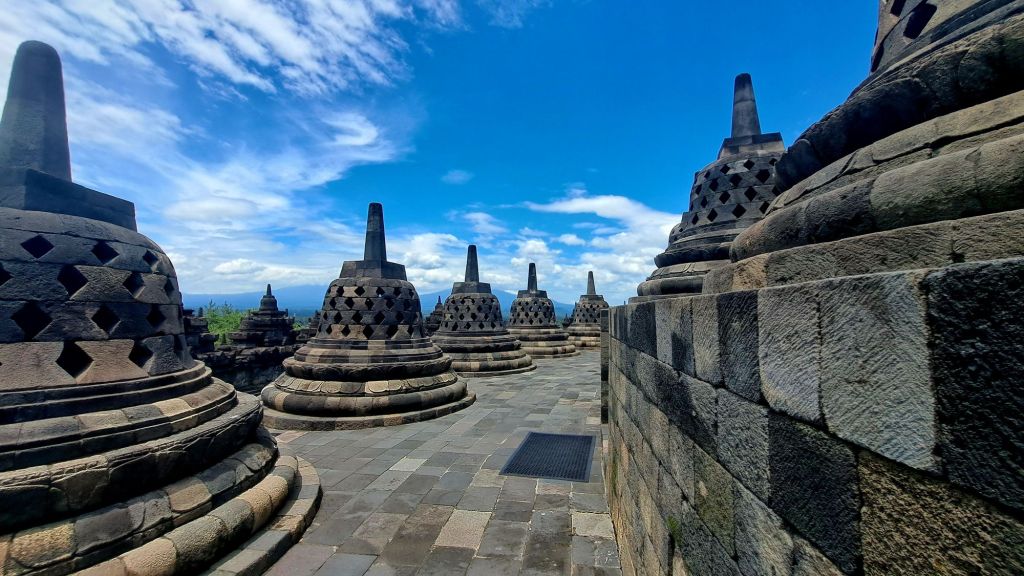
The official tour lasts around 45 minutes and consists of a guide taking a group of us up to the top of the temple platform by platform, of which there are 9 in total. As we ascend we take in some of the 2600 or so relief panels that decorate each layer, and witness how the effects of centuries of extreme weather have meant that some are in better condition than others. It’s the very top of the temple though, the central dome, that impresses the most. That’s the bit that we’ve all been waiting to see. Instantly recognisable from the 72 bell-shaped structures known as ‘stupas’ that each contain a statue of Buddha inside, it’s something which truly does take one’s breath away. And not just because of the number of steps it took to get this high.

The guide gives us 15 minutes to explore the central dome, which to me just doesn’t feel long enough. One minute for every year spent anticipating ever being here. It still feels completely surreal: the history, the tropical panoramics, and the ominous sight of Mount Merapi in the distance. Mount Merapi, which did its very best to keep the rest of the world from ever seeing Borobodur, and which would have succeeded had it not been for the curiosity of Sir Raffles.

This quiet moment of wonder and reflection is suddenly penetrated by loud conversations taking place around me spoken in native English. It’s the first time I’ve been around any of my compatriots for a week or so, and I quickly gather that this merry lot are visiting the temple as part of a cruise around South East Asia.

One of them slumps herself on a piece of sacred stone and starts fanning herself with a leaflet, her face very red:

“Err am joost too ‘ot, me, wanna get back on bert!”

Meanwhile, a few metres away, Grandma is being called into action by a young girl in her 20’s:

“Nan! NAN! NAAAN!”
“Yes love?”
“Get lots of pictures of me!!!” she orders, before performing a series of pouts in front of a stupa whilst Nan clicks away, almost dismantling the ancient structure with her big handbag as she rapidly switches between poses.

I will fully admit to judging people who are lucky enough to travel to the other side of the world only to then moan about the heat, or who seem to spend so much time taking curated photos for social media that they don’t actually look at what they’re there to see. So I walk away disapprovingly before asking a fellow tourist to take a photo of me from behind, which I later upload to my Instagram story. What can I say, Nan’s granddaughter influenced me.

As we start to make our way back down the temple I spot the smiling face of Bima waiting for me at the bottom with a bottle of water, and he suggests that we go for some lunch before driving on to the Hindu temple of Prambanan, 53km away. The place he suggests, ‘Borobodur Silver Resto’, is the perfect choice, serving traditional Indonesian food on a suspended outdoor decking area which overlooks rice paddies. We don’t have long, but it’s a good opportunity to reflect on Borobodur, catch breath and refresh.

After our meals Bima fetches the car and asks me to sort the bill whilst he does so, so I inevitably end up paying for his lunch, which he doesn’t acknowledge as I get back into the car. Although I recognise this to be a bit sneaky of him, I don’t actually mind. He’s a good guy, and his Bakso soup and Diet Coke were not exactly expensive. In a strange way, the cheekiness endears me to him even more.

Bima drives us around the countryside to a place where we can buy a bag of local fruit – Salak – which he describes as “Snake fruit” due to its coarse leathery skin. I have a couple of snake fruits and they’re pleasant enough, but also quite nutty, dry and filling. We have bought an entire kilogram and the majority of them spend the rest of the journey in my lap.

We then stop so that I can take a picture of Mount Merapi, an active volcano and one of the reasons why Borobodur was a secret to the world for so long.

“It’s very much active”, Bima responds to my question. “Erupts quite frequently. When it does, you can see the bright red lava flashing against the night sky.”

Over 300 people were killed during the last major eruption of Merapi in 2010, but even a ‘small’ eruption in December 2023 tragically ended the lives of 22. I think about what it must be like to live near an active volcano, and the persistent, uncontrollable threat that poses. You could ask yourself why people don’t just move away, but this is their home, and they just don’t have that sort of freedom of mobility. The entirety of Indonesia sits on the Pacific “Ring of Fire”, and even if you were to live a somewhat safe distance from the 130 or so active volcanoes, you’re always at a significantly high risk of other natural disasters, like tsunamis, or earthquakes. A terrible one of those would hit one of Indonesia’s South East Asian neighbours, Myanmar, just a few days later, killing over 5000 people with the wider devastation felt as far away as Bangkok. It’s a sobering reminder of how dangerous these places can be because of simple geography, and how much we should appreciate what it means if we are simply lucky enough to live on less scary tectonic plates.

We continue on to Jogja’s other famous temple, the Hindu Prambanan, and whilst it’s another spectacular sight to behold its fair to say that I’m not as awestruck by it as I was Borobodur. It’s probably because I’m feeling a bit tired by this point, and my brain is running out of storage space for any more of the temple-related facts being churned out by Bima. We whizz around it quite quickly before calling it a day.

As we drive back to my hotel in downtown Jogja, Bima makes a series of comparisons between the where we are and Jakarta.

“So you know that in Jakarta, where you stay before, it‘s very loud, right? Lots of traffic, lots of beeping. In Jogja you don’t get that at all. It’s a lot quieter.”

It’s unfortunate for Bima that after stating what I’m sure is usually true, our conversation is perforated by the sound of the longest car honk in the world just ahead of us. A female student on a moped has made a badly-timed right turn into oncoming traffic to get into her college, and the wailing car whose discontent we have overheard has pulled to an emergency stop. Fortunately nobody is hurt, and the student even seems to find the whole thing quite funny, but there’s an awkward silence in our car following the contradiction just observed.

“It seems it is quieter.” I move to assure Bima, who has gone as quiet as the streets of Jogja usually are apparently, later realising that my comment probably sounded sarcastic without intending to be.

We arrive back at the hotel and Bima tries to offload the rest of the Snake Fruit we had purchased earlier, but I don’t want it. Tasty though it was to try, I hate wasting food, and there’d be no way I’d get through the whole kilogram of it myself without making a great, fine-incurring mess in the hotel bathroom, so I insist he keep it and share it with his family and friends.

“Matur nuwun Miss Sophie!! Thank you so much ya!”
“Terima kasih juga, Bima! Wait I mean, ma-…mat….”
“Matur nuwun…”

Bima smiles and drives away and I know I’ll never see him again. It’s another example of people you meet on the road with whom all you’ve ever know is that special little chapter that you shared on just one of the 30,000 days we typically have on Earth. Tomorrow, Bima will be picking up a fresh group of tourists and reminding them to bring their rain jackets and sun-block. He’ll teach them phrases like ‘matur nuwun’ and eat Snake Fruit with them, and I’ll be about to leave a city which I dearly enjoyed experiencing, but probably won’t ever return to, given that it took me 15 years to come here in the first place.

But Borobodur? That’ll outlive us both. At least for another thousand years, and especially if people keep wearing those upanat sandals…

YOGYAKARTA, PART I – SEARCHING FOR BATIK IN THE HEART OF JAVA

I still remember the first time I set my eyes on the ancient temple of Borobodur, a UNESCO World Heritage site, and the largest Buddhist temple in the world.

Except I wasn’t looking at the real Borobodur, but a miniature wooden replica, housed in a museum in West Sumatra, almost 2000 kilometres away.

It was 2010 and my fellow international trainees and I had been taken to the museum by our Indonesian hosts to learn more about the nation’s history and culture.

“Do you know what this is, sister?”
“Egyptian pyramid?”
“Haha no sister. This is Borobodur. Famous Buddhist temple, near with Jakarta. You should go one day ya sister.”

15 years later I alighted in Yogyakarta – the closest city to the temple – after a train journey from Jakarta which took 6 hours, a close proximity by Indonesian standards. My opportunity to see the temple had finally presented itself, but I was also keen to explore its home city.

Yogyakarta is a city most known for being the cultural hub of the island of Java. It’s also pronounced nothing like ‘yoghurt’, which is how I’d been saying it to the Indonesians all week, but ‘Jogjakarta’ , or usually referred to as just ‘Jogja’. I was staying at the hotel ‘Royal Malioboro by Aston’ (not selected because of the football team I’m unfortunate enough to support) which was handily located opposite the train station, according to the description. Despite this convenience, I still struggled to find it, and mustered up my best Bahasa Indonesia to ask a stranger for directions:

“Saya (I am) looking for hotel Royal Malioboro Aston”

I was met with a puzzled look that I initially thought was down to the bad Bahasa, before being motioned to look across the road at a building with a sign at the front that said in big letters, ‘Royal Malioboro Aston‘. Oops.

After dumping my things in my room and changing into clothes that weren’t dripping with sweat from the long train journey, I was keen to head straight back out to check out the markets. Due to its rich cultural heritage, Jogja is considered by many to be the home of Batik, a traditional Indonesian dyeing technique involving wax which coincidentally I happen to love, with its bright colours and patterns. It’d been many years since I’d last had an opportunity to buy authentic Indonesian Batik clothing, and I was keen to add some more to my collection.

I started browsing around the various shops and stalls along Jalan Malioboro – a renowned shopping street – before a smiling man with a very friendly round face started speaking to me in English, asking questions about who I was and why I was here.

“Oh, you like Batik? Follow me, we have a special exhibition in town today. One day only.”

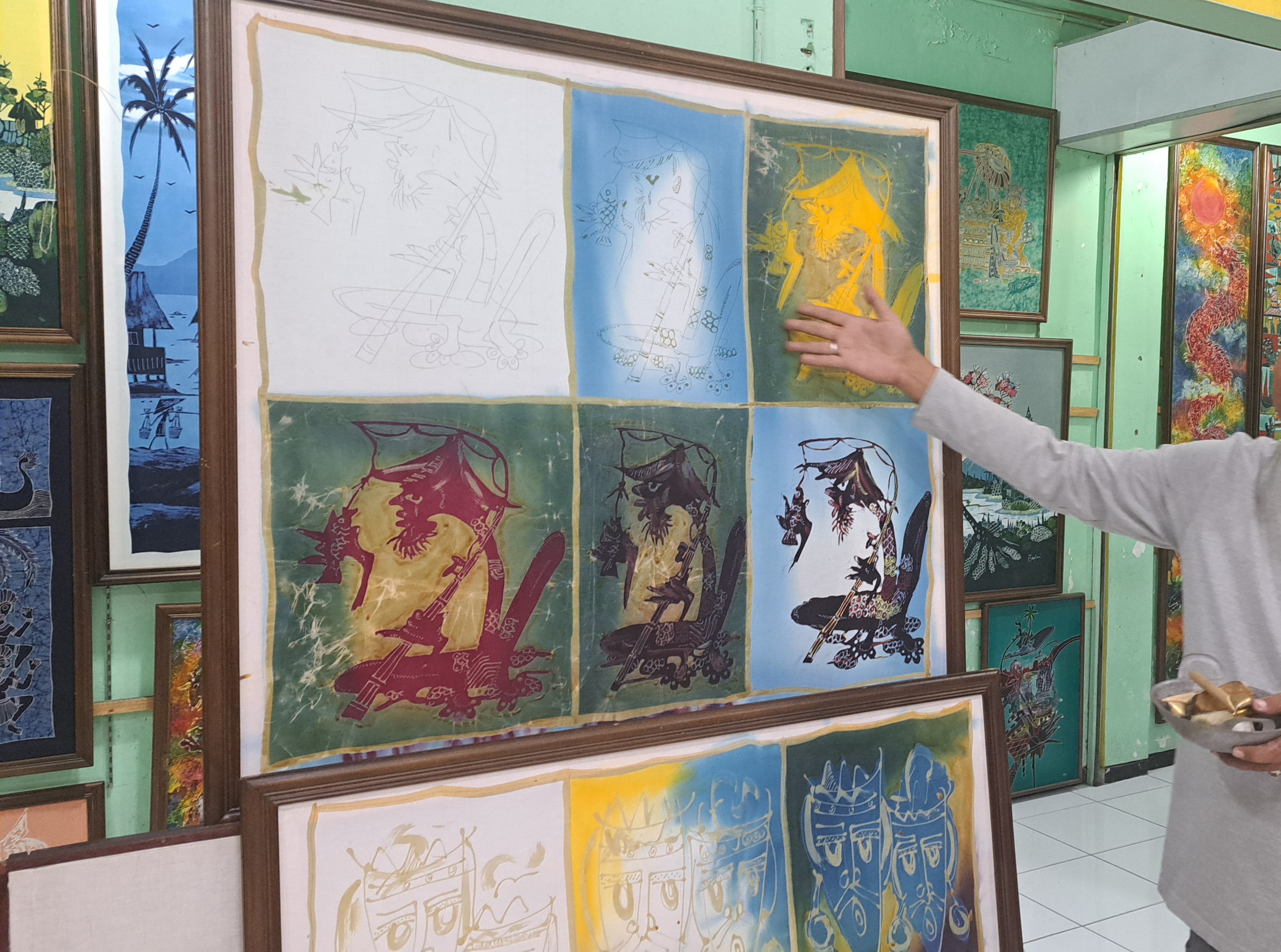
I followed the man around numerous winding backstreets into a gallery adorned with what were indeed, some amazing bits of Batik. I was served a glass of sweet tea and began to hear about the process of making it all. Hot wax is drawn onto a fabric which is then dyed. The wax prevents the dye from penetrating the waxed area, and when the fabric has dried the wax is removed, leaving behind a pattern. Depending on how intricate and colourful you want to make your design, you can then repeat this process many times.


“Now, take a look around. Remember this exhibition is one day only, so you can get good price.”

I would have happily bought all the prints if I had had the money and luggage allowance, but there was one in particular that really caught my eye, which depicted an evening scene featuring a traditional Javanese horse-drawn andong silhouetted with some volcanoes against a hazy dark purple backdrop.

“Berapa ini?” (“How much is this?“)
“150 USD”
“Ohhh, I didn’t realise, I don’t think I can – “
“One day only, Miss!”
“Saya tahu (I know), but I can’t afford to – “
“ONE DAY ONLY! Tomorrow – gone”
“Maaf (sorry) but I can’t – “
“Oke oke 130 USD because you seem nice Miss?”

Now I know that bartering is commonplace in this part of the world, but as much as I had fallen in love with this piece of art and would have loved to have taken it home with me, I didn’t have the energy for negotiating that day, and no amount of complimentary cups of sweet tea were going to convince me to change my mind, as much as I appreciated this gentleman’s time and explanation of the Batik production process.

I apologised awkwardly and scuttled as far away from the gallery as fast as I could in search of some street satay.

After my snack, I continued shopping and went to ‘Hamzah Batik’, a well renowned Batik shop recommended by a friend.  I was able to recognise it instantly from the assembly of people sat outside the shop playing local Javanese music in traditional costumes, just like my friend had told me they would be. Javanese music centres around the ‘gamelan’, a distinctive collection of tuned percussion and bronze gongs, and it accompanies you as you browse around the shop’s many floors.

You’d probably need a good few hours in Hamzah Batik to be able to leave feeling like you’d seen it all. Not only is the space itself massive, but the literal thousands of items and fabrics are piled high from floor to ceiling, which makes you wonder how many years some of them have been in there, waiting to be purchased. I observed a number of keyrings and other ornaments where the colours had faded and the dust had started to collect, and that only consolidated my feeling that a lot of the things here have been so for a very long time. There was something that felt quite sad about that.

Whilst rifling through what felt like the hundredth aisle of tunics, something very strange happened. A particular song being blasted through the speakers from the musical performance outside had seemed to be playing for an inordinate period of time, and I was beginning to find it ever so slightly irritating.

But then something suddenly switched. A key change grabbed my attention and I realised that whilst I had been conscious of the music playing during my visit, I hadn’t really been listening to it. When I finally did, I realised just how beautiful it actually was, and felt a strange sense of emotional overwhelm. I suddenly felt very far away from the life I know – 12,000 kilometres away to be precise – and even the old friends who’d made me feel so at home in Jakarta were now 600 kilometres away too. I felt very small and alone, though not lonely, and in many ways galvanised by the sensation that I was living a very different life to the one I normally do, and could do absolutely anything I wanted and nobody would know, like go back to the hotel with a hot…

…beef Rendang curry. Which is exactly what I would do for dinner that evening, in bed, without shame.

Maybe it’s not such a different life on the road after all.

After browsing for an eternity I eventually settled on a couple of blouses and a dress – the total of which cost about £10 – and left the shop. As I did so I was keen to learn more about the beautiful music that had accompanied my visit, so asked an assistant if they spoke English so that I could ask some questions. They didn’t, but in true Indonesian style they were able to quickly help me out anyway by finding a colleague who did, and I found out the name of the song that had instigated my ‘moment’, Nyidam Sari. I also checked whether it would be considered either welcome or patronising to give some change to the musicians outside the shop in appreciation of their performance. The assistant confirmed that it would be very much welcome, so I went outside, bought an ice lolly, and sat there for a little while longer to take it all in.

Nyidam Sari is a well known Javanese song that has been performed by many, but this version is perhaps the closest to the one I heard in Hamzah Batik:

I would spend a further two days in Jogja, one to finally explore Borobodur and the second to visit the shops again before leaving for Bali. As I made my way back down Jalan Malioboro to visit Hamzah Batik for the second and probably final time ever, I passed a man stood in a similar spot to where I’d encountered the one from my first day:

“Miss do you like Batik?  We have Batik exhibition. Good price. One day only!!”

My guess is that the exhibition would be sticking around in Jogja for a lot longer than I was…

THE INDO WINDOW – JAKARTA

“Jakarta, the city you’ll never love.”

The two friends I was travelling with and I were on a flight to…well – Jakarta – as we read this sentence. And having known nothing of it besides the fact that it was Indonesia’s capital and so the best place to sort the necessary logistics of our next travel plans – like obtaining visas and being able to take onward international flights – we had enthusiastically jumped to its section of the Lonely Planet guide to read about what else we could experience there.

We giggled at the underwhelming opener. A capital city which even the travel guide – a book designed to encourage tourism – had given up on, with what was basically a politely worded version of “CBA” before it even started. When does that ever even happen? Poor old Jakarta.

That was 2010. I spent several weeks there waiting for a visa to be processed at the embassy and have been back three times since, most recently in March of this year. Jakarta is a place that has – in spite of its ‘unloveable’ ways – become very dear to me. It was back then, and it remains so now.

A pretty place it most definitely is not. It consistently ranks among the highest of the world’s most polluted cities, both in the air and in the water, and when you combine the scents of that with those of the durian fruit – famed for its pungent smell and sold in massive batches down every street – you get an aroma unlike anywhere else. It’s a unique blend of exhaust fumes, heat, sweat and – owing to the durian – stale cheese and nappies. With a bit of South East Asian lemongrass thrown in for good measure.

As soon as I exited the city’s Soekarno Hatta airport in March this year, that very same smell enveloped me like an old friend offering a warm embrace (literally warm, we’re only a little below the Equator). And it made me smile and feel like I had walked back into an old home, because I had in a way.

Jakarta, and Indonesia generally, has been home to an annexed piece of my heart for fifteen years. I don’t often get to tap into it these days, but when I do, it’s still there, and – unlike an old watch in a drawer – it’s still beating like it’s never stopped, and that’s never going to change. A lot of people who I care about a great deal live there, and meeting up with them again for the first time in many years was incredibly special. What the city might lack in terms of organised infrastructure and beautiful aesthetics, it makes up for in the warmth and wonderfulness of its humans, and I much prefer things that way round.

Monas, a powerful symbol of Indonesian resilience and independence

I had chosen to stay at the Sparks Hotel, which was situated in a bustling neighbourhood known as ‘Mangga Besar’ (‘big mango’). Now I do enjoy mangoes, and so I’d be especially delighted to come across a big one, but that wasn’t the reason I chose to stay here (which is for the best since I didn’t even see any of the famed trees that apparently used to rule this ‘hood and gave it its name).

I’d chosen Sparks because it was the same hotel I stayed in for three weeks 15 years ago, and I was intrigued to see how much or how little it had changed. I also recalled it had an epic swimming pool on a mezzanine near the roof, so that you could cool yourself down whilst being even closer to the grey, traffic-choked clouds than you would be if it were on the ground.

Walking in jet-lagged, and stale from the sweltering, evening heat to a brightly lit lobby with its overwhelming smell of lemongrass felt like deja vu. It was 2025, but it could have very easily been 2010. The hotel had recently undergone a general refurbishment, and the new restaurant area behind the reception desk looked very inviting. Yet when I stepped into the elevator to get to my room, I recognised the same interior design, the same buttons, and the same sign prohibiting the presence of durian fruit that I had seen fifteen years ago, only a lot more worn and faded now.

The rooms themselves were also just the same. The same suitcase rack – more dimpled from all the heavy luggage dumped on it over time – the same yellowing plastic kettle, the same night stand, the same clunky safe in the wardrobe, the same feeble hairdryer. And the same view from the windows…

I’d spent many an evening in August 2010 gazing out of these windows. I had been on a shoestring budget and so had to spend a lot of time confined to the hotel, where I didn’t need to spend any more money. I remember explicitly at the time noticing the neon yellow lights of the Grand Paragon Hotel in the distance. It was one of the main (only) focal points of the view, and I remember staring at it once whilst making a very expensive phone call to the Student Loans Company in Scotland. They had sent a letter to my parents’ whilst I was away asking me why I wasn’t making any payments, and demanded I get in touch to explain. I remember this call for two reasons, the first being that it was very lengthy and I was squirming the entire time about how much it was costing me, and the second because the adviser made a snippy comment about the fact I was travelling and not working. I was so annoyed by her judgemental tone, that it made me want to stay travelling and not work. Ever.

The view from the window

In March 2025, I looked out again at the Grand Paragon – same neon yellow sign – and internally responded to my 24 year old self, the one who’d just ended the call with the SLC and had vowed to bum about travelling forever just to make a point to the moodywomaninScotland:

“Bold plans there, Sophie, but in two months’ time you’ll be catching a bus at 7am every morning to deal with customer complaints for 9 hours a day. In Hemel Hempstead.” 

Moody SLC woman would win in the end, it would turn out. Damn her, although I also partly cringed at the brashness and naivety of my younger self for thinking I could spend my whole life avoiding reality and not paying back my student loan. Selling coconuts on Sumatran beaches to get by, that had been my grand plan. Instead, I’d soon be desperately trying to appease customers who were angry that the brown boots they’d ordered were missing from their delivery.

The longer I looked out of the window, the more the vivid memories came sweeping back. Things I hadn’t thought about since that time – the clothes in my suitcase – which I wouldn’t wear now. My old Nokia ringtone. The content of Skype conversations that took place at the table next to me each evening. How I spent a lot of that time missing the experience and people I’d just met in West Sumatra, and the crispy prawns I’d enjoyed once from room service. Visual memory recall does some incredible things. I almost felt like I was still my 24 year old self, only more grey, creased and knackered by life – but still with a fondness for Indonesian satay and Bintang beer – and maybe that’s the closest to time travel we can get.

The longer I stayed in Jakarta this year, at 39, the more I wondered how the younger me had ever managed to navigate its crazy and chaotic infrastructure. The traffic and sprawling neighbourhoods that blend one into the other, and the other, and the next. No Google maps, no smartphones, no mobile WiFi, and certainly no GoJek (Indonesian Uber, but with motorcycles instead of cars).

Even with all of these digital additions now to assist, Jakarta still feels like an intense and sometimes intimidating place. One which never sleeps and which keeps you on your toes – literally – since the pavements are speckled with gaps that could take you plunging right down for a bath in the sewers if you mis-step.

Yet somehow, it all just works. There’s always a way. You always get to where you need to on time, even when the odds feel stacked against you, even when the traffic is stagnant and the clock ticks down. The train will depart from Gambir Station in 45 minutes, and that’s 60 minutes away, but you can feel assured that you’ll be on that train. Somehow.

I needed a new set of headphones to enjoy music on the 6 hour train journey to Yogyakarta that followed, and somehow they were the first thing I spotted on sale at the station. I needed to obtain a refund for another ticket and expected a battle at the ticketing office, and somehow I was met with a welcome “Here you go” as the Rupiah notes were handed over. A friend wanted to meet me to say goodbye and he was miles away with minutes to spare, yet somehow I was boarding the train with the bag of travel snacks he’d just bought for me in what felt like just thirty seconds later.

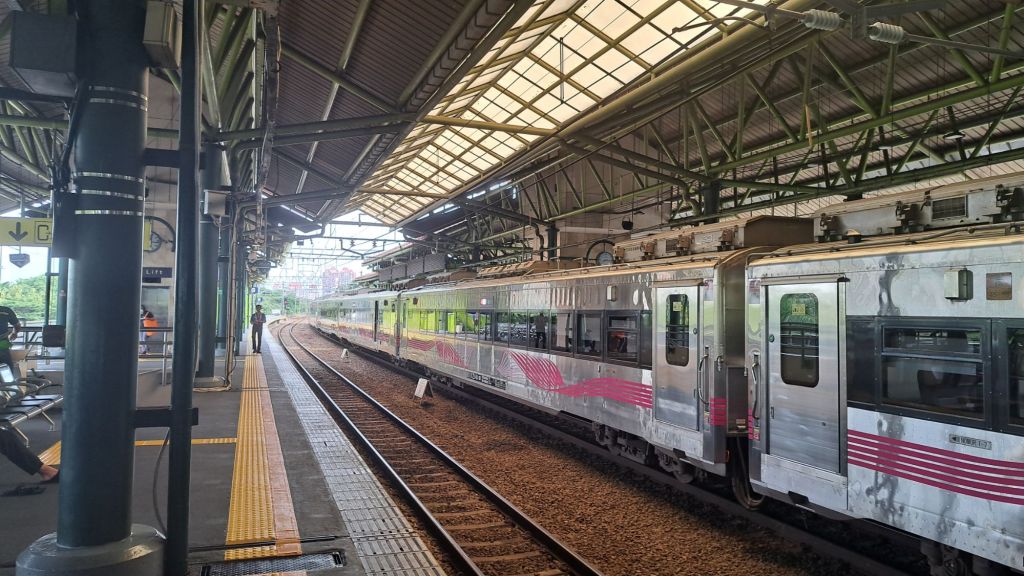
A train arriving at Gambir Station (their trains are infinitely better and cheaper than ours, by the way)

And if you need help, they’ll bend over backwards to help you, even if the conversation is a mixture of the most basic English and Bahasa. And it somehow feels easier and more straightforward than it does at home, suggesting that sometimes it’s better to just roll with the chaos rather than to stress and try and deconstruct the problem to find a logical solution that may or may not even work.

One evening this year, I booked a motorcycle taxi to take me back from my friend’s house to the Sparks Hotel, a 30 minute journey which cost the equivalent of one pound. As the motorcycle – driven by a guy wearing flip-flops and no helmet – perilously weaved between the cars on the freeway underneath the night sky, I realised I was doing something I don’t think I’d have the courage to do at home. It would feel too scary to sit on a motorcycle there, even though the roads are safer and driving standards more uniform. I wondered why that was, and then that same thought hit me again: sometimes it really does take more mental energy to try and coordinate the chaos than to just sit back and surrender to it.

Indonesian windows offer many alternative views.

I thought back to those now infamous words:

“The city you’ll never love”

But, I do. And I always will.

And not just for the people.

LES PETITES CHOSES QUI J’AIME* (‘THE LITTLE THINGS I LOVE’ – PARIS EDITION)

(*I used Google Translate. My recollection of French barely extends beyond a poem we learnt in year 8 about a frog who fell from a ladder, so I really can’t claim to be a polyglot.)

Ask any woman aged between 35-45 from where her first impressions of Paris arose, and she may very well respond with, ‘Amelie’, the 2001 film starring Audrey Tautou in which a young French woman with a pronounced-bob hairdo breaks away from an isolated, sadness filled childhood in the countryside to the capital, where she works in a cafe and finds a calling bringing joy to others’ through the simple pleasures in life. 

Her favourite simple pleasures include: plunging her hands into sacks of grain, tapping her spoon on a creme brulee, and skimming stones along the Canal St Martin. She considers the small things to be the big things, and takes masses of delight from them. And she’s quite right about that. And we could probably all do with being a bit more Amelie Poulain.

The film was an unparalleled success which provided many with a beautiful, romanticised insight into Parisian life that could not be learned from GCSE French classes and clichés about garlic and baguettes. As with any piece of art, it wasn’t to everyone’s tastes (a Lancastrian roommate at University was particularly unimpressed, handing the DVD back to me whilst muttering simply, “woman in it is serrrrrr fookinannoyin‘” – poor ol’ critically acclaimed Audrey Tautou!), but in the quarter of a decade since it premiered, it has become one of the most renowned bits of cinema, and even led to an uptick in the number of baby girls being named after the leading character in the early ’00s.

It’s a film that once seen, stays with you. To the point where it’s hard to take a trip to Paris without seeing it through the eyes of Amelie, looking out for the tiny treasures, and yearning to float around the streets and parks of Montmartre as she did, in her uniquely whimsical way. Not here to tick off the famous landmarks, just here to simply feel all the simple feels. And eat all the delicious eats.

So, in the spirit of Amelie, I’ll write not an entire piece on everything that happened during a recent weekend away in Paris, but some of the small things that played a few notes within a beautiful piece:

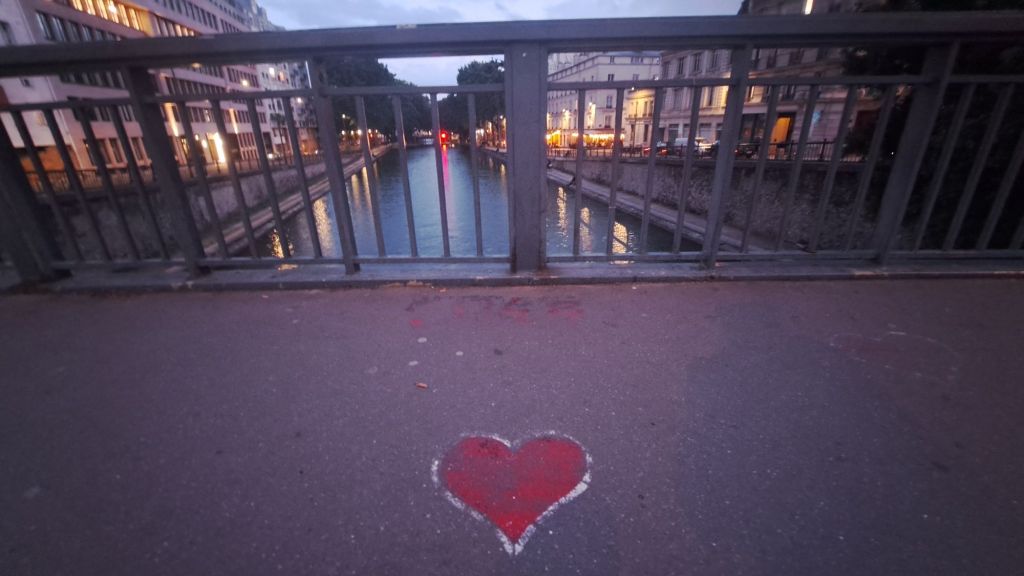
  • A simple heart painted onto the street, on a bridge over Canal St Martin. Maybe the same one Amelie enjoyed skimming stones off of.

  • The perfectly imperfect choir rehearsals taking place in the church at Abbesses. The wrong notes. The stopping and starting over, again and again, until it works.
  • The way Paris makes you question if everything you see is an intentional piece of art. Along the Rue de Dunkerque, a lettuce had been dropped on the pavement outside the greengrocers, and I wondered for a good few minutes about what the meaning of that was. Lettuce be more grounded? Lettuce leaves in a hurry and stumbles? Or maybe it just fell during transit, and means absolutely sod all. Nah, that can’t be the case! This is Paris!
  • The repeated sound of the ‘Correct!’ notification on DuoLingo as a lady in the hostel dorm completes a French language challenge at midnight. This weird fusion of actuallythatsquiteannoyingbutIalsoquiteadmireit. Pa-baaa!
  • The sight of a man on a bicycle wearing headphones, holding the handlebar with one hand and swinging the other to the beat of whatever he’s listening to.
  • A big, grey cat sleeping in a living room window that overlooks the Rue de 3 Freres, to the delight of pedestrians walking by.
  • Amusingly titled food products in foreign supermarkets:
  • An American woman sat next to me in a cafe apologising to the waiter for how she’s “about to pronounce the words here‘”, which I think is very nice of her albeit unnecessary, until she goes on to absolutely butcher ‘Croque Monsieur’ to pieces, and a polite laughter among us – a group of strangers who’ll never see each other again – ensues. Croak Monjaw.
  • Walking alongside the River Seine in the sunshine. Watching a guy do backflips on a wall. And another listening to French hip hop, whilst a third is drawing a landscape in fine ink. So many individual stories unravelling alongside this impressive waterway.
  • Waiting staff who politely make you feel like an A* French student just because you said that the dish was, “delicieux”, aka one of the few bits of vocab you can remember: “Ohhhh your French, tres bonne!”, I mean it’s not really is it? I said one measly word. But thank you anyway, I’ll take it!

In fact I’ll take you any day, France.

THE “UK’S WORST HOTEL”, A DESERVED TITLE?

I have a really strict criteria when it comes to hotels. Since they’re not cheap, when the rare opportunity arises for me to stay in one, it absolutely has to be one of two things:

A little bit quirky

OR

Have lots of terrible reviews

I know it might seem like I’ve made a typo in the latter, but I mean every word. Unless I’m travelling with friends or family – when I’ll comply with more ‘normal’ choices – I’ll always choose budget and character, over nice, but expensive and boring.

I haven’t always felt this way, but then in 2017 I needed to book into a hotel opposite the train station in Stoke on Trent, and it changed everything. Say what you will about cleanliness and quality (neither of which that hotel particularly had), but I’ve never stayed in a hotel I’ve spoken about more. I can’t even remember most of the others. My stay at the North Stafford Hotel prompted much laughter, and conjured bizarre stories and anecdotes in abundance.

It also gave birth to a dream of visiting terribly rated hotels all over the country and writing a book about them, but I never pursued that dream due to both time and financial constraints. Now, a vast number of writers and YouTubers have beaten me to it, and probably do it better than I could anyway.

But there’s always been one hotel here in Kent that’s been on my list of places to experience before I die. Maybe it would be in poor taste to name it, so let’s just say I’ve been burstin to go ever since I found out it earned the grand title of the ‘UK’s worst hotel’. For several years running. Perfect.

I finally got to tick this item off my bucket list (no, not ‘sick bucket’!) in April 2025, when a Folkestone-based friend was having some birthday drinks. I could have found a way to get home that evening if I’d tried to, but I didn’t try. At all, in fact.

It was time.

Beautiful Folkestone, a town I always enjoy visiting

After a delicious lunch on the Harbour Arm and an hour reading my book on the dreamy seafront, I finally make my way to the hotel to check-in. The automatic door opens, so already my expectations have been exceeded.

“I like your green shoes, love!”

The group of men in the lobby start laughing. Maybe I should be offended, but I’m not. I’m too excited to be fulfilling a dream, and am eager to check-in. The service is friendly, professional, and hassle-free, and this would be the case in every encounter with staff during my stay. Before heading to my room, I take a little tour of the building. It’s everything I hoped it would be. Hypnotic carpets. Worn leather seats. Yellowing ceilings. I feel like I can still smell the many B&H’s that would have been smoked in these rooms in the 1980s, and strangely, I don’t actually dislike that fact.

The whole place brings back memories of some of the best nights out in my life. Only those who attended Lancaster University before 2010 will understand it when I say this is like Morecambe’s Premier Venue – the Carleton (R.I.P) – but for those who didn’t, the Carleton was basically like this, but with stickier floors, cheesy music, and people throwing up everywhere (not always me) after one too many of the venue’s signature cocktails, named ‘stiff’uns‘. Maybe that’s what happens to this place at night, too. That’s something I’ll have to find out next time.

I head to my room and elect to take the stairs over the elevator, on account of only being on the first floor. Room 151. If this was the North Stafford Hotel – which incidentally belongs to the same chain as this one – Room 151 would probably be between rooms 312 and 543 on floor 7, but here, the numbers do seem to run in a logical order. On my floor, at least.

Room 151 is in the very regal sounding ‘C Wing‘, although some odd kerning on the signage makes it read more like ‘C WIN G’. To get to C WIN G I must walk down a very long corridor. A very long corridor.  One which I’m not sure even has an actual ending, and quite possibly doesn’t. I walk along and am enveloped by a smell that evokes memories of visiting my much missed grandmother in her care home shortly before she passed away. It’s both a comfort and a discomfort and it leads me to ruminate, but I’m quickly detracted by a piece of paper stuck to a door on which a note has been scrawled and highlighted with a blue Stabilo marker pen:

“KNOCK BEFORE ENTERING PLEASE

I make a mental note to keep my door locked, and wonder what sort of commotion has been ensuing along this very long corridor recently.

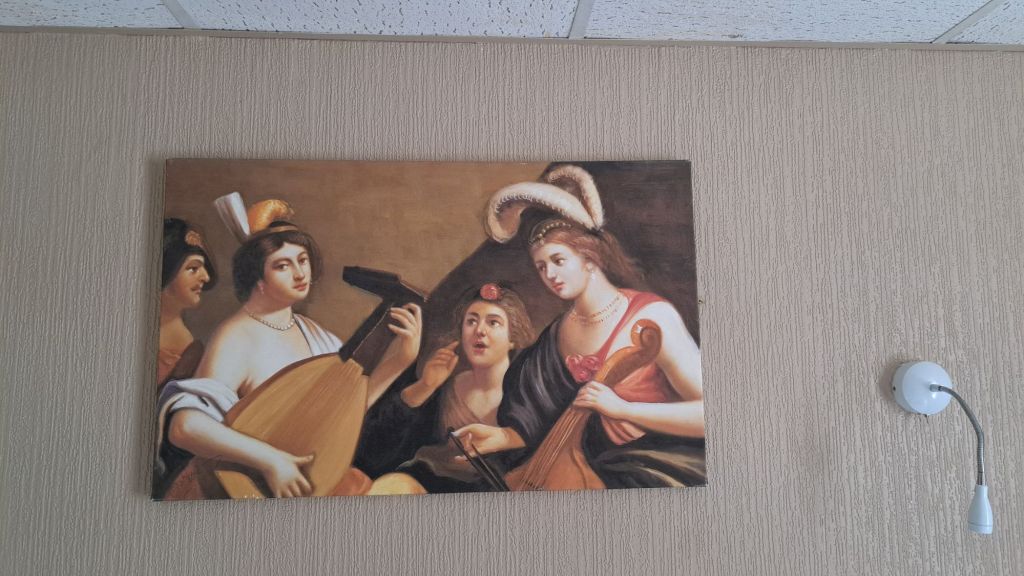
I enter my room, and am pleasantly surprised. The reviews and articles I’d read had evoked visions of walking into some sort of bog with bricks for beds and stained underwear for curtains. Instead, I walk into a light, bright space which upon first inspection seems clean and tidy, although the artwork is a little terrifying:

Lute, or weapon?

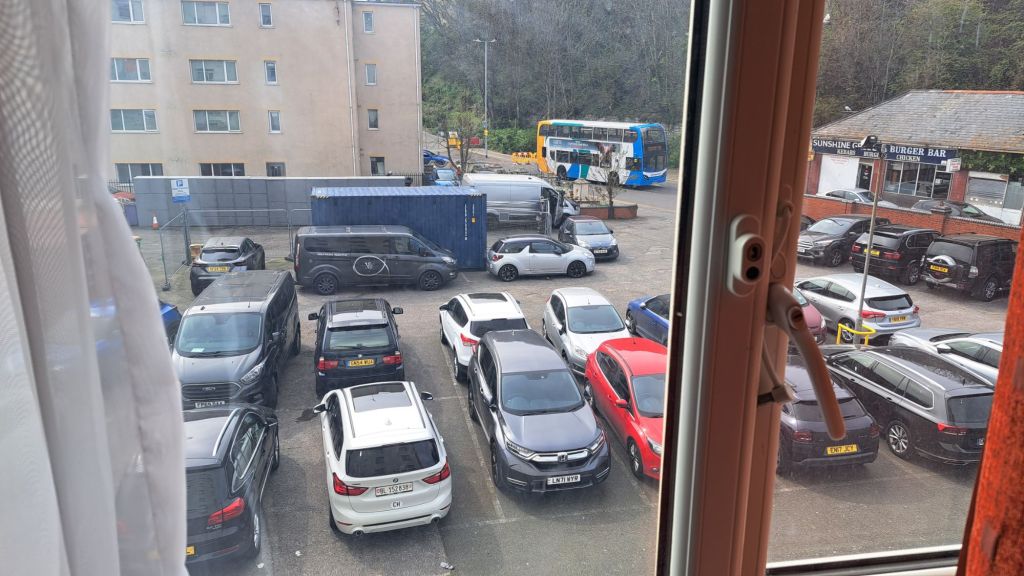
My room is – unfortunately – on the wrong side of the building for a sea view. Instead, I am proffered stunning views of the car park, and the Sunshine Bar and Grill over the road. Still, it’s better than the view of vents and discarded Styrofoam containers I had at the North Stafford. Another thing I have here, which the North Stafford didn’t offer, is a full on ironing board and iron. Just in case I fancy straightening out any creases in my luggage whilst absorbing the beautiful panoramic:

I make myself a coffee and notice what appears to be Pot Noodle dust peppered around the spout of the kettle, but it’s nothing a little wipe can’t fix.

I’d been hoping to use my time pre-party to check out the sauna, but the swimming facilities were closed due to staff sickness, so I decide to have a bath instead. It’s during this initial venture into the bathroom that I discover the previous occupant has failed to flush the loo (I wonder if they had been burstin, and just forgotten to flush in the wake of overwhelming relief), and there is no sign that there has ever been any shower gel in the shower gel receptacle. I draw a bath anyway, and become perplexed at how the bath tap seems to activate the sink tap too. Multitasking! The running water alternates between trickles and full on downpours, but we get there eventually.

Bathed up and dressed, I decide to head down to the bar area for a coffee. And to be honest, it’s all absolutely fine. It’s busy – proving that even in spite of the reputation, the hotel remains popular – and I appreciate the range of dialects I can overhear. Scottish. Irish. American. I’m proud to live in a county so attractive to tourists. It makes me feel like I’m on holiday, too.

I choose the comfiest looking piece of worn furniture and am shortly joined by a noisy group next to me, where one lady in particular is enjoying herself and appears to be a little inebriated. She starts to empty the contents of her handbag all over the table. One of the items is some lipbalm:

“Sharon’s never seen me without my Carmex, and we’ve been friends for 20 years!

She then cackles out an incredibly loud innuendo about the lipbalm that’s too filthy to put into print, and people turn to look for from whom that exclamation came from. She doesn’t care, she’s enjoying her own joke too much, and I actually quite admire the hubris. Good for her, I think to myself.

Coffee consumed, I decide to venture out in the sunshine to grab a sweet snack and test my theory that everybody always looks deadly serious when eating ice cream cones. I return a few pounds heavier, having witnessed no challenges to my hypothesis.

Back in my room, I make a phone-call, and whilst gazing ahead notice what appears to be a blob of snot affixed to the wall. Of everything I’ve experienced in this hotel so far, this is the one thing that crosses a line, and makes me physically gag. I reassure myself I’m only here for one night, and by the time I return from the party it’ll be hopefully too dark to see it. Or not. It’s pretty fudging massive, like it came out of the nostril of a hippo, or some other megafauna. It’ll probably even illuminate the room overnight with its green glow, I guess I’ll find out later.

A short while later my ‘neighbours’ arrive. I don’t see them, but I can definitely hear them:

“No, please don’t, you’ll set off the alarm. You’ll set off the alarm. YOU’LL SET OFF THE ALARM!”

“Oh, alright then, I won’t!”

Phew.

I then hear them comment on their impressions of their room. They, too, are in awe of the ironing board. They also rate the beds, and have an early start in the morning. A sheet of toilet paper dividing the rooms – like the one I found in the loo perhaps – would provide more sound insulation than the existing walls, I’m sure.

***************************************

I return from my evening out around 11.30pm and walk over a pile of crushed tortilla crisps that have integrated into the hypnotic carpet. No salsa. The bar is busy and full of life, and accents from all over the world. I love it. It feels like the entire planet has compressed itself into this little tatty cruise ship shaped building in East Kent, frozen in time since the ’80s. The nautical theme also makes it feel like the cross-channel ferries I used to take with my grandparents around the same time, watching the ashes from Nan’s fag drip down into an aluminium ashtray whilst nibbling on a Toblerone too big for my infant-sized mouth.

Back in the present, I hear only laughter, people conversing with strangers, others burstin into song, and the likes of ‘Time of my Life’ emanating from the ballroom. I see people smiling and enjoying themselves within the craziness of it all. I hear an American comment that life is not about money, but community, having fun, and eating tasty food. Last night, he ate the best prawns he’d ever had in his life. He “even took a photo.” I love him.

If this hotel is ‘bad’, then I’m not sure I really care about ‘good’.

Character over perfection, every single time. I’m burstin to tell you, that places like these are so much better than you think they’ll be, and they will almost always make you smile, and even laugh a bit. They’ll also save you a fair amount of money, so you can afford to come back again.

Now there’s an idea…

A CLAMBER UP THE QUARRY

What would you do if you came across an injured goat on the side of a mountain? Who should you call? What if you don’t have signal, would you just have to leave it?

These were the questions I was pondering to myself one warm August morning earlier in the year whilst ascending the steep, slate inclines of the Dinorwic Slate Quarry in Llanberis, Snowdonia. The air was so still, so silent, that it greatly amplified the sound of a goat bleating coarsely from beyond.

So intrusive to the tranquility was the noise that my immediate thought was that the creature must be in distress, and maybe I could find it and provide some aid. I subsequently pondered over the questions above, and was concerned that I didn’t really know any of the answers.

It was whilst doing this I saw something that would put my mind at rest. On a not too distant peak, I was just about able to make out two fuzzy balls of copper bounding towards one another, bleating recognisable bleats. They had been using their vocals – which were now softening – to find each other, and it had worked. Mystery solved, and thank goodness, because I’m not sure I’d have known what to do if my initial concerns had been realised. I carried on with my walk to the summit.

The day had started off in a strange tone. Until this point, I had spent my Snowdonia trip in the company of loved ones and we had all had a lovely time, but first thing that morning they had returned home and I was suddenly alone. Alone time is never usually a problem for me. As an introverted-extrovert, my energy sources oscillate fairly evenly between company and lack thereof. I need them both at different times. Many of my favourite outdoor adventures have been the ones I’ve had by myself, exploring and getting lost in nature and my favourite music, but this morning, there was that subdued feeling similar to the one you might feel as you chuck bits of popped balloons and food waste into binbags following an enjoyable party, that missing people feeling.

I knew that the best way to respond to this would be to give myself a bit of a mission for the day ahead and I immediately knew what that mission would be – to find the Anglesey Barracks (which, confusingly, are not on Anglesey).

The Anglesey Barracks are a group of granite cottages that were built high in the Dinorwic slate quarry during the 1870’s to serve as homes for those working there, to save the daily commute. One need only look at what remains of them today to know that they didn’t boast the greatest of living standards, even in those more basic of days. Each cottage housed four workers across two small rooms: a communal kitchen space and a shared bedroom. At no point during their occupancy did they have access to electricity so the only source of heat was a fireplace fuelled by coal that they had had to lug up those testing terrains in all weathers. Water needed to be collected from streams, and lack of hygiene and sanitation was a big problem. 

Use of the barracks for housing ceased in the late 1930’s for this reason, and since this time the buildings have been left and reclaimed by nature. It is this, combined with the history, that provides the mystical and intriguing aesthetic that makes them so popular with explorers, historians and photographers. Indeed, I had only come across their existence from an Instagram post, and then a framed photo on the wall in the cottage which we had just been staying in. Although the barracks themselves weren’t widely signposted I could tell from a bit of brief internet research of whereabouts they were, within walking distance from Llanberis, a place I knew fairly well.

I headed towards the Power Station and looked to my left for a footpath that would take me up towards the top of the quarry. It was pretty much where I expected it to be, and so began the steep incline to the top. The first fifteen minutes or so was all about big steps. The ones that make you feel like you’re doing a high-knees HIIT session on repeat. Although towards the end they were getting quite tiring, I also knew that big steps meant big heights, and big heights meant better views. I was excited to clear ‘tree level’ and to reach the steep dark-grey slate paths that wound round the side of the quarry peaks. I knew the barracks couldn’t be too far away, and persevered against the inclines, which were altogether more challenging in the August heat.

The barracks would have been easy to miss. The main footpath takes you only parallel to them for a few brief moments, and they are concealed by both a copse of trees and being lower down than the path itself, accessible by steps. I had reached a bend in the footpath and it was only from this that I noticed the neon jacket of a fellow explorer 140 degrees to my right, stood in the centre of the historic residential street. 

The sights did not disappoint, feeling every bit as intriguing as they had seemed on screen, but looking most definitely smaller than what I had been expecting (and I certainly hadn’t expected them to be spacious). I carried on walking through ‘streets’ that would have once seen heavy footfall every day but today only had a couple of prints, those of neon jacket guy, and mine. It was humbling to observe.


There were more cottages around the corner. These ones seemed to have experienced an even greater reclamation from nature. Mossy green branches protruded out of what were once bedroom windows, roots had broken into the foundations leading to piles of collapsed slate everywhere, and there were certainly no roofs on any of them. The exposed remains of a lone cottage sat slightly closer to the edge of the ridge and afforded a great panoramic, the perfect place to eat my ham sandwich. I sat for a while looking out towards Yr Wyddfa and though from here I couldn’t see a single soul on the mountain I knew that up close it would be teeming with hundreds of hikers striving for the summit, like ants crawling an anthill. I gave myself time to absorb the moment. Yes, I was still feeling some dregs of loneliness, but what a stunning place to be (and what a fit sandwich to be eating too, I seem to recall that one was particularly good).

Fuelled up on protein, fibre and a rush of adrenaline from the views I continued my ascent up the winding slate path to the top of the quarry. It was during this stint that I heard the not-so-distressed goats, and also saw a few others, such as this pair, which studied me intensely as I approached:


I couldn’t get over the fact they had actual horns, just like the ones found in storybooks. Fittingly, they seemed to disappear the closer you got, leaving you wondering if they’d even be real or just an illusion catalysed by the drop in air pressure from the rising altitudes.

I eventually reached the quarry peak, which somehow reminded me of a cross between the surface of the moon and the American West, not that I know either of those well. There were clear signs of human activity, not least from signage warning of electrical currents, yet very few actual humans about. Everything about it felt other worldly, and I enjoyed wandering aimlessly for a while, in awe of the sheer size of the expanse. 

A man-made pier-like structure led out to a viewpoint, at the end of which somebody had recently attached a bouquet of flowers in poignant memory of a loved one. This must have been a special place to the departed and as I once again took in the panoramic I could completely understand why. I admired the dedication of their loved one for keeping the bouquet so intact during what it is a steep and testing climb, and imagine it brought them some solace to place it there.

It’s hard not to fall massively in love with this part of the world. It’s not the best kept secret, but neither is it a full front-page spread. The perfect balance, maybe.

I looked down over the village of Llanberis, where I had checked into my bunkhouse a few hours previously, and was surprised to see it now looking like a small blur, a good time to start my descent perhaps.

The goats were fine, my mission had been achieved, and it was time for a curry and a pint of Snowdonian IPA.

KLEIN WUNDEREN AM RHEIN / SMALL WONDERS ON THE RHINE

There is a large number of things that I have loved about Germany for a very long time. They mostly centre around food (Spaghettieis for the win!), music (Blümchen, Die Ärzte and Fettes Brot to select from a variety of genres) and the varying landscapes that characterise so many different corners of the country, from the alpine mountains in the south, the industrial cities of the north, and the various yellows, greens and blues that form the Rhineland in between. Then of course, there’s all of those gorgeous colourful timber-framed buildings that you can see all over the country, often evoking imagery of something out of Hansel and Gretel (minus the witch, hopefully, but also minus the Battenberg windows, sadly).

This year, I was delighted to have the chance to get back out to Germany with a friend. I had seen some extremely cheap flights to Cologne in the Summer, and snapped them up whilst I could. It was a very busy and extremely entertaining weekend, not least from the fact we had arrived during ‘Karneval’ weekend. This was something which had been unbeknown to us but not to the entire rest of the German population, who all seemed to descend upon the city every 11th day in November, our first full day there. This centuries old tradition was originally celebrated as a way to scare away winter spirits, and nowadays translates into revelers from all over the country packing every square inch of the streets of Cologne in fancy dress and enjoying several biers and glühweins whilst singing songs together extremely loudly. After the initial shock to the system, we felt extremely pleased to have been able to experience it, but were admittedly extremely grateful when the crowds started to clear and we could move about more easily.

However, my favourite part of the weekend was a boat ride along the Rhine that we had booked for the Sunday afternoon. To me, the experience brought together all the things I love about Germany in one river-roving vessel. During this 1.5 hour journey towards the southern borough of Rodenkirchen and back, a gentleman played classic German pop covers and traditional songs on a keyboard whilst groups of friends and families jigged about on the dancefloor, cheering on all those who came to join them. Extremely polite waiting staff took drinks orders and talked us through the different varieties of schnapps on offer, before bringing back a Kölsch and a shot glass of dark, syruppy matter which would clear the airways for the next decade.

Next to us, an elderly lady appeared so delighted with the size of the sausage brought out to her that she held it up in the air in disbelief, waving it about whilst her daughter grinned on. Up on deck, a young man named Ben enjoyed practising his English on us, although I was keen to try to speak the best German I could remember from school whilst conversing back at him. Ben explained that his family had traveled to Cologne from Berlin, especially for Karneval. We spoke about his life in Berlin, and how he supported F.C Union Berlin and specifically not F.C Hertha Berlin. Ben volunteered to take a picture of my friend and I, before heading back down to his family, a group made up of several generations.

Alongside the friendly company, amazing hospitality, classic tunes and good local beer, what I also loved was the river itself. This huge expanse of water was a true gift to the senses, and conjured up much in the way of imagination. At 1,225 kilometers long, from Switzerland to the North Sea, our little boat ride barely scratched the surface of the entirety of what the river has to behold, and that’s not even accounting for the vast history, which includes being a vital conduit for trade during the Roman era.

No sooner had I arrived back in the UK, I was looking up how much it might cost to travel a longer distance along the Rhine, and the general upshot was that I’d need to sell my home and probably a limb to be able to do so. So, with that dream out the proverbial porthole, I’m instead just basking in the memory of a very magical 1.5 hours in November.

Song of the Day: The Dining Rooms – Wild Love

The Dining Rooms is an Italian band who combine ambient and electronic music together in a fusion they refer to as ‘downbeat’. This isn’t the sort of song I’d put on whilst getting ready to head out, but it’s perfect for a long drive on dark and rainy evening. Very atmospheric and appropriate for this time of year.

DELIGHTING IN FRENCH DE-LIGHT

One of the most endearing experiences of natural light I’ve ever come across occurred last weekend, not far from Calais, France. A friend and I had some time to spare before catching our ferry back to England, and thought we should use the time to try and juice being abroad as much as possible, and see as much of it as we could see.

It was a Sunday, and most of France was typically shut beyond some vague signs of life at Cite Europe, a shopping estate reminiscent of a bunch of metal shipping hangars with an enormous car park where the painted arrows seem to have a mind of their own. We browsed around and found only a couple of uninspiring English-themed pubs and a Thai cafe – where we ended up ordering a quick snack from a very unobliging waitress – open.

It’s fair to say – after we finally received our food – that this experience wasn’t making us feel that we were making the most Frenchy use of France, so we took a look at Google maps and noticed an appealing streak of yellow on the coastline a twenty minute drive away. A drive there followed by a quick walk on the beach would then set us up nicely to get back to the port in time to catch our boat.

As we drove to Plage de Strouanne near the small town of Wissant, the enormous grey constructs of Cite Europe became smaller and smaller in the rearview mirror and were replaced with some of the brightest greens and blues I had seen in a while. The small village of Peuplingues that we went through en-route could have been right in the very heart of France, since it felt so far removed from the industrial environment we had been sitting in just a few minutes and kilometres earlier.

We were making our journey during that magical window of time just before the sun starts to set, a time when it seems to be saying to itself, “I know I’m about to disappear for a few hours, so let’s leave them all with a little parting gift.” The golden gloss it had lacquered across the French hills was accompanied by a rainbow that seemed to last for about twenty minutes. I’m not sure I’ve ever seen a rainbow as close to a sunset before, but it was the most perfect fusion of lighting and colour.

When we reached Plage de Strouanne we parked up and followed the footpath towards the water, eventually working our way down a steep set of sand dunes to reach the beach itself. From here the panoramics were pretty incredible, and though the photos don’t do it justice, I hope they’re enough to make you consider taking a little detour here if ever you have some time to spare before catching a ferry from Calais.

No sooner had we driven away to make our way to the port, dusk set in, the blinding lights of the A16 no patch on the natural lighting we had just experienced.

We reached the ferry port, took it in turns to seriously believe we had lost our passports evoking much panic, and then ate far too many Kinder Schoko-Bons in quick succession to heal said panic before catching the ferry home across a pitch black channel.

It had been a detour well worth making, and I was strangely thankful for the fact everything else had been closed.

Song of the Day: Siriusmo – Gummiband

Sticking with a continental theme for this month’s post I’m sharing this track from Berlin-based electronic whizz Siriusmo.