A COFFEE IN 1950’S SOUTH EAST LONDON

“Oh no, it’s no good, I can’t decide between the jacket potato or the panini…”

My attention was roused. Somebody nearby was experiencing a menu-related dilemma and I needed to hear the conclusion. What was it about the jacket potato that was creating doubt? Or, were they simply in more of a mood for bread? Were they going to opt for tuna, or cheese and beans?! I needed to know, and decided to take a pause from the various bits of life admin arithmetic I was scrolling out in my trusty green notebook so that I could listen in and find out.

It was a beautifully hot and sunny Wednesday afternoon in September and I was sat in a pondside pavilion cafe in a bustling and beautiful South London park. As much as people may malign London for being what they perceive to be a giant sprawl of dark concrete, little gems like this help to showcase how green it actually is. There’s a very good reason why it became the world’s first national park city in 2019, and as I take in the landscape around me, I’m full of appreciation for just how much brighter and emerald-like the biodiversity is when juxtaposed against the beige and greys of the ’60’s architecture on the other side of the railings. In many ways, it makes it sweeter.

I’ve plonked myself here because I full-on fancied the shade from the parasols – although – a particularly strong coffee has undone some of the remedial work and a light-headed feeling has come over me. I’m going to be here for a while, so the notebook has come out to accompany my pondside repose.

It’s hard to focus at first. On the table to my left are two screaming babies and their mothers’ ensconced in loud chat about irregular feeding times, toilet trips and somebody else’s “disastrous” engagement party. I’m somewhat relieved when they leave, because the sudden vacancy of sound amplifies the conversation to my right.

It’s this party of people, four older ladies (including the one in a quandary about what to order) who captivate my attention.

Once they have been served their lunches (with jacket potatoes prevailing, by the way), they perform grace. I’m not sure I can remember the last time I heard anybody say grace. It may not even have been within the last two decades, so this really stands out. The lady leading it pays particular homage to “our Tom, looking down and with us in spirit.”

“I really appreciated that part. Thank you so much.” says a lady in a green top and a headband who gives away her name several times during ensuing conversations, but let’s just call her ‘Dorothy’ for now. It becomes clear that she is recently widowed, and that she was very much in love with Tom.

Of the four ladies, it is Dorothy who speaks the most. There is a sense that these ladies go back a very long way, but also that there is a lot about each other they’ve still to learn. Dorothy talks at length about growing up in south east London – in Brixton to be precise – and how six people would routinely share a bed in their family home. Money was very tight back then, Dorothy explains, so much so that by the end of the week, she and her family would often be making a dinner out of bread dipped in gravy (I guiltily acknowledge my thought that this actually sounds quite appealing to me).

This part of the conversation prompts a lively discussion about today’s youth. Each of the ladies agree, that young people today “have it so much easier in comparison”. As somebody without children, who – at this point – is hearing a child in the background wailing loudly about not getting an ice-cream, I find myself inclined to agree, on the back of what I’ve just heard. But then I recall being a young person myself and hearing older generations say similar things back then, too, and they were never particularly helpful comments to hear and nor did I think they were right. In truth, I don’t think any generation has – or had it – harder than anyone else, instead I just feel that different times present different challenges.

Having said that, it’s hard not to feel a real admiration for these ladies and their experiences in life. Dorothy tells a fascinating story about how an older cousin she had growing up turned out to be her sister. The mother had been very young when she first gave birth, so her parents – Dorothy’s grandparents – brought her first child up as their own. It is hard not to notice the parallels with a particularly famous Eastenders storyline, and it is absolutely fascinating. The two ‘cousins’ grew apart over the years and only reconnected after Dorothy researched the family tree. This was the point at which the truth of the relationship surfaced, sadly long after the death of the sisters’ mother. Dorothy and her sister didn’t speak overly often, but would always send one another a Christmas card.

There is a lot of talk around family units and – in particular – the role of the patriarchy in 1950’s south-east London. A story is shared which illustrates this perfectly:

“She would prepare his suit every Friday, so that he could wear it to the social club on Saturday. She’d send her little daughter, Jackie, to the laundrette in Camberwell Green to collect it. One time when she was running this errand, little Jackie was struck by a car, and when the Police broke the news to her mum, she just replied, ‘But what about his suit?’ “

Another lady at the table talks about her grandparents. Nan and grandad. They never went on holiday together, because they didn’t actually like each other, but they stayed together:

“People did in those days, women were too financially dependent on their husbands to leave.”

“The husbands would sometimes leave the wives, though. My husband’s granny… her husband left her with nothing and she had to put the two boys into a home because she couldn’t afford them. People seem to think that kind of thing didn’t happen in those days, but it did. And then there were the workhouses, that’s where a lot of them ended up…”

Workhouses. A well-known characteristic of Victorian-era Britain in which those unable to support themselves financially would spend 12 hours a day carrying out the most monotonous and grueling labour, like breaking stones and crushing bones to extract the fertiliser, in exchange for a roof over their head, albeit a very cramped one with residents consisting mostly of the elderly and sick.

Though I maintain that different times present different challenges, I’m hugely relieved these things were abolished long ago.

After a fascinating fifteen minutes within this south east London time portal, the conversation shifts back to the present. They’re about to head off. They pull out their phones and share despondence that none of them have received any messages, except for Red Top, she’s had twelve, but most of those are from ‘Carol in the group chat‘. And there are some new pilates classes coming to the centre that they feel will be just as popular as the chair yoga, but it’s the impending electronic bingo machines that really excite Dorothy.

I feel so sad when they leave.

People often speak of eavesdropping like it’s a dirty thing to do. I’ll agree, there are times when it’s clearly not appropriate. But, in comparison to the talk of nappy habits and disastrous engagement parties that made my initial coffee a slightly testing experience, I know which conversation I’d prefer to overhear. I don’t think it does us any harm to sometimes sit and listen to people who we may never otherwise get to meet, to hear their stories and thoughts, to learn about different lives in different times. Different struggles, different joys.

As the ladies leave they excitedly remark about a heron on the opposite side of the algae-strewn pond:

“There he is, in his usual place!”

Thank you for letting me stay for this short and most memorable while in yours.

10,000 DAYS OF DIARIES

This is my collection of personal diaries, which are kept in a fire-proof box at my parents’ house. There is one for every year since 1996, and every single day’s entry has been completed in full, meaning around 10,000 days have been recorded among them. This only meant a few lines per day for the first four years, before an A5 page a day from 2000 onwards (I had no idea what to do with all that additional space to start with, but made it my mission to fill it up somehow, and once I’d started with that, didn’t want to break the sequence). I was inspired to start keeping a diary by my mum, who has religiously kept a diary for decades too.

My diary collection is one of my most valuable and precious material possessions. They are deeply personal, but I’ve often been happy to share excerpts with friends and family upon request, particularly the more historic they become! Many of their own memories are captured in there too, and often this includes things they had long forgotten about. As well as being an outlet for me each day, this is one of the diaries’ most important purposes. They ensure the preservation of special moments, special people and special things. Of course, there’s a lot of not so nice or more mundane moments stored in them too, but even those help serve perspective when reading them back.

Back in January 1999 I was incredibly upset about the fact my group of school friends had had a falling out, because there were more of us than there were members in the band Steps, and this meant not everybody could take part in the talent show performance, leading to some people feeling left out, and arguments occurring. We laugh about it now. In 2001, a classmate borrowed my felt pens but didn’t put the lids back on after using them, and the nibs dried out. I’ve deliberately selected some of the silliest examples here to help illustrate a point, but still I look back and realise how fortunate I was that things like that represented my biggest concerns. Life before mortgages and MOTs.

A couple of years later I was scribing grumbles about having to go and visit my grandparents after a night of one too many cider ‘n’ blacks. And you know how it goes; I obviously read that back too and think about how much I’d love just to have the option to visit them now. Then there are frustrating accounts of entire days being too busy playing Mario Kart or chatting on MSN to complete an application to something that I’m fairly sure I would have loved to do. Unlocking Rainbow Road and discussing plans for a night out felt way more important at the time. There were far too many daylight hours at University that were spent sleeping or eating instant noodles, and not enough trips to the Lakes. I spent a whole afternoon of my 2010 Indonesia stint ferrying around the city trying to find somewhere to access the internet just so that I could read some emails that I can’t even remember who sent them now or if I even had any at all.

In the more recent years, the contrast isn’t quite as extreme. Progressively throughout adulthood we learn a bit more about who we are, and what our values are. I stopped having entire days in front of computer games many, many years ago (though I do still shamelessly enjoy the odd bit of Mario Kart!) and though it probably would still irritate me if somebody caused my pens to dry out by neglecting to replace the lids, I doubt I’d consider it noteworthy enough to scribe into my personal history anymore. But that said, there are still things I read back on that seemed like such a big deal at the time and now seem like nothing, and it’s always so interesting to see that.

Making the most of any given day and realising not to sweat the small stuff are two of the biggest things that keeping a daily diary has taught me, and I think those are two lessons that I’m happy to re-learn over and over from every single page.

One day I hope these books will be useful to somebody else too; how that’ll happen I’m not really sure, but even if they just give some descendants something to read for a bit and laugh over then I guess that’ll be something.

Song of the Day: Yamar – Dry Bread

A nice, Summery toe-tapper of a tune with Caribbean infusions.

https://www.youtube.com/watch?v=bx9P5lW2c5M

THE MYSTERY BOX

My microwave blew up the other month.

It was all very chaotic.

The turntable was smashed to smithereens, the food inside splattered everywhere and – perhaps worst of all – lunch was completely lost. A bowl of soup now fodder for the kitchen bin. Serves me right for cooking it the lazy way, I guess.

After fooling myself for about three hours that I could manage life without a microwave I succumbed to ordering a replacement, and for a somewhat halcyon period after it arrived, all seemed right and merry with the world again.

But joy eventually turned to despair when this new microwave too, started going a bit crazy. After a few weeks, it would turn on by itself and start rotating about, as though a ghostly apparition was in my kitchen heating up a big bowl of invisible ghost food. Now I may come from a family that loves to eat, but I couldn’t think of any of my dearly departed relatives who would choose to re-emerge just to use a microwave. Many of them spent their whole lives without a microwave for god’s sake.

No. The somewhat less exciting reality was that my new microwave had a known manufacturing fault and needed to be returned, but the explanation behind the plight of the microwave is not the point of this post.

The point of this post is to showcase examples of the hidden impacts from what can sometimes seem like trivial, insignificant things.

To cut out a long and really boring bit of detail, I needed to post my microwave off within the next few hours to be able to get my refund, as I was only a couple of days from the end of the Return period. Taking it to the Post Office was no problem, but securely packaging it was. In all the joy and merriment of receiving my new microwave, and to save space in my flat, I’d thrown away the original box, which just so happened to be absolutely massive and tricky to replace.

I visited a number of shops to try and buy a replacement box so that I could hurriedly ship Micky M II back to Amazon in time, but nowhere sold ones anywhere large enough. I went to almost every shop in town to see if they had any boxes they wanted to shift, but it seemed I was out of luck.

A supermarket on the outskirts of town was my final hope and by that point, I had explained my request so many times that I was spluttering out my words with the same complete lack of panache as a faulty microwave launching lunch all over its insides.

“Hi, errere bleurghy bleh looking microwave box” – or so I’m sure it sounded.

The gem of a lady on the Customer Service desk politely endured my incoherence and disappeared for what seemed like quite a long time. She returned with a massive cardboard box that to my delight, was not only the size I was after but had also once been a receptacle for packs of Roast Beef Monster Munch. She explained that it had taken a while because she had needed to shelve its contents first.

After offering my profuse thanks, I took my box to the Post Office and had a long date with some sellotape and bubble wrap before posting my faulty item off forever.

Though it may sound extreme, I’m fairly convinced that by going out of her way to help somebody who wasn’t even a customer in supplying a surplus to requirements box, this lady saved me £80. There was no way I was going to be able to get the item sent off in time if not. So whilst she may have felt she was providing me with something of very little meaning or value, the hidden context – that she wasn’t aware of – meant that actually, she really was.

It made me think more generally about acts of kindness and how what may seem like small gestures can have a massive meaning and impact that we won’t necessarily ever get to know about. I am (fortunately) not £80 away from being bankrupt, but what if I had been? In these challenging economic times, it’s clearly not an amount people can just throw away.

In the town I live we have a thriving freecycling and sharing community where people give items they no longer need or want to people who do. It’s a wonderful initiative that is becoming country-wide and I’d love to see the impacts of the exchanges looked at in further detail, and hear the stories behind them. A top that no longer fits one person that may make another feel like a million dollars. An old karaoke set that was taking up space in somebody’s lounge and then brought a surprise form of entertainment to another family’s Saturday night. Functional stuff like food or USB cables that made somebody else’s day that little bit easier.

What might be of little value or seem a small gesture to some, can have massive meaning for somebody else.

Sometimes what’s in the box is much more than meets the eye. A true mystery box.

Song of the Day: Tears for Fears – My Girls (cover of Animal Collective)

The experimental music of 21st century US act Animal Collective may not to be to everybody’s taste (though it definitely is mine). But then how better to make a tune appeal to the masses than by drafting in a well loved ’80’s pop band to make a cover of it that sounds akin to something that would manage to get everyone – without exception – on the dancefloor. This cover sounds exactly how you might anticipate it would and it’s awesome.

THE TALKING TATE

I’m not usually one for an art gallery. If you were to plonk me in a random city and ask me to pick from a list of local attractions, I’d prioritise: a) anything that involves moving on water, b) anything that involves interesting food, or c) anything that will make my ears happy and my legs want to dance. I don’t think you can usually do any of these things in an art gallery (but if you can, please tell me about it!)

The Tate Modern is one of the UK’s most famous art galleries and I have been twice throughout my entire life. Once with a couple of friends (all I have is a fleeting memory of something we were chatting about as we descended an escalator), and once when I needed to quickly make use of the facilities whilst drinking from the pop-up places on the South Bank. I have often heard and read about how wonderful this place is supposed to be, yet I’ve probably never really embraced it properly. I love the concept of art, but mostly as written or musical forms as opposed to static ones. When it comes to the prospect of art galleries, I just don’t always get them.

On a recent day off work, I was in London with some time to spare and thought I should try and broaden my horizons by making a proper visit – alone – without the distraction of catch-up chats with friends going on in parallel, and with the time to move around on my own terms. To read what I wanted to read. To pass by what I wanted to pass by.

I ended up covering every square meter of the Tate within about 50 minutes (the recommended visiting time is 3-4 hours). I guess I just don’t have the sort of brain which is always receptive to what I’m sure are genius feats of creativity. During my trip, I was confronted by: some fluffy drapes hanging from the ceiling in the entrance hall that resembled something from the dodgy Ghost Train at Cassiobury Park funfair in the 1990’s, Cezanne’s paintings of a few discoloured apples that looked like something from a yellow-sticker haul, and a picture frame sculpted into the wall that just looked like somebody made a mistake with a chisel then tried to make it look intentional by completing the rectangle shape. Each of these things are no doubt way better than any ‘art’ I could produce and I mean no disrespect to the artists, but they just didn’t make me feel anything at all.

But, there were a few exhibits which really did make me stop, stare and think. Tracey Moffatt’s ‘Up in the Sky’ collection of photographs designed to capture indigenous and non-indigenous lives intertwined in a deprived town in the Australian outback, Martha Rosler’s representations of American airports as channels of the human body and transience of life, then this one, Cildo Meirele’s ‘Babel 2001‘:

It’s a tower comprising of 800 vintage radio sets ranging from the oldest at the bottom, to more modern ones at the top. They are all playing at the same time; different frequencies, at only slightly different volumes. “No two experiences of this work are ever the same”, reads one of the only exhibit descriptions I have ever been interested enough to read in full.
And that’s entirely the point of it. Meireles’ exhibit aims to remind us that as soon once we reach information overload, communication fails. Read one hundred random facts and you’ll maybe remember ten percent of them. Read three and you’ll probably remember one hundred percent.

Out of 800 radio sets that were all playing at once; I could only really recognise one song, an ’80’s number I never remember the name of. There were dozens of voices, but I couldn’t make out what any of them saying. A friend of mine went to the same exhibit a few days later and heard something else entirely. I found the whole thing incredibly clever, and very powerful. When one person speaks you’ll hear every word but when everybody is doing so at once, in different frequencies but similar volumes, nobody really gets heard, and that’s a shame.

We live in an age where technology has advanced so much, even since 2001 when this work was completed. The parameters of choice have become so broad, that we’re far less likely to be hearing or seeing the same things anymore. I have previously written about the impact of the likes of Freeview and streaming services on the day to day chats we used to have about television, but it doesn’t end there. These methods of communication and entertainment are designed to make our lives better and our minds more informed but I’m not always entirely sure that they do.

The more we have of something, do we still make the most of each individual component? Do we really remember each episode we’ve watched if we’ve binge-watched several series? Each book we’ve read if we’ve almost exhausted the Library? Or each stereo we listened to if there were 800 to choose from? Does knowing that we can pretty much find out anything we want to know within minutes thanks to the internet make us really feel more intelligent as a society or does it only make us set a higher bar for ourselves? I remember sitting in front of the computer in my early ’20’s, fresh out of Uni with no idea what to do next, knowing that in the hidden corners of the internet right before me I could probably find an opportunity that would change my life or kick-off my career, but feeling slightly pressured by that same knowledge, and simply having no idea where to start looking. I think I searched for a bit of advice, only to find dozens of people sharing a billion contrasting opinions that only added to the confusion, and ended up giving up and looking up recipes for interesting curries instead.

Among the vintage radios forming Babel, I recognised the Sony stereo that accompanied my school homework and thought back to the days when you couldn’t simply skip a song you didn’t enjoy, only manually fast forward. And though something like Spotify would have seemed the stuff of dreams back then, I felt some nostalgia for the days when you’d just have to listen to a song regardless, and would often grow to like it in time. We are very lucky with what we have now but there is definitely something to be said for keeping it simple, too.

I left the Tate, bought a coffee, and spent some time thinking about what I’d just seen. I then realised what I was doing, and acknowledged taking a step closer to realising what all the fuss about art galleries is about 😉

(But seriously, if you know of an art gallery on a speed boat, that serves unusual world grub and plays Weezer as you walk around please let me know)

Song of the Day: The Shins – The Great Divide (Flipped)

This is the sort of anthemic song you feel should have been around for years, but in reality it’s only a couple of years old. It’s just lovely. That is all.

“Ooh, the blind
Collective mind of man is all they’re offering
Then you bring a breath of life out of the emptiness
Your hand in mine, oh-oh-oh (your hand in mine)

The great divide”

GOAT TO THE MOUNTAINS

If there’s one thing I don’t like so much about the Kent landscape (which I will otherwise wax lyrical about) it’s that it’s a little bit too flat.
I probably shouldn’t complain about that too much, because if it wasn’t then we’d all have to perform hill-starts more regularly, and would probably have slipped over countless more times in this past, particularly icy week. Plus, I can still feel my heart crunch when I recall younger times trying to carry my weekly grocery shop up a particularly steep alleyway in Lancaster that always felt as challenging to conquer as I imagined the ascending travelator on Gladiators would (the sausage roll and fags diet probably didn’t help with that, mind).
Either way, when you’re used to living in a county which is predominately flat – albeit beautiful – it’s easy to forget just how massively diverse the landscape is across the rest of the UK. Only in relatively recent years have I really started to realise and appreciate this; and because to get to these places requires resources which we don’t always have spare, it makes any opportunity to see them that little bit more precious.
I was absolutely stunned by Snowdonia when a close friend who grew up there first showed me around her home, to the extent where it seemed hard to believe that it shares the same island as the likes of the M25. Fresh air, clear water, wild ponies roaming around in heather-topped hills, and other mesmerising panoramics, were in abundance, and the best thing is that they were all free to see, and get completely lost in. As a bit cringe as the saying may sound, Snowdonia is an area that truly feeds the soul and I try to return whenever I can for some ‘lunch’. Every time I go, I realise I have still only seen a small fraction of it. My friend says that she often wished there had been more for young people in North Wales to do whilst she was growing up – more cinema complexes and McDonalds like we had plenty of in Watford – and I tell her that I often wished I’d had mountains and lakes nearby, instead of concrete consumerism and pollution. I always sucked at bowling anyway.

Both of us craving mountains over the Christmas break – but with North Wales seeming too far for the time we had – on New Years’ Eve we decided to visit the Peak District for a day, another area which I know shamefully little about and had only visited once previously. We spent the afternoon walking up Mam Tor – a route recommended by Much Better Adventures – and from the peak looked out at a huge expanse of land consisting of multiple counties of northern England. We also read a bit about the famous caves – some of which were still inhabited at the turn of the 20th century – and found out about the limestone quarries the area is famous for. It was a very wet, windy and slippery day (made more challenging by the fact neither of us were wearing the right shoes) but the harsh gradients enabled us to give our legs a good stretch so that by the time we eventually got back to the car – covered in mud and exhausted – we felt deserving and ready for some stodgy food at the pub. It had been a good workout and an even better exploration of some dramatic yet beautiful – and completely new to us – scenery. Well worth the four hour drive.

We weren’t there for long but it was enough time to make a big impression. I have been thinking about it a lot since, and have many daydreams about going back and seeing more of it. And so, since it’s January and a time to traditionally look ahead, I suppose it’s reasonable to state the following: I have absolutely no idea what assortment of good, bad or bizarre things 2023 may conjure up but as long as it features some hills and mountains, that’s okay 😉

Song the Day: Mikron – Lyre

Feeling electronica at the moment! This is a nice chilled piece from a duo of Irish brothers. One of those songs you can file away in ‘perfect for driving at night or working to’.


A DECEMBER DIP

From the safe distance of three days, and combined with the presence of a couple of drinks in the pub, I fully agreed with my friend’s suggestion that to take a dip in the sea before sunrise the following Tuesday morning was a most excellent idea. Seize (or rather, ‘seas’) the day, and all that jazz.

By Monday evening I was experiencing more than a few second thoughts about this great plan. I really wanted to do it, but I also really didn’t want to do it. Life is perpetually freezing at the moment, with its sub-zero temperatures and heating rations, and so it would surely defy all logic to make it even more so.

I text my friend to see if she still wanted to go ahead, and stated that I would be happy either way – which was true – but I’d be lying if I said I wouldn’t have felt a slight (read: ‘massive’) relief had she had a change of plan.

But she still wanted to go.

And as it turns out, I’m very grateful for that.

We met at Seasalter at 7:30am, whilst the sky was still that inky shade of navy blue that makes everything else on the horizon seem way more magical and mysterious than it does in daylight, the lights of Whitstable harbour glowing in the distance.

The air was fresh, but milder than the days that had preceded it. It actually felt quite nice. There was barely anybody about, apart from a couple of people walking their dogs, and a soothing silence, aside from the gentle lapping of waves.

Getting into the sea itself was not without some immense discomfort and anguish. My friend was much braver than I, and was able to submerge herself pretty quickly, whilst I merely paddled and shook my limbs about like an octopus trying to take off a t-shirt for a while in the hopes that it may warm me up. Eventually I followed her lead, and whilst neither of us were submerged in the water for long, we both felt so refreshed afterwards and were pleased to have got in. I was also glad to have brought along a hot water bottle, and the coffee felt extra amazing.

Though it hadn’t quite been a refreshingly cooling bathe on a hot Summer’s day, I was grateful to have had a fix of nature first thing, and grateful to my friend for encouraging me to do it.

I was washed, dressed and back at my desk for 9am. Just another reason why I love living near to the sea, and another reason why sometimes you just have to say yes.

Song of the Day: The Magnetic Fields – The Luckiest Guy on the Lower East Side

This is hands down one of the most beautiful songs ever made, in terms of both composition and message. For me it’s one of those ones you forget about for years then it comes on on the shuffle playlist, and sounds though you’re hearing it for the first time all over again. Just don’t try singing along from 3:05 onwards because you’ll run out of breath, I’ve tried many times over the years 😉

THE ANCIENT PYRAMIDS AT CANTERBURY, UK

Out of the 150+ posts on this blog across the past eleven years, I’d guess that around 50% of them reference things seen or experienced whilst out and about in rural Kent. That was never the intention, I never really warmed too much to the idea of keeping to a main theme, even though a lot of people suggested it was the best way to create an established blog. It’s just testament to the local area that so many of my outdoor rambles have managed to inspire the content for the monthly post.

It seemed to start about ten years ago with a trip to the beach, continued with a maybe slightly-cheesy-in-retrospect ‘life lesson’ from the maze at Leeds Castle in 2015, a fresh glut of writing upon moving to Faversham in 2018 and then an even bigger one in 2020/2021, because walking outdoors was essentially all we were able to do.

And though we can thankfully do a lot more again now, there are still few things that I enjoy more than being out exploring the pretty unique surroundings of Kent (or perhaps it’s just because I grew up in Watford, where postcards feature the ring road and you feel privileged just to see a tree.)

(That’s possibly being a little unfair, you’ll often see one. But only one.)

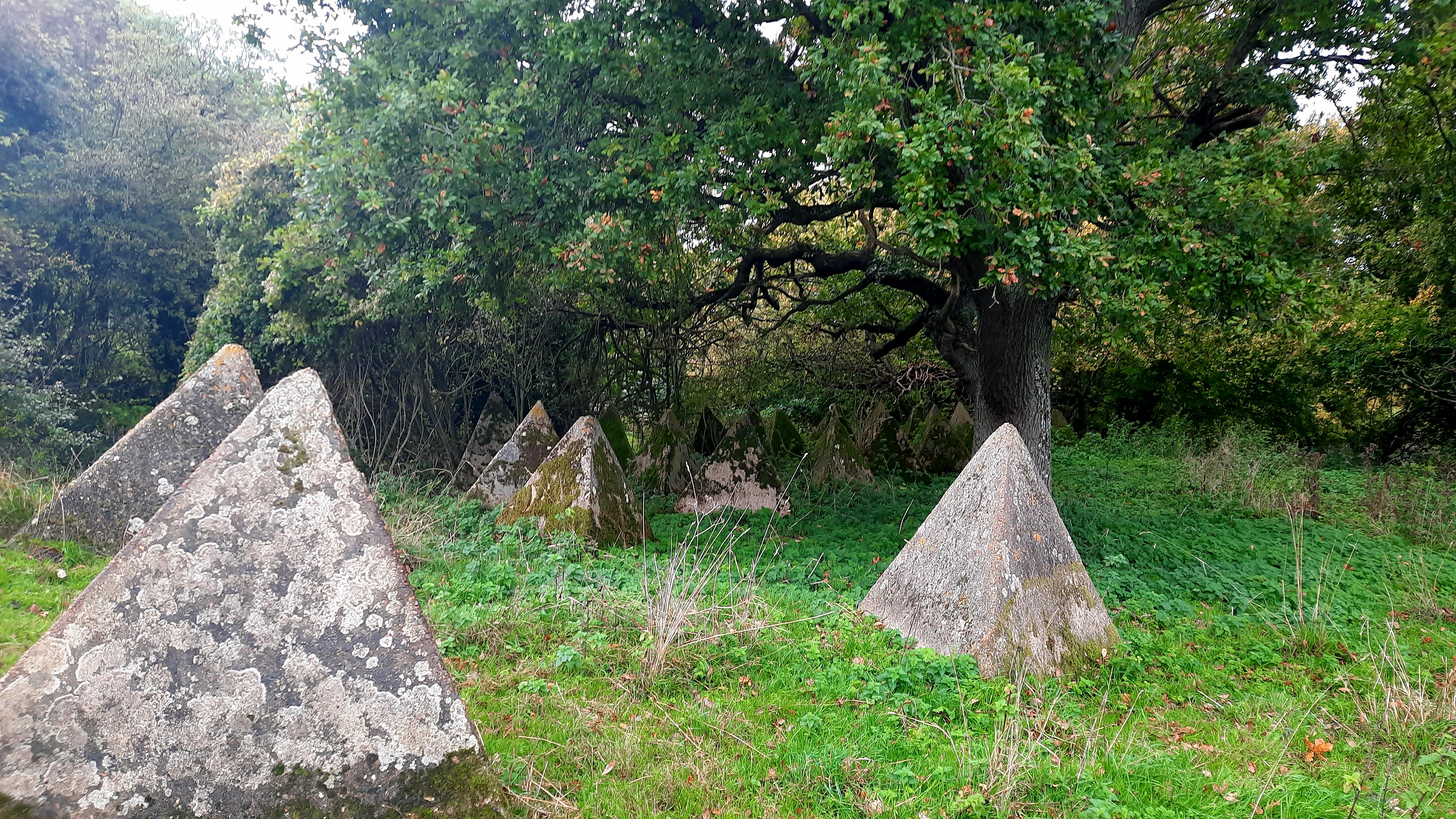
Nonetheless, in over ten years of living here I’m still not bored of Kent, and despite having walked round the countryside near to where my parents live in Canterbury countless times, it took until now to learn that we have our very own set of pyramids:

Giza, Canterbury

The photo above features what is known locally as the ‘Tetrahedra Field’. It can be found at the end of a private residential gravel-track road leading out of a village just outside of the city. With minimal footfall, it’s of little surprise that hardly anybody knows of it, and though it could be easy to assume (I certainly did) that these stones are probably nothing of note, the reality is much more intriguing.

It turns out that these triangular structures lie on what was once the site of a World War I aerodrome. Their purpose was to generally get in the way of the tanks that were used by the opposition, and if you look closely, you can still see the letters and numbers which identified them. When the airfield was closed down in the 1940’s, they were all moved into the random field above, next to the railway line.

At first glance it may only look like a graveyard for unwanted giant Toblerones circa Christmas 1972 (though that too would be exciting) but it’s also a classic example of the benefits of looking at some things twice. I will continue to be intrigued by what other hidden gems and pieces of secret history we may have lying around us here in the Garden of England, and I want to go and find and write about them all, ha!


Song of the Day: The Bad Plus – Silence is the Question

Eight minutes that’ll change your life (I exaggerate. But I promise you, it’ll do something). I don’t normally have the patience for long songs, particularly if they start off too slow, and nor do I really listen to jazz, but I somehow stumbled across this one and it sucked me in. I’ll say no more, you just have to listen to it all in one go. Just amazing.

NEW VIEWS: THANKS FOR THE CACHE

With everything that’s going on nationally and in the world at the moment, you have to celebrate every pleasure where you can at the moment, no matter how small it may seem.

Geocaching is one of my favourite things to do in my free time these days because it combines exercise with nature, and I like the challenge of trying to find things. It’s a hobby that many haven’t heard of, but with 35 million players all over the world, it’s actually hugely popular. ‘Caches’ are hidden pretty much all over the place, most often in points of interest, and people of all ages like to search for them whilst exploring the world.

With International Geocaching Day having taken place this month, I’ve been trying to get into the spirit of it by getting out and doing it as much as possible to make the most of the light Summer evenings. One of my favourite things about it is that the GPS map of the geocaches gives you reasons to take turns you’ve never taken before, explore new places, and find out new things about your surroundings. Geocaching has guided me to disused Underground stations, memorials for historic events I’d never heard of before, and seemingly random spots that offer some of the most stunning of views. All places I may well not have ventured if not for the game.

It was during one such occasion recently that a turn I probably wouldn’t have taken otherwise afforded me this beautiful panorama of golden fields and gorgeous horses:

It was a scene of pure peace against the external noise of current affairs, and during those moments of taking in the scenery around me, I felt I had discovered something very special and secret.

And these kind of moments make me wonder more generally, about what else is out there waiting to be found? What other beautiful views? What other contented creatures? Maybe sometimes we underestimate the potential for these things to be much closer than we think. Maybe it’s not always about going further, but simply going different. Not overlooking that plain old alleyway to our right, but wandering up it anyway and just seeing what’s on the other side.

Some years ago, I used to think that to see something really new and breathtaking you had to travel very far, but you don’t. You’ve never had to.

Not if you’re willing to look.

Song of the Day: Teenage Fanclub – Speed of Light

Classic Scottish indie. I borrowed this album from the library in 1999 and it doesn’t seem any less new now than it did then. Does this mean I’m officially old?

Actually, not sure I want to know the answer to that…

MISSING THE AUDIENCE: A LESSON FROM THE TELEVISION

“RICKAYYYYYYYYYY!!!!”
Harold & Madge
“You are the weakest link, goodbye!”
Beek-her Grerrrv – ha-ha, ha-ha, ha-ha.
“Here’s our Graham with a quick reminder”

If, as reading the above, you either heard or visualised them within, then the chances are that you are a similar age or above to me and would have seen them on the television at some point. I feel confident that most people can identify all five and I feel that way because for many years the majority of us were all watching the same things, and I miss that.

During the 1990s there were several things I would religiously watch: Grange Hill / Byker Grove at 5:10pm, Neighbours at 5:35pm, The Simpsons at 6pm, Eastenders at 7:30pm (or 8pm on a Monday!) as well as all of the Saturday evening classics: Noel’s House Party (gutted I never received an invite), Blind Date, Casualty, Gladiators, and all the rest. Does this sound familiar to you? Chances are it does. Just the other week, among a small group of friends, we randomly established that half of us were still haunted by an episode of Michael Buerk’s 999 where the lady got her long hair stuck in a jacuzzi filter and almost drowned. It was probably only broadcast once or twice, in the mid-90s, yet several of us remembered it well. We think about it every time we affix our hairbands in the swimming pool changing rooms, yet I can’t tell you anything about what I watched last year.

Nowadays, even though my television gets turned on almost every evening in the hope of being mind-blown, there is nothing I regularly watch, and if I do get really stuck into something, chances are I’ll only chat to one or two others who watch it too.

It’s easy to understand why this is. In the halcyon days described above, there were far fewer channels, no such thing as Freeview, and only a fortunate minority of the population owned a satellite dish. The internet was still several years off being something the majority had access to, and barely anybody owned a mobile phone on which they could while away time sending yellow faces to friends. When the weather was a bit rubbish (and remember, this is England) there was only a choice of about four things to do of a typical evening, and they each had their own button on the remote.

There were no such things as spoilers, no world wide web to give away the plot, and you either watched a programme at the same time as everybody else or you didn’t watch it at all (okay, strictly speaking you could watch it back on a recordable VHS, but the success of that was always at the mercy of whoever was in charge of setting it up). Our interest in soaps, sitcoms and dramas was always about the characters, and not the cast’s messy personal lives. Those two things never intertwined, like the media manages to make them do today.

Whilst these days watching television would not be something I endorse people doing too much of, I do – in some ways – miss how it used to be. That’s not because I believe the standard of programming has decreased in quality, but that the way in which we watch it has.

As of December 2018, there were around 460 available television channels in the UK. Of course, not everybody will have access to all of these, but on Freeview alone there are at least 70, and that’s not inclusive of the fact that you can essentially watch any programme hosted by the main channels at any time if you have access to their free streaming hubs.

This magnitude of choice may have sounded very appealing back in the 1990’s – when the likes of the Antiques Roadshow being on would decrease the likelihood of an evening being fun by twenty five percent – but in my experience, it’s turned out to be anything but. In fact, it’s probably one of the key reasons why I don’t tend to watch much anymore.

Earlier this week, I returned from an evening walk feeling shattered and cold and in need of a nice Winter evening on the sofa. I liked the idea of being ensconced in a bit of escapism in the same way I was in the past, and after making myself that little bit more comfortable, took a look through the numerous channels to find something that I could get stuck into for an hour or so. Snacks were prepared for this event.

But it just didn’t happen.

By the time I’d found something I felt compelled to watch for longer than ten minutes, the snacks had long gone, but it wasn’t because there wasn’t enough on the listings to interest me – just the opposite – and I found it hard to settle on one. If I wasn’t fully absorbed by a programme within the first five minutes, my mind wandered to the other listings I’d seen and I’d change the channel and start watching something else. This wasn’t an isolated incident either; flitting between various channels and applications is often the rhythm of my television viewing, and maybe that’s why – in my mind – there isn’t a modern day equivalent of ’90’s soaps and game shows, even though some of those same ones still run.

But this post isn’t meant to sound as though I’m trying to make a first world problem of not finding anything mesmerising enough to watch on the telly. It’s about the identification that sometimes, you can have too much of a good thing. More options to choose from – whether they’re television channels, music streaming apps, careers, profiles on online dating sites, travel destinations or varieties or McFlurry – are undoubtedly a product of the modern age for which we can only be thankful and I would not wish for this post to undermine my gratitude for that. But are they really making us happier, or have they diluted the joy we once took from these things when they were that little bit more rare: classmates bonding over their opinions of Who Shot Phil Mitchell because we’d all watched it (Google now tells you within an instant, it was gravel-voiced Lisa, IF you’d forgotten); Growing to love Track 9 on the New Kids cassette because there’s no quick option to skip and only three other cassettes to listen to; that place you kept going back to on holiday every year because you loved it so much; that one conversation you had time for on MSN Messenger because you couldn’t access the internet for more than fifteen minutes a day. It seems to me that we used to appreciate these things so much more.

My recent fiddle with the remote is just the latest manifestation of something that I have realised numerous times. It’s not always what you want, or even what you have, that makes you happy. It’s just as much about what you do and how it makes you feel. The programme can only be good if you’re watching it. You may never realise how much you love a song if you always skip it after the intro. Distance from home is unlikely to be the reason your favourite holiday was your favourite holiday, and just how memorable can a conversation be if you are having three others at the same time? Spreading things too thin is only a good idea if the jam is toxic. You’re less likely to die after one bite. But if it’s a really tasty, non-toxic jam, you’ll enjoy that bite so much more if you’ve more of it on the bread, even if it means eating a smaller piece.

One of my favourite things about the television is that I learn a lot from it; I didn’t always realise how much.

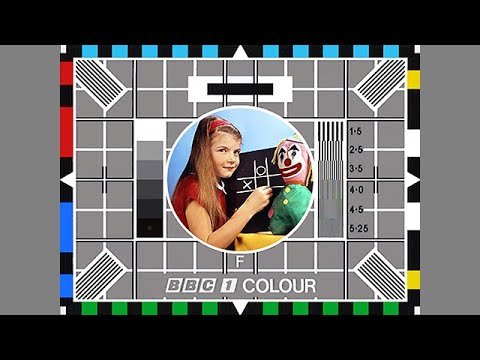
Something else many will recognise: The BBC testcard was in use from 1967 and 1998 and its predominant function was to freak the bejeezus out of anyone who turned the television on too early in the morning. And some other technical function apparently.

Video of the Day: The Simpsons – Your Putter’s Name is Charlene

What more fitting for this post than to break from tradition by including a video as opposed to a song, and this particular one is an example of how the internet can ruin classic tv. For years I’ve laughed at the scene when Homer vehemently suggests that Bart call his putter “Charlene”. It just seemed so random, why Charlene? Is the putter reminiscent of Kylie Minogue’s character in Neighbours circa 1989 or something? Would the wedge be called Scott and the green itself, Madge? I would chuckle internally at my own poor joke whenever I saw this clip. But I recently found out that it’s actually just a copy of a line from a war film. So it’s nothing at all to do with Neighbours, and there’s a logic to it afterall. Damn.
But still. A classic scene.