My guide for the day, a friendly man called Bima, comes to collect me from my hotel first thing in the morning and is very concerned about whether I have packed enough water, sun-block, and a rain jacket. Indonesia is one of the hottest countries in the world, but it also experiences a rainy season every year, and I was travelling towards the end of it, meaning I’d spend my time being either very hot or very wet, or both.
It takes us around an hour to drive to the ancient Buddhist temple of Borobodur, so we’re able to chat and get to know each other. Bima explains that he’s originally from here in Java, but his wife is from West Sumatra. They are among a minority (10%) of Christians in a predominantly Muslim (87%) country and they live in a bustling suburb of Yogyakarta with their children. We spend some time discussing the cultural and linguistic differences that can be found among the many different islands and regions that all call Indonesia home, and he teaches me some basic Javanese, like “matur nuwun”, or “thank you”, which is very different to the “terima kasih” of the official national language, Bahasa Indonesia, that I’m more accustomed to. I try my best, but have to ask him to remind me of it every time I need to give thanks throughout the day, which is quite often when you’re being driven around everywhere.
We arrive at the grounds of Borobodur and the temple itself is hidden from view as we drive up, which makes it all the more exciting. Bima sorts our entry, gives me my wristband, and we take a shuttle cart closer to the temple along with a dozen other tourists.
Before the official tour begins, I replace my shoes with the special upanat sandals – with soft soles – issued at reception. Introduced only in 2023, they serve as an effort to reduce the wear and tear on the ancient stone. 1200 pairs of feet stomping all over it every day could cause considerable damage otherwise, and one of the best bits about the upanats is that you get to keep them afterwards! They’re pretty jazzy too.
Before the official tour starts, Bima takes me on a little tour of the grounds. I still can’t see the temple, even though it’s one of the largest in the world! I begin to question my eyesight until Bima leads me round a corner into an avenue lined with ashoka trees and points ahead.
And there it is.
And wow.

It’s fair to say it’s a little bit bigger and more impressive than the wooden replica I’d observed at the museum in West Sumatra all those years ago. I’m brimming with excitement and even detect a bit of a tear in my eye, but must wait before I get any closer so that I can be shown around by an official temple guide, another rule that was introduced in 2023 to help protect the temple longer term by managing the numbers on the stone at any given time.
The sensation of suddenly witnessing the temple felt not too dissimilar to the story Bima had been telling me on how Borobodur was re-discovered. Originally built somewhere around the 8th Century during the era of the Shailendra Dynasty, the temple was in popular use for a few years before being abandoned and deserted after the dynasty was overthrown. It remained this way for a number of centuries, during which it was gradually covered in jungle growth as well as ash from the nearby volcano Mount Merapi, eventually obscuring it completely from view. It wasn’t until 1812, when the British colonial official Sir Thomas Stamford Bingley Raffles re-discovered it, that the existence of Borobodur was known once more. Throughout the remainder of the 18th and 19th centuries, the temple underwent a series of restoration works that were eventually completed as recently as 1983. When you consider the year it was first built, that recency is pretty staggering.

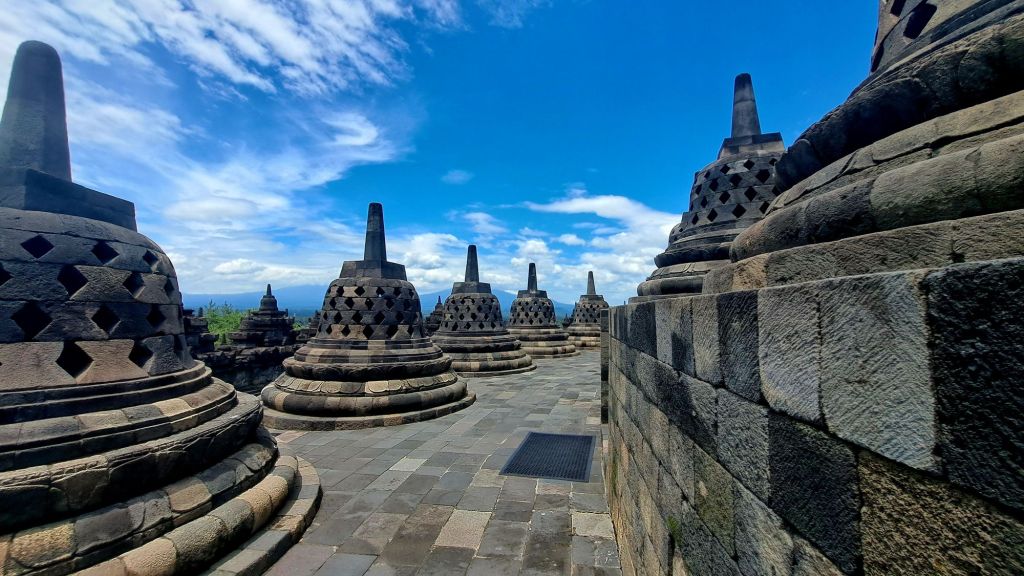
The official tour lasts around 45 minutes and consists of a guide taking a group of us up to the top of the temple platform by platform, of which there are 9 in total. As we ascend we take in some of the 2600 or so relief panels that decorate each layer, and witness how the effects of centuries of extreme weather have meant that some are in better condition than others. It’s the very top of the temple though, the central dome, that impresses the most. That’s the bit that we’ve all been waiting to see. Instantly recognisable from the 72 bell-shaped structures known as ‘stupas’ that each contain a statue of Buddha inside, it’s something which truly does take one’s breath away. And not just because of the number of steps it took to get this high.
The guide gives us 15 minutes to explore the central dome, which to me just doesn’t feel long enough. One minute for every year spent anticipating ever being here. It still feels completely surreal: the history, the tropical panoramics, and the ominous sight of Mount Merapi in the distance. Mount Merapi, which did its very best to keep the rest of the world from ever seeing Borobodur, and which would have succeeded had it not been for the curiosity of Sir Raffles.
This quiet moment of wonder and reflection is suddenly penetrated by loud conversations taking place around me spoken in native English. It’s the first time I’ve been around any of my compatriots for a week or so, and I quickly gather that this merry lot are visiting the temple as part of a cruise around South East Asia.
One of them slumps herself on a piece of sacred stone and starts fanning herself with a leaflet, her face very red:
“Err am joost too ‘ot, me, wanna get back on bert!”
Meanwhile, a few metres away, Grandma is being called into action by a young girl in her 20’s:
“Nan! NAN! NAAAN!”
“Yes love?”
“Get lots of pictures of me!!!” she orders, before performing a series of pouts in front of a stupa whilst Nan clicks away, almost dismantling the ancient structure with her big handbag as she rapidly switches between poses.
I will fully admit to judging people who are lucky enough to travel to the other side of the world only to then moan about the heat, or who seem to spend so much time taking curated photos for social media that they don’t actually look at what they’re there to see. So I walk away disapprovingly before asking a fellow tourist to take a photo of me from behind, which I later upload to my Instagram story. What can I say, Nan’s granddaughter influenced me.
As we start to make our way back down the temple I spot the smiling face of Bima waiting for me at the bottom with a bottle of water, and he suggests that we go for some lunch before driving on to the Hindu temple of Prambanan, 53km away. The place he suggests, ‘Borobodur Silver Resto’, is the perfect choice, serving traditional Indonesian food on a suspended outdoor decking area which overlooks rice paddies. We don’t have long, but it’s a good opportunity to reflect on Borobodur, catch breath and refresh.
After our meals Bima fetches the car and asks me to sort the bill whilst he does so, so I inevitably end up paying for his lunch, which he doesn’t acknowledge as I get back into the car. Although I recognise this to be a bit sneaky of him, I don’t actually mind. He’s a good guy, and his Bakso soup and Diet Coke were not exactly expensive. In a strange way, the cheekiness endears me to him even more.
Bima drives us around the countryside to a place where we can buy a bag of local fruit – Salak – which he describes as “Snake fruit” due to its coarse leathery skin. I have a couple of snake fruits and they’re pleasant enough, but also quite nutty, dry and filling. We have bought an entire kilogram and the majority of them spend the rest of the journey in my lap.
We then stop so that I can take a picture of Mount Merapi, an active volcano and one of the reasons why Borobodur was a secret to the world for so long.

“It’s very much active”, Bima responds to my question. “Erupts quite frequently. When it does, you can see the bright red lava flashing against the night sky.”
Over 300 people were killed during the last major eruption of Merapi in 2010, but even a ‘small’ eruption in December 2023 tragically ended the lives of 22. I think about what it must be like to live near an active volcano, and the persistent, uncontrollable threat that poses. You could ask yourself why people don’t just move away, but this is their home, and they just don’t have that sort of freedom of mobility. The entirety of Indonesia sits on the Pacific “Ring of Fire”, and even if you were to live a somewhat safe distance from the 130 or so active volcanoes, you’re always at a significantly high risk of other natural disasters, like tsunamis, or earthquakes. A terrible one of those would hit one of Indonesia’s South East Asian neighbours, Myanmar, just a few days later, killing over 5000 people with the wider devastation felt as far away as Bangkok. It’s a sobering reminder of how dangerous these places can be because of simple geography, and how much we should appreciate what it means if we are simply lucky enough to live on less scary tectonic plates.
We continue on to Jogja’s other famous temple, the Hindu Prambanan, and whilst it’s another spectacular sight to behold its fair to say that I’m not as awestruck by it as I was Borobodur. It’s probably because I’m feeling a bit tired by this point, and my brain is running out of storage space for any more of the temple-related facts being churned out by Bima. We whizz around it quite quickly before calling it a day.
As we drive back to my hotel in downtown Jogja, Bima makes a series of comparisons between the where we are and Jakarta.
“So you know that in Jakarta, where you stay before, it‘s very loud, right? Lots of traffic, lots of beeping. In Jogja you don’t get that at all. It’s a lot quieter.”
It’s unfortunate for Bima that after stating what I’m sure is usually true, our conversation is perforated by the sound of the longest car honk in the world just ahead of us. A female student on a moped has made a badly-timed right turn into oncoming traffic to get into her college, and the wailing car whose discontent we have overheard has pulled to an emergency stop. Fortunately nobody is hurt, and the student even seems to find the whole thing quite funny, but there’s an awkward silence in our car following the contradiction just observed.
“It seems it is quieter.” I move to assure Bima, who has gone as quiet as the streets of Jogja usually are apparently, later realising that my comment probably sounded sarcastic without intending to be.
We arrive back at the hotel and Bima tries to offload the rest of the Snake Fruit we had purchased earlier, but I don’t want it. Tasty though it was to try, I hate wasting food, and there’d be no way I’d get through the whole kilogram of it myself without making a great, fine-incurring mess in the hotel bathroom, so I insist he keep it and share it with his family and friends.
“Matur nuwun Miss Sophie!! Thank you so much ya!”
“Terima kasih juga, Bima! Wait I mean, ma-…mat….”
“Matur nuwun…”
Bima smiles and drives away and I know I’ll never see him again. It’s another example of people you meet on the road with whom all you’ve ever know is that special little chapter that you shared on just one of the 30,000 days we typically have on Earth. Tomorrow, Bima will be picking up a fresh group of tourists and reminding them to bring their rain jackets and sun-block. He’ll teach them phrases like ‘matur nuwun’ and eat Snake Fruit with them, and I’ll be about to leave a city which I dearly enjoyed experiencing, but probably won’t ever return to, given that it took me 15 years to come here in the first place.
But Borobodur? That’ll outlive us both. At least for another thousand years, and especially if people keep wearing those upanat sandals…
 sophiekemsley