
I still remember the first time I set my eyes on the ancient temple of Borobodur, a UNESCO World Heritage site, and the largest Buddhist temple in the world.
Except I wasn’t looking at the real Borobodur, but a miniature wooden replica, housed in a museum in West Sumatra, almost 2000 kilometres away.
It was 2010 and my fellow international trainees and I had been taken to the museum by our Indonesian hosts to learn more about the nation’s history and culture.
“Do you know what this is, sister?”
“Egyptian pyramid?”
“Haha no sister. This is Borobodur. Famous Buddhist temple, near with Jakarta. You should go one day ya sister.”
15 years later I alighted in Yogyakarta – the closest city to the temple – after a train journey from Jakarta which took 6 hours, a close proximity by Indonesian standards. My opportunity to see the temple had finally presented itself, but I was also keen to explore its home city.
Yogyakarta is a city most known for being the cultural hub of the island of Java. It’s also pronounced nothing like ‘yoghurt’, which is how I’d been saying it to the Indonesians all week, but ‘Jogjakarta’ , or usually referred to as just ‘Jogja’. I was staying at the hotel ‘Royal Malioboro by Aston’ (not selected because of the football team I’m unfortunate enough to support) which was handily located opposite the train station, according to the description. Despite this convenience, I still struggled to find it, and mustered up my best Bahasa Indonesia to ask a stranger for directions:
“Saya (I am) looking for hotel Royal Malioboro Aston”
I was met with a puzzled look that I initially thought was down to the bad Bahasa, before being motioned to look across the road at a building with a sign at the front that said in big letters, ‘Royal Malioboro Aston‘. Oops.
After dumping my things in my room and changing into clothes that weren’t dripping with sweat from the long train journey, I was keen to head straight back out to check out the markets. Due to its rich cultural heritage, Jogja is considered by many to be the home of Batik, a traditional Indonesian dyeing technique involving wax which coincidentally I happen to love, with its bright colours and patterns. It’d been many years since I’d last had an opportunity to buy authentic Indonesian Batik clothing, and I was keen to add some more to my collection.
I started browsing around the various shops and stalls along Jalan Malioboro – a renowned shopping street – before a smiling man with a very friendly round face started speaking to me in English, asking questions about who I was and why I was here.
“Oh, you like Batik? Follow me, we have a special exhibition in town today. One day only.”
I followed the man around numerous winding backstreets into a gallery adorned with what were indeed, some amazing bits of Batik. I was served a glass of sweet tea and began to hear about the process of making it all. Hot wax is drawn onto a fabric which is then dyed. The wax prevents the dye from penetrating the waxed area, and when the fabric has dried the wax is removed, leaving behind a pattern. Depending on how intricate and colourful you want to make your design, you can then repeat this process many times.
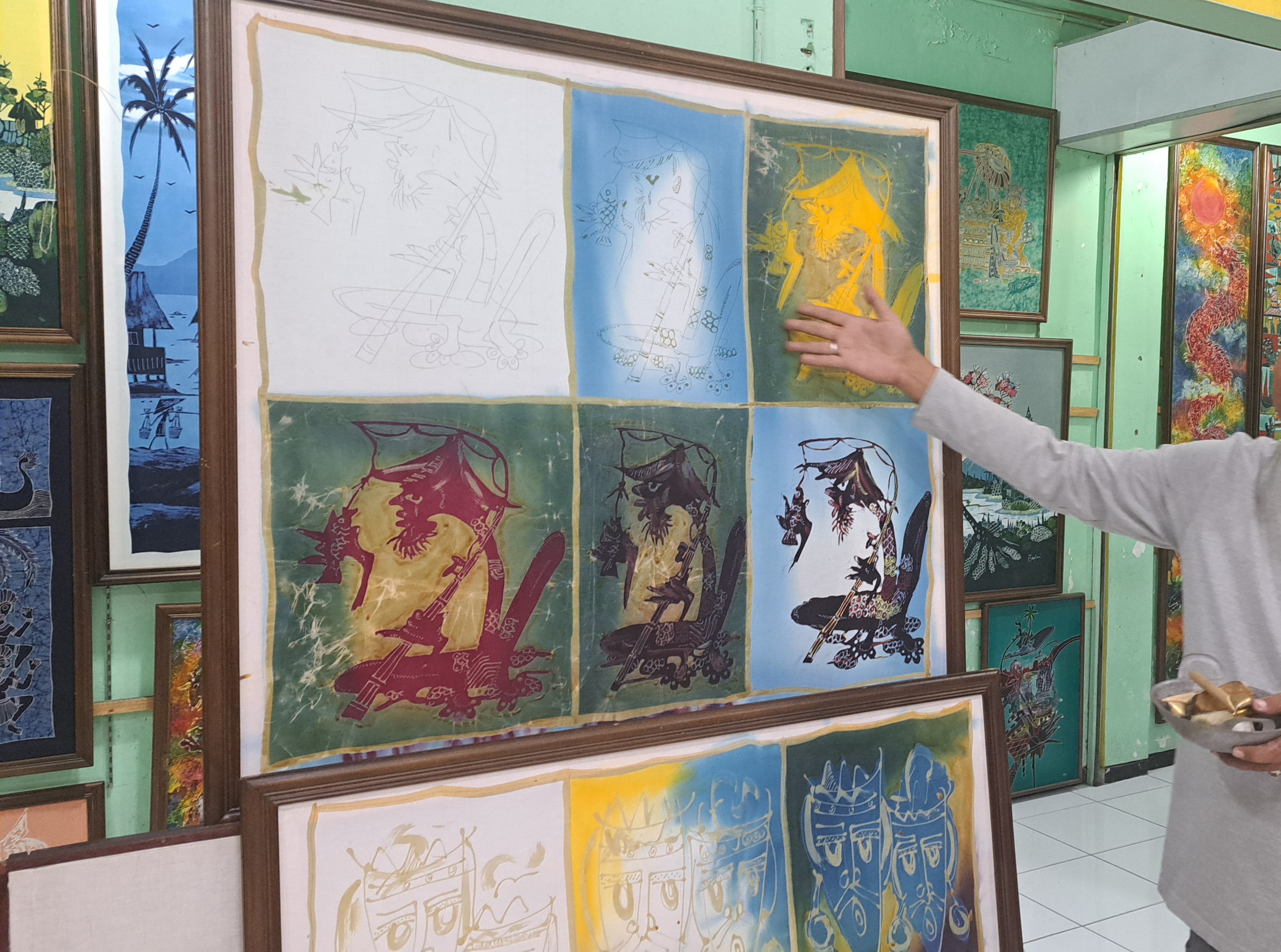
“Now, take a look around. Remember this exhibition is one day only, so you can get good price.”
I would have happily bought all the prints if I had had the money and luggage allowance, but there was one in particular that really caught my eye, which depicted an evening scene featuring a traditional Javanese horse-drawn andong silhouetted with some volcanoes against a hazy dark purple backdrop.
“Berapa ini?” (“How much is this?“)
“150 USD”
“Ohhh, I didn’t realise, I don’t think I can – “
“One day only, Miss!”
“Saya tahu (I know), but I can’t afford to – “
“ONE DAY ONLY! Tomorrow – gone”
“Maaf (sorry) but I can’t – “
“Oke oke 130 USD because you seem nice Miss?”
Now I know that bartering is commonplace in this part of the world, but as much as I had fallen in love with this piece of art and would have loved to have taken it home with me, I didn’t have the energy for negotiating that day, and no amount of complimentary cups of sweet tea were going to convince me to change my mind, as much as I appreciated this gentleman’s time and explanation of the Batik production process.
I apologised awkwardly and scuttled as far away from the gallery as fast as I could in search of some street satay.
After my snack, I continued shopping and went to ‘Hamzah Batik’, a well renowned Batik shop recommended by a friend. I was able to recognise it instantly from the assembly of people sat outside the shop playing local Javanese music in traditional costumes, just like my friend had told me they would be. Javanese music centres around the ‘gamelan’, a distinctive collection of tuned percussion and bronze gongs, and it accompanies you as you browse around the shop’s many floors.
You’d probably need a good few hours in Hamzah Batik to be able to leave feeling like you’d seen it all. Not only is the space itself massive, but the literal thousands of items and fabrics are piled high from floor to ceiling, which makes you wonder how many years some of them have been in there, waiting to be purchased. I observed a number of keyrings and other ornaments where the colours had faded and the dust had started to collect, and that only consolidated my feeling that a lot of the things here have been so for a very long time. There was something that felt quite sad about that.
Whilst rifling through what felt like the hundredth aisle of tunics, something very strange happened. A particular song being blasted through the speakers from the musical performance outside had seemed to be playing for an inordinate period of time, and I was beginning to find it ever so slightly irritating.
But then something suddenly switched. A key change grabbed my attention and I realised that whilst I had been conscious of the music playing during my visit, I hadn’t really been listening to it. When I finally did, I realised just how beautiful it actually was, and felt a strange sense of emotional overwhelm. I suddenly felt very far away from the life I know – 12,000 kilometres away to be precise – and even the old friends who’d made me feel so at home in Jakarta were now 600 kilometres away too. I felt very small and alone, though not lonely, and in many ways galvanised by the sensation that I was living a very different life to the one I normally do, and could do absolutely anything I wanted and nobody would know, like go back to the hotel with a hot…
…beef Rendang curry. Which is exactly what I would do for dinner that evening, in bed, without shame.
Maybe it’s not such a different life on the road after all.
After browsing for an eternity I eventually settled on a couple of blouses and a dress – the total of which cost about £10 – and left the shop. As I did so I was keen to learn more about the beautiful music that had accompanied my visit, so asked an assistant if they spoke English so that I could ask some questions. They didn’t, but in true Indonesian style they were able to quickly help me out anyway by finding a colleague who did, and I found out the name of the song that had instigated my ‘moment’, Nyidam Sari. I also checked whether it would be considered either welcome or patronising to give some change to the musicians outside the shop in appreciation of their performance. The assistant confirmed that it would be very much welcome, so I went outside, bought an ice lolly, and sat there for a little while longer to take it all in.
Nyidam Sari is a well known Javanese song that has been performed by many, but this version is perhaps the closest to the one I heard in Hamzah Batik:
I would spend a further two days in Jogja, one to finally explore Borobodur and the second to visit the shops again before leaving for Bali. As I made my way back down Jalan Malioboro to visit Hamzah Batik for the second and probably final time ever, I passed a man stood in a similar spot to where I’d encountered the one from my first day:
“Miss do you like Batik? We have Batik exhibition. Good price. One day only!!”
My guess is that the exhibition would be sticking around in Jogja for a lot longer than I was…
 sophiekemsley